NIED-SHIELD Joint Workshop


Date and Time
October 21, 2026
8 a.m. to 5 p.m.
Location
UTIG Seminar Room (ROC 1.603)
J.J. Pickle Research Campus
10601 Exploration Way, Bldg. 196
Austin, TX 78758-4445
Project SHIELD is hosting a joint workshop with Japan’s National Research Institute for Earth Science and Disaster Resilience (NIED). The workshop will bring together researchers from NIED and the Jackson School of Geosciences to share ongoing research and explore opportunities for future collaboration in hazard science and resilience.
Please RSVP by October 14, 2026.
Participation is limited to 75 attendees. If interested in presenting a poster, please provide a title during registration. The maximum poster size is 32” (width) x 44” (height).
About NIED
NIED was established in 1963 in response to the devastating Ise Bay Typhoon of 1959, which claimed more than 5,000 lives. Guided by its mission, “Science for Resilience,” the institution integrates fundamental hazard science with practical approaches to disaster resilience. NIED supports nationwide real-time observation networks for seismic and volcanic activity, as well as large-scale experimental facilities for research on earthquakes, extreme rainfall, and snow and ice hazards. For more information, please visit the NIED website.
Workshop Agenda
| Time | Event |
|---|---|
| 8-8:30 a.m. | Registration and Breakfast |
| 8:30-9:15 a.m. | Session 1: Setting the Stage
|
| 9:15-10:45 a.m. | Session 2: Earthquake and Subduction Zone Hazards
|
| 10:45–11 a.m. | Morning Coffee/Tea Break and Group Photo |
| 11 a.m.–12 p.m | Session 3: Extreme Weather and Compound Hazards
|
| 12–1 p.m. | Lunch |
| 1–2:15 p.m. | Session 4: Hazard Monitoring and Risk Analytics
|
| 2:15–3 p.m. | Poster Session and Coffee/Tea Break |
| 3–4 p.m. |
Session 5: Breakout Discussions Group 1: Solid Earth Hazards (ROC 1.603) Guiding Questions:
Expected Output:
|
| 4–5 p.m. |
Session 6: NIED-Jackson School/SHIELD Collaboration Roadmap Reporting from Groups 1 and 2 Cross-Cutting Opportunities
Collaboration Priorities |
| 5 p.m. | Meeting Ends |
Event Location
The workshop is hosted by The University of Texas Jackson School of Geosciences. The main workshop will be held at The University of Texas Institute for Geophysics Seminar Room (ROC 1.603).
The University of Texas Institute for Geophysics
Research Office Complex (ROC)
10601 Exploration Way
Austin, TX 78758
Parking
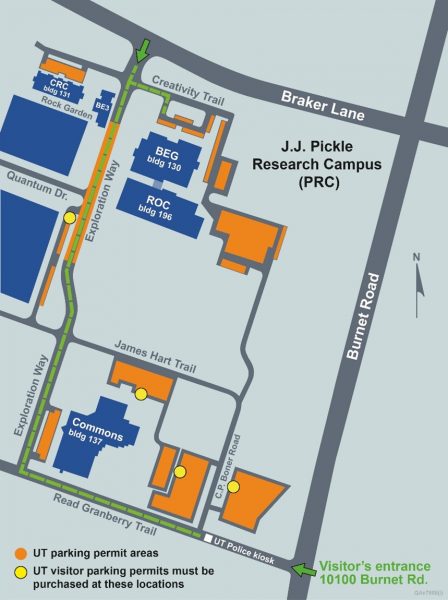
Visitors to PRC can obtain a visitor parking permit from our check-in desk on the morning of the event or from the Pay and Display kiosks at 10500 Exploration Way or 2905 Read Granberry Trail. UT affiliates can use valid UT parking permits labeled “A”, “C”, or “Disabled”.
You may park in parking spots marked “Any UT Permit.”
Hotel Recommendations
Hotels near the Pickle Research Campus may be found at: https://www.beg.utexas.edu/about/hotels
Contact & Information

James Thompson
Research Assistant Professor
Bureau of Economic Geology
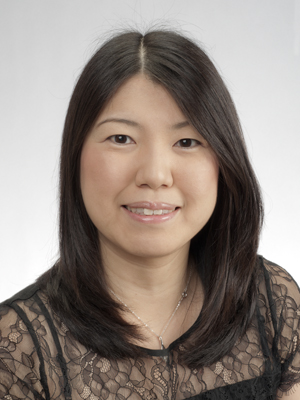
Yuko Okumura
Research Associate Professor
University of Texas Institute for Geophysics
Any questions? Please email SHIELD@jsg.utexas.edu for additional information.