A Petroleum Engineer’s Journey from Curiosity to Cutting-Edge Reservoirs — and Back Again
June 15, 2026
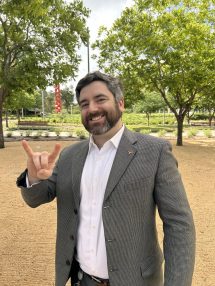
An interview with Michael Cronin (M.S. ‘14), Reservoir Engineer at ExxonMobil
Michael is a licensed Professional Petroleum Engineer in Texas who has spent his career tackling complex reservoir challenges, from unconventional development to deepwater exploration off the coast of Guyana. He has earned international recognition for his work, including the SPE International Cedric K. Ferguson Medal and the Offshore Technology Conference Emerging Leader Award (2023), and is lead inventor on multiple pending US technology patents.
Michael’s passion for geosciences goes back to a childhood curiosity about how the Earth works. He brings a rare dual fluency in geology and reservoir engineering, which he sees as his superpower for bridging interdisciplinary gaps. Outside the office, he’s a father of four who shares his love of rocks and the outdoors with his children.
What first sparked your interest in geosciences, and what ultimately led you to choose the Jackson School? As a boy, I was always interested in how the Earth worked and how to build things, which led me to pursue geosciences and petroleum engineering. The Jackson School was a natural choice after being invited by Dr. Peter Flemings to the Geofluids consortium meeting. The technical topics, students, and industry engagement convinced me that I would be joining a team creating the technology needed to develop more accurate reservoir models and drill better wells.
Was there a class, professor, research experience, or field experience at the Jackson School that had a lasting impact on you? The SVALEX trip to Svalbard (Norway) in the Arctic Circle stands out. I had never launched to shore in a Zodiac or been somewhere with more polar bears than people. From a geology standpoint, it was incredible to see North Sea reservoir rocks in outcrop and smell oil after cracking open the source rock.
Tell us about the work you’re doing today. What excites you most about it? I work as a reservoir engineer and have contributed to a few tip of the spear projects. I started in unconventionals working on cube development optimization, frac diagnostics, fiber optics, production surveillance, and RTA. My favorite project was being part of the petroleum coke lightweight proppant field trials. I’ve since switched to deepwater Guyana doing exploration/appraisal and field development planning for future offshore discoveries. The pace in Guyana is unparalleled, and my time in the Jackson School equipped me with skills to be successful.
Looking back, what skills or lessons from your time at the Jackson School have stayed with you the most, and how have you applied them in your career? Two things really stand out. First, strong technical writing with conviction and clarity sets you apart. Second, never underestimate the value of a sketch or cartoon to communicate something in a simple and useful way. There is a French proverb, “a man who knows two languages is worth two men.” As a geologist and a reservoir engineer, I draw from each hemisphere to bridge interdisciplinary gaps and move the work forward by speaking both languages. Energy professionals are paid for our judgement in the face of subsurface ambiguity and uncertainty, as well as our sense of adventure. UT gave me a great technical foundation and I’m very blessed for the experience.
What advice would you give to current students or recent graduates interested in geosciences or energy‑related careers? First, learn how to do things by hand (or sketch them out on a whiteboard) before using software and/or machine assisted techniques. This practice helps you develop the conceptual understanding and technical judgement required to be truly effective with modern tool sets and data streams. Second, spend time reading papers and field case studies to sharpen your skills and learn “new’’ ideas. In my own career, I’ve been able to put these small building blocks together in new and creative ways to file several industrial patents with the USPTO and solve interesting problems. Third, never forget that humans need to be kept in the loop. Machine learning and LLMs are powerful, but there is no replacement for human intuition, judgement, and imagination. Tools work for you, not the other way around.
How do you like to spend your time outside of work? As a father of four, time is my most limiting variable. The whole point of our education and experience is inspiring the next generation. Sharing my hobbies with my children, like collecting rocks on morning walks, running, and cycling is incredibly rewarding. A couple of years ago, I discovered that one of my boys had taken a geology textbook from my office and was reading it with a flashlight under his bed. My wife, who I met during my program, and I had a hilarious parent teacher conference about his wide vocabulary. Pretty sure we have a future geologist in the family. What starts here, truly changes the world, with the next generation.