
Jackson School Class Helped Model July 4 Storm and Found That Rainfall was Slightly Suppressed
June 24, 2026
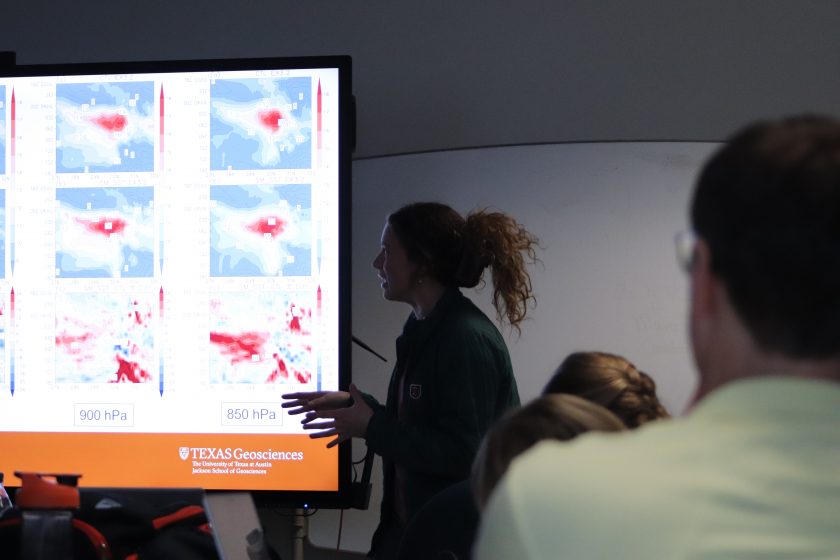
Last fall, a group of 12 students huddled around their laptops in a dark room in the Jackson School of Geosciences building. Their screens, which displayed colorful swirls over a map of Central Texas, emitted a jolt of color into the space. Most of them had never done climate modeling before. And as residents of Central Texas, their first project hit close to home. They were all dedicated to modeling the same extreme weather event: the July 4, 2025 rainstorm that had so utterly devastated the Texas Hill Country only a few months prior.
This storm caused catastrophic flooding that killed at least 139 people, 37 of whom were children. Even for people who hadn’t lost a friend or family member in the flood, this weather event loomed large in the students’ memory, and the project carried emotional weight.
When the assignment was announced, Elizabeth Chapa, who at the time was a third-year climate system science major, immediately called her parents to tell them what she’d be working on.
“I get to apply what we’re learning to something that’s happening in the real world — something that affected so many different people,” Chapa said, recalling how she felt at the time. “All across Texas, this was a huge deal.”
Edward Vizy, a research scientist in the Department of Earth and Planetary Sciences, teaches GEO 347G “Climate System Modeling” once every couple of years. Typically he lets students decide the weather event that they’ll be modeling over the course of the class. But after this summer storm devastated an area so near The University of Texas at Austin campus and so dear to many students, he decided to dedicate the class to it.
“I’m sure many of the students were in the area, and they certainly know the aftermath of it. I thought it was a very relevant case to look at,” Vizy said.
While the class set out to understand the climatological factors that made this rainstorm so severe, what they discovered was that the storm in fact could have been worse.
In a paper published recently in Geophysical Research Letters, Vizy and Jackson School of Geosciences Professor Kerry Cook analyzed the class’s work and discovered that above-average sea surface temperatures weakened an air current known as the Great Plains low-level jet, thus weakening this enormous rainstorm.
Had sea surface temperatures in the Gulf of Mexico been at the 40-year average for this week in early July, the researchers estimate that rainfall totals could have been 5-8% higher over Central Texas. (Vizy said it would take further work to quantify how exactly this would have impacted flood levels.)
Instead, warmer-than-average sea surface temperatures reduced the contrast between land and ocean temperatures, and this slowed down the jet. The Great Plains low-level jet is a fast-moving current of air that curves from the Gulf of Mexico over Texas, the Great Plains, and eastern United States. As the jet stream’s winds hit the higher terrain of the Texas Hill Country, they are forced upward, triggering a mechanism that can cause storms to develop and intensify. A weaker low-level jet means weaker storms and less intense rainfall.
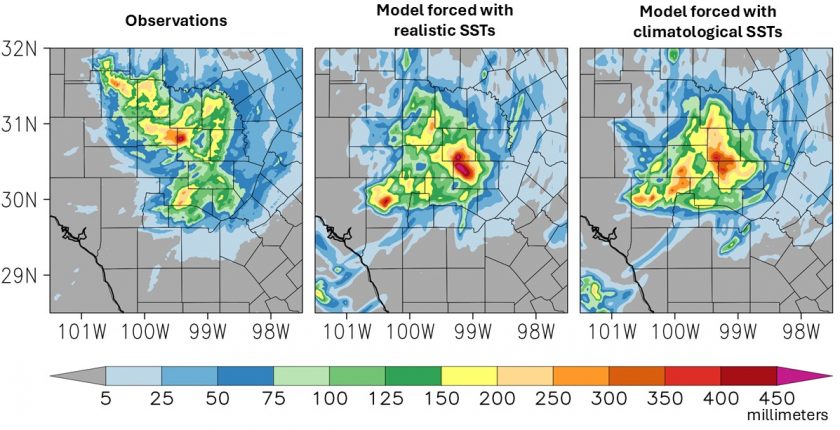
There are many factors that contribute to how a storm develops. Vizy and Cook concentrated on the storm’s relationship to sea surface temperatures and soil moisture because it can inform the prediction of future storms.
“Sea surface temperatures in the Gulf of Mexico, soil moisture — these surface conditions are more persistent than the storm itself. So it gives you a leg up on predictability,” Cook said. “We say, ‘there’s memory there.’ That’s what can help with lead times.”
The models the GEO 347G class and the researchers ran are very similar to models that forecasters run for weather prediction. Cook said that forecasters and climate scientists at the Austin/San Antonio office for the National Weather Service will see the results from this study; her hope is that it will help them better understand the role of the Great Plains low-level jet in storm development when predicting future storms.
Soil moisture also contributed to the development of the storm; soils in the region were wet following Tropical Storm Barry, an on-the-ground condition that can enhance storm precipitation totals. Vizy and Cook found that soil moisture not only acted as a source of moisture for storm development, it also influenced the circulation and the low-level jet strength, which affected the storm rainfall totals.
For the first few weeks of the semester, the students in GEO 347G worked to model the storm exactly as it occurred, working to simulate how, when and where the rain fell in this storm, as compared with satellite observations, radar data and ground conditions. This initial step is not a simple one. For instance, a small spinning circulation in the thunderstorm, known as a mesoscale convective vortex, formed within the larger storm. For this weather event to have been properly simulated in the models, that vortex needed to develop over the Hill Country at the correct time.
The class then made a series of changes to the models’ surface conditions, changing sea surface temperatures and soil moisture to their average values to see how the storm would change. These perturbation simulations, as they’re called, were run on the high-performance supercomputers at the Texas Advanced Computing Center, which completed them in a matter of hours. This access to TACC is what made it possible for the class to present on their findings in the span of one semester, Vizy said.
And to have 12 students be able to complete all these runs really added to the robustness of the final study.
“It was certainly a huge help to have the students help with these runs. You can only imagine how much time it takes to prepare, set up, and get a run going,” Vizy said.
After the paper was published, Chapa said she felt proud to have contributed to the findings. This class was a special experience, she said.
“(This storm) directly affected everyone in this class,” Chapa said. “The scientific question was so specific to us and to Texans, so I think that makes it even more special that we got to contribute to this specific paper on this specific topic.”
For more information, contact: Anton Caputo, Jackson School of Geosciences, 210-602-2085; Monica Kortsha, Jackson School of Geosciences, 512-471-2241; or Julia Sames, 210-415-9556.