The New York Times Accompanies UTIG Researchers on Mission to Antarctica
November 17, 2026
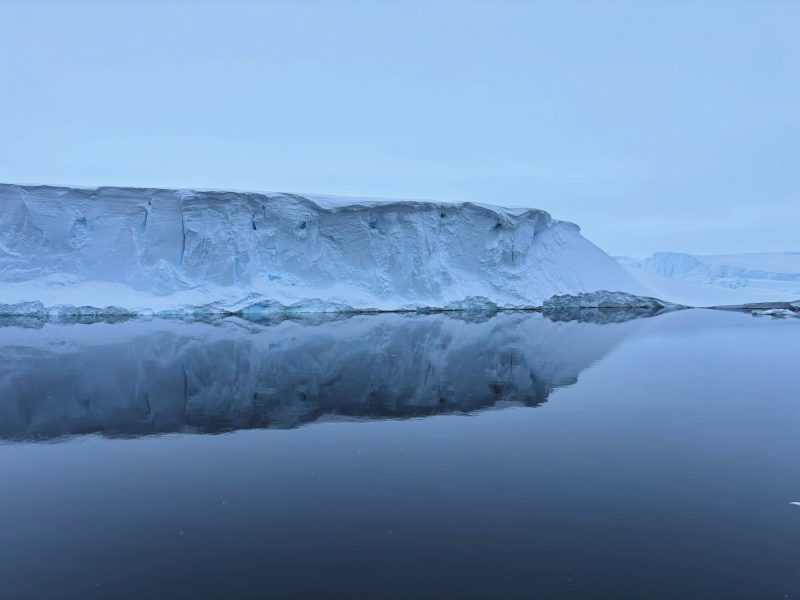
In January and February 2026, Jackson School of Geosciences researchers boarded a South Korean icebreaker along with 40 other scientists from around the world, and journalists from The New York Times, for a mission to Thwaites Glacier.
The team included researchers Dillon Buhl and Jesse Houghton from the University of Texas Institute for Geophysics (UTIG), along with Jason Bott, an undergraduate geophysics student at the Jackson School.
Thwaites is the largest glacier in West Antarctica and plays a critical role in stabilizing ice in the entire region. However, the glacier has been rapidly shedding ice. The researchers on the mission studied Thwaites and areas around it to better understand what its future could hold.
The researchers used a helicopter and ice-penetrating radar to take nearly 3,000 kilometers of scans from Thwaites and neighboring glaciers and ice shelves. The scans revealed hidden features, including fractures, deformations and subglacial water that can influence glacier movement and evolution. The scans are the farthest upstream look at Thwaites that radar has captured to date.
In addition to understanding ice on Earth, this data has applications for understanding ice on other worlds too — namely Jupiter’s icy moon Europa. UTIG leads the science for a similar ice-penetrating radar instrument, REASON, that is currently traveling on NASA’s Europa Clipper spacecraft. When scans arrive back from REASON in 2030, UTIG scientists are ready to apply what they have learned in Antarctica to interpret the features of Europa’s icy shell and the ocean hidden beneath it.
Read a dispatch from the ice from The New York Times’ climate journalist Raymond Zhong on UTIG’s radar surveys in Antarctica: https://www.nytimes.com/2026/01/27/climate/antarctica-thwaites-radar.html