When Blackouts Occur During Heat Waves, Austin Homes Pose Major Risk
February 10, 2026
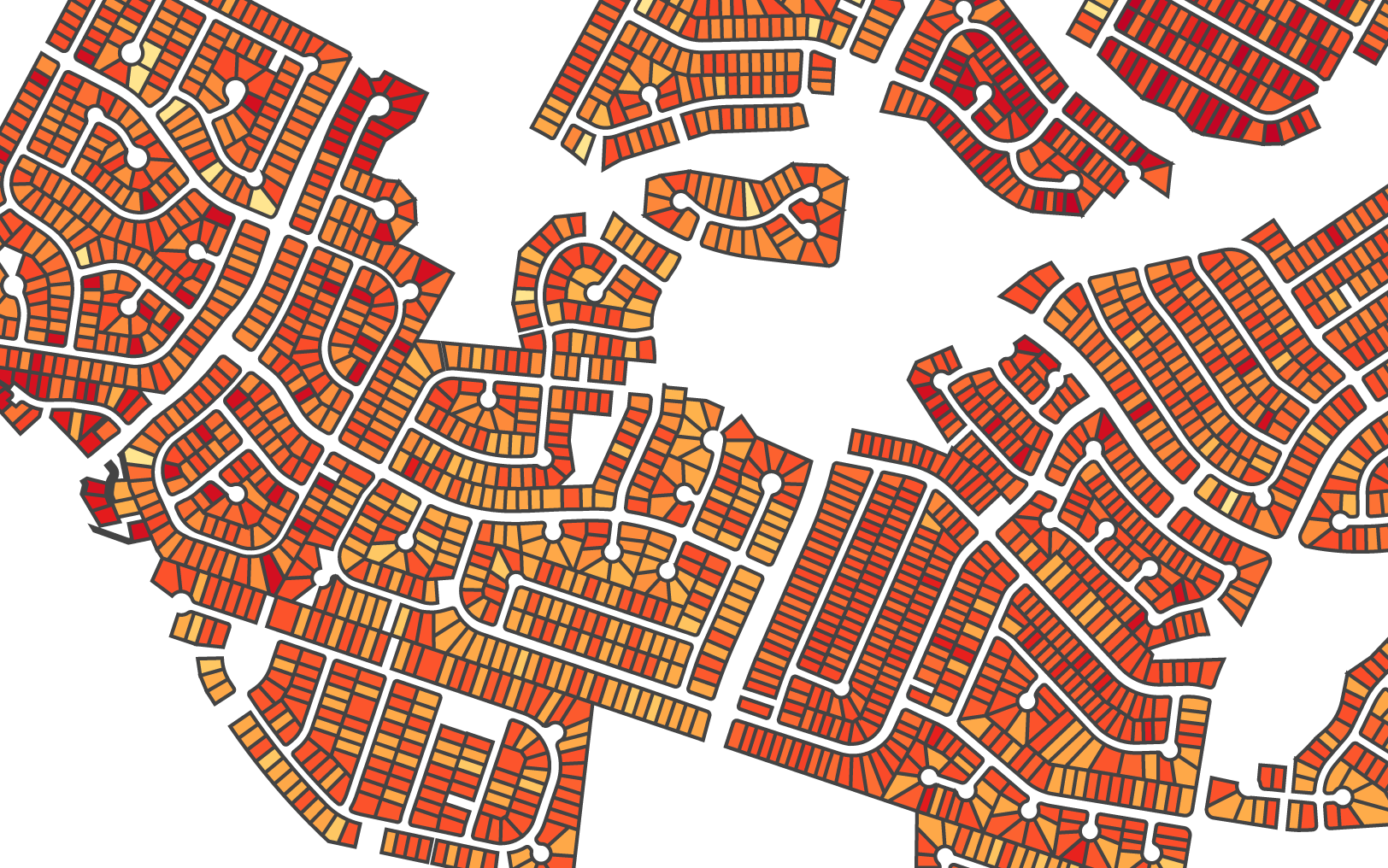
If the power goes out during a heat wave, there’s nowhere more dangerous to be than where people spend most of their time — indoors.
A new study led by researchers at The University of Texas at Austin is the first to assess the indoor heat vulnerability for each single-family home in an entire city. The research used Austin as its testbed, but the approach can be applied to most cities in the U.S.
The researchers found that if the power were to go out during a heatwave, 85% of Austin’s single-family homes would pose significant risk of death to an elderly person inside. For the younger population, the current risk is far less — about 15%. The Rundberg and St. John neighborhoods are the most vulnerable overall, according to this study.
The study was published in the journal Building and Environment. It’s a project that was facilitated by the UT-City CoLab, an initiative that brings together UT researchers, Austin city officials and community members to build climate resilience. This is part of a larger collaboration between UT and the City of Austin that connects University research with community needs.
Dev Niyogi, a professor at the UT Jackson School of Geosciences and CoLab co-lead, said that this study helps pinpoint locations that would benefit from heat mitigation efforts akin to what is already done for homes near the floodplain.
“We are elevating the problem. Rather than saying, ‘Austin is hot. We need to cool it,’ we’re saying, ‘Here’s where we need to focus. And here are the kind of solutions we can do,’” Niyogi said.
Marc Coudert, climate resilience and adaptation manager for Austin Climate Action & Resilience, said that this city-wide model is just the starting point.
“This allows us to know what’s actually happening within the neighborhoods, and who’s most vulnerable, without having to go door-to-door,” he said.
And now that this indoor heat risk data is available, the city can take a methodical approach to mitigating risk — adding cooling centers or starting up home weatherization programs, for example, Coudert said.
To conduct the study, researchers assessed heat risk for each home by replicating the conditions of a historical three-day heatwave in Austin where temperatures exceed 110 degrees Fahrenheit. They simulated this happening at the same time as an energy grid blackout, and then determined the survivability of those conditions for different age groups.
In future scenarios that consider climate change, nearly every single-family home in Austin poses some level of heat risk, according to researchers. In Austin, the frequency of heatwaves is predicted to double by the year 2100, according to UT-City CoLab data.
Most heat-related deaths in the U.S. occur inside, but the issue is rarely studied. As with a greenhouse or a hot car, heat gets trapped inside homes with nowhere to dissipate, raising temperatures to levels that are not survivable.
According to the study’s corresponding author Zoltan Nagy, the heat risk for specific buildings can vary widely based on attributes like age, materials and construction. That means that outdoor temperatures are not necessarily a good indicator of what it feels like inside any particular building during a blackout.
“What happens inside depends very much how your house was built,” said Nagy, who conducted the research when he was an assistant professor at UT’s Cockrell School of Engineering. “If you have good windows, and it’s well-constructed, it takes a long time until the heat builds up. But if you have cracks all over the place, and it’s an old house with single-pane windows, then it’s a lot faster for the house to heat up.”
Calvin Lin, a graduate student at the Cockrell School, assessed Austin’s housing stock and matched each home with a national housing dataset from the U.S. Department of Energy. Using publicly available data from the Travis County Appraisal District, Lin and Nagy matched Austin’s 213,626 single-family homes to 717 models based on attributes such as year of construction, number and quality of windows, number of floors, square footage, foundation type and roof type.
The effects of climate change will not happen equally across the world, Niyogi noted. So it’s important to understand their effects at the human level. Researchers said accounting for indoor heat in specific neighborhoods will become even more important as Austin gets hotter with climate change.
“Even though in conversations we always talk about global change, it is really what happens in your neighborhood, what happens at the local city level that matters,” he said.
This research was funded by Bentley Systems, the UT-City CoLab, City of Austin, National Oceanic and Atmospheric Administration, National Institute of Standards and Technology, National Science Foundation, National Aeronautics and Space Administration, UNESCO Chair AI, Water and Cities, UT-UNESCO International Initiative by Kumar and Bashyam, and the Farish Chair Endowment at the Jackson School of Geosciences.