Making Memories in the Mountains
November 1, 2026
The summer before my junior year at The University of Texas at Austin, I had the
once-in-a-lifetime opportunity to travel to Northern Italy with a cohort of fellow Jackson Scholars. Over the first few days, we explored everything from Venice lagoon geology to hydroelectric power and landslides, all while surrounded by the breathtaking landscapes of Northern Italy. But looming ahead was one of the most memorable days of our trip: an 8-mile hike through the Latemar Triassic Reef.
On June 24th, we woke up with the sunrise and gathered in our hostel dining room to fuel up. Our usual Italian breakfast of a croissant, bread, and cheese suddenly seemed pitifully inadequate for what was ahead, so we ate a little more than usual. We boarded our bus, and Fabrizio, our trusty Italian bus driver, delivered us to the trailhead, roughly 2,000 meters above sea level.
We began climbing toward Passo Feudo, where University of Padova professor Nereo Preto introduced us to the geology of the Latemar, a remarkably preserved Middle Triassic carbonate platform. As I sat in the tall grass sketching the volcanic dikes and layered carbonate formations around us, Nicola Tisato, associate professor at the Jackson School and Italian native, pointed toward the upper part of the platform. From that viewpoint, he told us we would eventually be able to see the core of the Latemar platform. This was when I noticed the tiny building perched impossibly far away on the edge. Our destination: Rifugio Torre di Pisa. Suddenly, those remaining miles felt a whole lot longer.
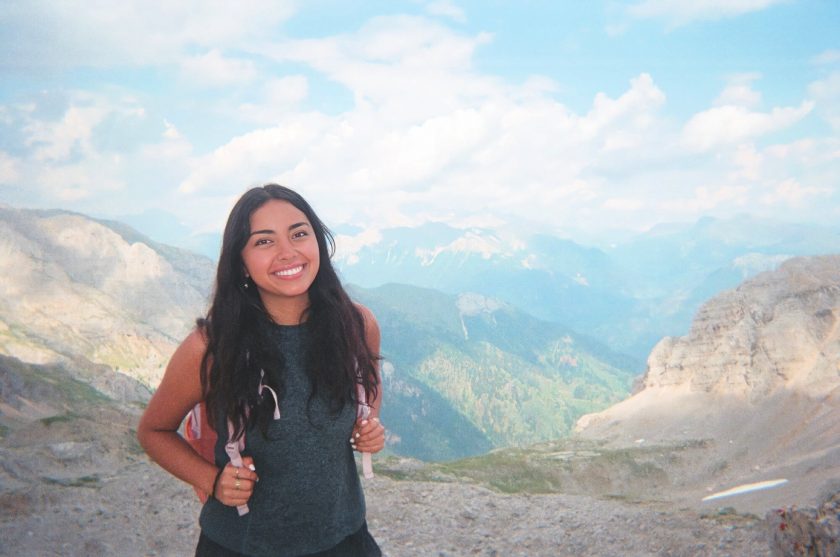
For the next few hours, the trail climbed through a series of switchbacks as we quickly gained elevation. Eventually, the definition of “trail” became increasingly generous. Large rocks replaced dirt, and our once loud and talkative group was reduced to the occasional huffing and puffing. But when we finally reached the top, the view was enough to completely silence us. From the summit, we could see the beautifully preserved geology of the Latemar platform, including its well-layered inner-platform rocks and steeply dipping slope deposits. Standing there made everything we had learned feel more tangible in a way that no classroom ever could.
As I sat on the rocks surrounded by friends and faculty who love this stuff as much as I do, I found myself appreciating just how lucky I am to study at the Jackson School of Geosciences. I left Rifugio Torre di Pisa feeling ready to take on the world and continue my career in environmental science. The only thing standing between me and that world? The 4-mile hike back down.