Jackson School Researchers Win Top Awards from AGU
September 23, 2026
Three researchers and a former postdoctoral fellow at the Jackson School of Geosciences have received top awards from the American Geophysical Union (AGU), the world’s largest Earth and space science association.
Ginny Catania, a professor in the Department of Earth and Planetary Sciences and University of Texas Institute for Geophysics (UTIG), and Laura Wallace, a research professor at UTIG, have both been named AGU Fellows, the organization’s highest honor. Since the program’s inception in 1962, less than 0.1% of AGU members have been selected as fellows each year. Catania and Wallace are the sixth and seventh Jackson School faculty members or researchers to be named an AGU Fellow.
Shujuan Mao, an assistant professor in the department, has received the 2026 Keiiti Aki Early Career Award. This award is given annually to one outstanding career seismologist for their scientific accomplishments in the field of seismology.
And Srisharan Shreedharan, a former UTIG distinguished postdoctoral fellow from 2021-2022, was awarded the Jason Morgan Early Career Award, recognizing his outstanding early career contributions in tectonophysics.
AGU Fellows
Ginny Catania
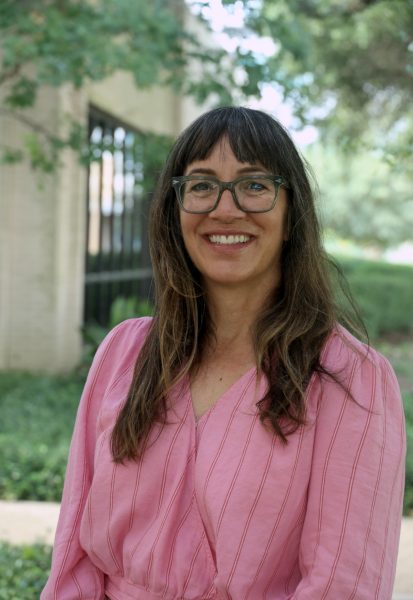
Ginny Catania is a glaciologist whose research focuses on the physics that govern ice sheets at ice-ocean and ice-bed boundaries. To date, she has led over a dozen expeditions to Greenland and Antarctica to study these inaccessible parts of the ice sheets, relying on the use of observations from both in-situ and remotely-sensed data.
“It’s incredibly meaningful to have my work recognized in this way by my scientific community,” Catania said. “I see this recognition as belonging in part to all of the people who have shared the science and the adventure with me.”
Currently, Catania is beginning to finalize findings from the recent TERMINUS project, which used novel field observations in a 2024 mission to West Greenland to better understand the processes occurring where glaciers meet the ocean and how those processes influence glacier retreat. This data is providing details about the morphology and the processes occurring at the ice’s edge at a level of detail never seen before. She is also beginning a newly funded project called AutoTerm, that uses artificial intelligence to automatically map the changing positions of Greenland’s marine-terminating glaciers from satellite imagery.
“The goal is to create an open, continuously updated record of glacier change that can be used by the broader research community,” Catania said.
Laura Wallace

Laura Wallace uses geodetic methods to study the deformation of the earth’s crust at tectonic plate boundaries. She conducts research in various locations, including New Zealand, Papua New Guinea, the Solomon Islands and Japan. She has a particular focus on understanding the spectrum of deformation processes that occur throughout the earthquake cycle at subduction zone plate boundaries.
In 2018, she co-led the IODP Expedition 375 on board the scientific drilling vessel JOIDES Resolution. The expedition investigated the causes of slow-slip events from Hikurangi and collected core samples and geophysical logs from rocks involved in producing slow-slip events at New Zealand’s Hikurangi subduction zone, and installed observatories beneath the seafloor to monitor changes in the crust during the slow-slip cycle.
Wallace maintains a joint affiliation with GEOMAR Helmholtz Centre for Ocean Research Kiel, where she has held a Helmholtz Distinguished Professorship for Geodynamics, which is part of the Marine Geodynamics research unit, since 2023.
“It’s terrific to see Ginny and Laura honored by AGU as voices at the forefront of cryospheric and earthquake sciences, respectively,” said Demian Saffer, director of the University of Texas Institute for Geophysics, and 2023 AGU Fellow. “These recognitions are a testament to their own foundational, sustained contributions in their fields of polar sciences, tectonics, respectively, as well as to the Jackson School and UTIG’s research footprint.”
Keiiti Aki Early Career Award
Shujuan Mao
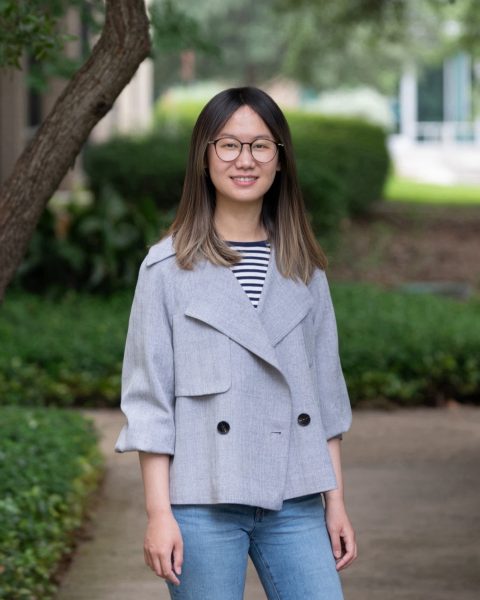
Shujuan Mao is a seismologist in the Jackson School’s Department of Earth and Planetary Sciences who develops innovative methods to investigate how the Earth’s subsurface changes over time.
“I am deeply honored to receive this award,” Mao said. “It is especially meaningful to be recognized by the seismology community and to receive an award named in honor of Keiiti Aki, whose pioneering work helped lay the foundation for my own research.”
Her research focuses on understanding the physical processes in subsurface fluid-rock systems, giving insight into the fundamental process that can affect groundwater sustainability, safe energy operations, and the preparation and mitigation of earthquake impacts. Mao uses a technique called passive seismic interferometry that turns ambient seismic noise — continuous ground vibrations traditionally treated as unwanted signals — into a non-invasive tool for continuous subsurface monitoring. Mao develops methods to use these signals to track subsurface changes in different areas over time.
Mao is well-known for her work monitoring groundwater resources. In a recent study of Southern California, she and collaborators used decades of seismic data to investigate groundwater depletion and recovery at different depths. Their work revealed persistent depletion in deeper aquifers despite substantial shallow groundwater recovery following atmospheric-river storms.
Department Chair Peter Flemings said he was thrilled to see Mao’s work recognized.
“Shujuan is a true innovator in the field of seismology. Her use of seismic interferometry to interpret the change in subsurface velocity in space and time within aquifers has produced a remarkable new way to ‘see’ the evolution of our water resource,” he said. “It is a wonderful application of the field of seismology to hydrology with enormous societal implications and broad interdisciplinary impact.”
The AGU award is meaningful to Mao for another reason aside from scientific recognition: She is the “academic great-grandchild” of the award’s namesake. Keiiti Aki, who is widely recognized for his work on earthquakes and the Earth’s interior, was the Ph.D. advisor of Mao’s Ph.D. advisor’s Ph.D. advisor.
Mao said she is grateful to her mentors, former advisors and community here at the Jackson School for helping to shape her as a scientist. She is looking forward to continuing that tradition of scientific inquiry and exchange.
“With the support of colleagues and leadership across the Jackson School, I am excited to pursue new scientific opportunities, including here in Texas, where groundwater resources, energy systems, and geohazards present so many important questions,” she said.
Jason Morgan Early Career Award
Srisharan Shreedharan
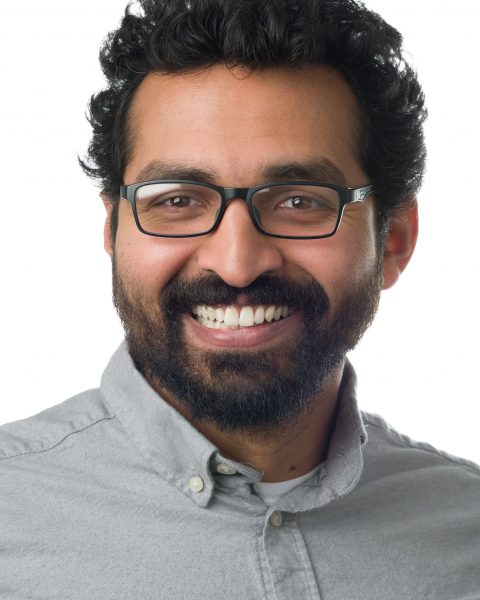
During his time at the Jackson School, Srisharan Shreedharan worked under the supervision of Luc Lavier, Laura Wallace and Demian Saffer. He is currently an assistant professor in the Department of Water, Earth, and Environmental Sciences at Utah State University, where he directs the Rock Deformation and Earthquake Mechanics laboratory.
“I’m grateful for this recognition, and understand that it belongs to more people than just me,” said Shreedharan. “I’ve been fortunate to have mentors, collaborators, and students who invested in me and my vision.”.
Shreedharan’s research combines laboratory experiments with numerical modeling and machine learning to understand how earthquakes start, propagate, and stop, from the Wasatch fault in Utah to subduction zones offshore New Zealand and Japan.