
Newly Discovered Coastal Shelf on Mars Could be Best Evidence Yet for Long-Gone Ocean
April 15, 2026
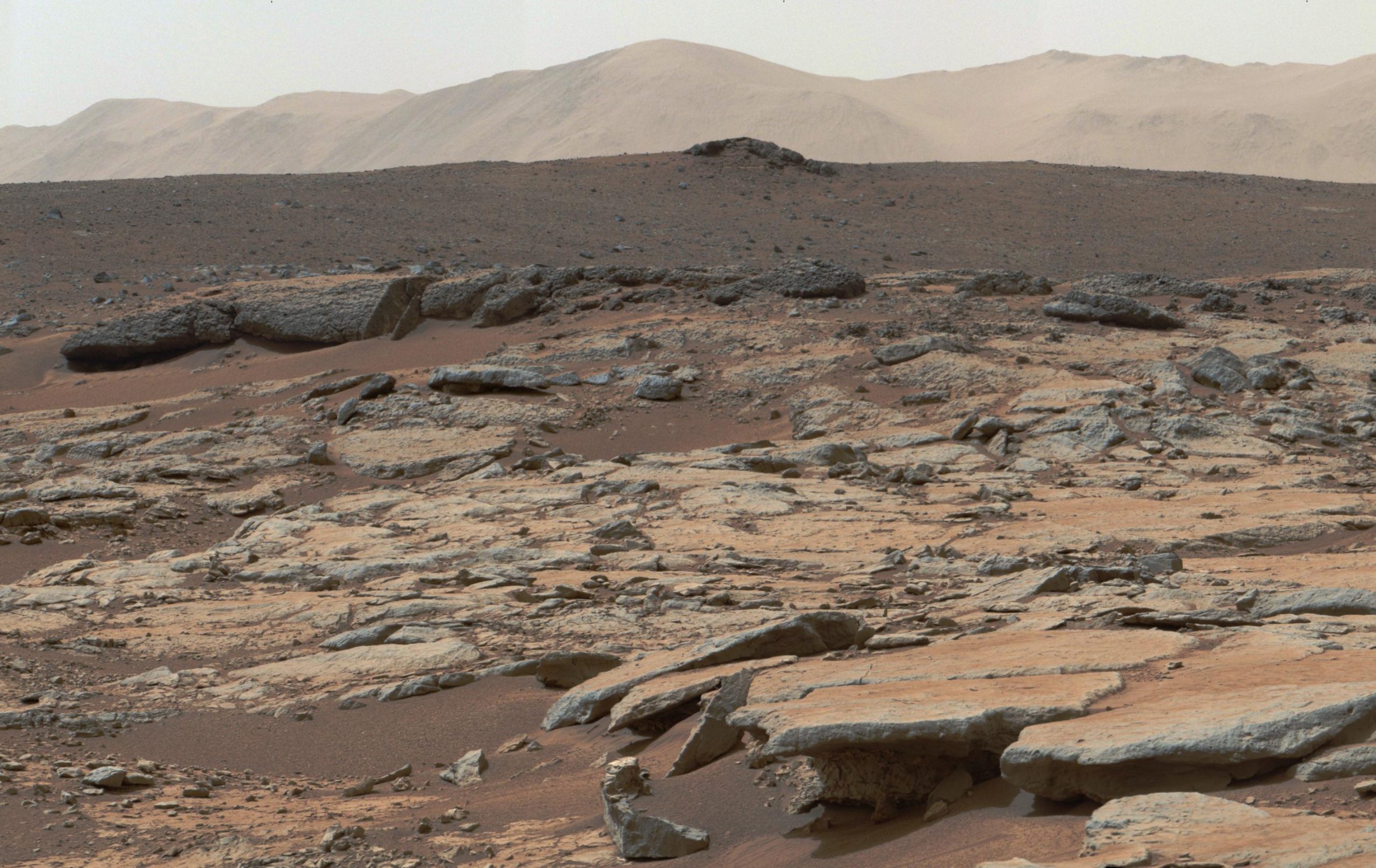
Scientists have discovered geological features on Mars that could point to the existence of a long-dried up ocean that once covered a third of the Red Planet’s surface. The geological formation is a wide and deep coastal shelf akin to the continental shelves that jut under the water where Earth’s land meets its oceans.
Their findings were published in Nature on April 15.
As a key ingredient for life, water on other bodies in the solar system is a major area of study. While it is widely accepted that Mars once had some amount of liquid water on its surface, it is still unclear whether that water was limited to lakes and streams, or if there was enough to form long-lasting oceans.
This finding of a coastal shelf is the best piece of evidence thus far of an ancient ocean on the Red Planet.
“It’s a strong additional piece of evidence supporting a northern ocean on Mars, but there’s plenty of follow-up work to be done for rovers to examine deposits and for further analysis of satellite data,” said Abdallah Zaki, a postdoctoral researcher at The University of Texas at Austin Jackson School of Geosciences.
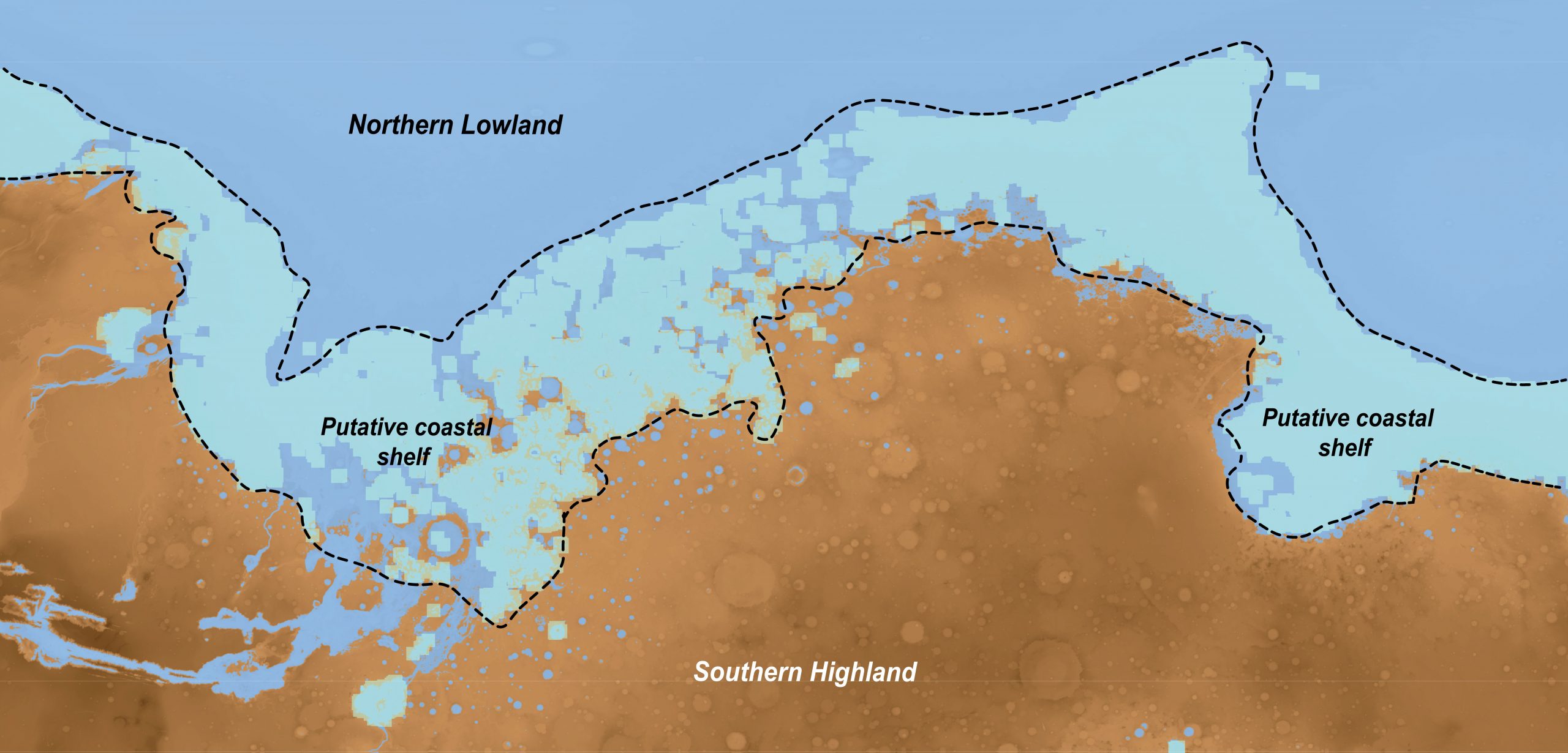
The study suggests new targets for future missions. If there once was life on Mars, sedimentary deposits from the Martian coastlines could have preserved its signatures, just as coastal sediments on Earth contain a historic record of fossils from the continents.
The research was conducted by Zaki and Caltech professor of geology Michael Lamb while Zaki was a postdoc at Caltech.
Past Mars missions have discovered geologic features that look like shorelines, but they are subtle and are found at varying elevations across the planet. If they were true signatures of a stable ocean, these shorelines would need to all be at the same elevation in the same way that sea levels are consistent across Earth.
“If Mars did have an ocean, it dried up a long time ago — possibly several billion years ago, more than half of the age of the planet itself,” Lamb said “There is hardly anything on Earth that is that old; anything on Mars from that time has been eroded by billions of years of wind blowing, volcanoes erupting, and other disturbances removing subtle features. We wanted to find a better topographic feature than shorelines that could be evidence for an ocean.”
Zaki and Lamb looked first to Earth to determine which geological features are indicative of an ocean on our own planet. Using computer simulations, they first “dried up” the oceans to see which topographic features remained.
The models showed that the most distinct feature of the oceans is a flat band of land, up to several hundreds of kilometers wide, wrapping the contours of where land meets ocean like a ring that remains around a drained bathtub. That band is called the continental shelf. Though sea levels on Earth, and thus the location of shorelines, have fluctuated over many years, the continental shelf is a large landform that is relatively stable over time.
The team then looked at topographic data of Mars taken by orbiters and found an analogous band that suggests the presence of a long dried up ocean in the Martian northern hemisphere covering a third of the planet’s surface. A landform like this takes time to form — and notably is not found around lakes — which indicates that the ocean must have existed stably for possibly millions of years.
Zaki said that the question of Mars having a coastal shelf like Earth’s had simply not been asked before.
“It’s very fundamental. If there is an ocean, there must be a shelf. This is a more stable topographic signature,” Zaki said.
The paper is titled “Identifying the topographic signature of early Martian oceans.” Zaki and Lamb are the paper’s authors. Funding was provided by Caltech, a Swiss National Science Foundation Postdoc Mobility Fellowship, and the Jackson School of Geosciences Distinguished Postdoctoral Fellowship at the University of Texas at Austin.
This story was adapted from a press release by Caltech. You can find the original coverage here.