Fa Li Brings AI Expertise to Jackson School Faculty
March 27, 2026
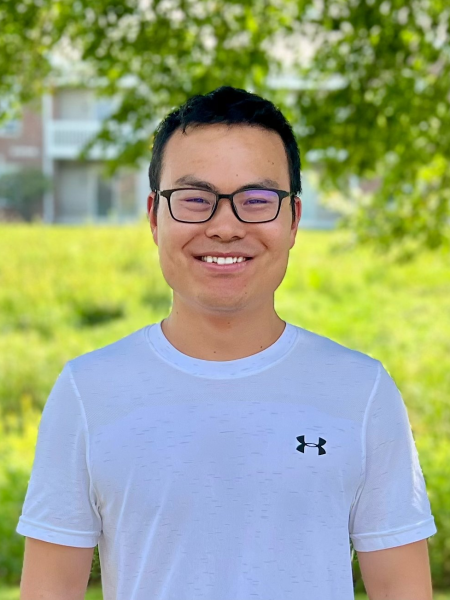 Fa Li, who uses artificial intelligence to study how ecosystems on the land respond to shifts in the climate and water cycle, joined the Jackson School of Geosciences Department of Earth and Planetary Sciences as an assistant professor this year.
Li studies terrestrial ecosystems, hydroclimatic hazards such as wildfires, and their interactions with human society. His goal is to integrate artificial intelligence, Earth system models, remote sensing, and field measurements to better monitor, predict, and reduce hydroclimatic risks affecting both people and ecosystems.
Li comes to the school following a stint as a postdoctoral scholar at Stanford University. He joins a cohort of geoscientists at the Jackson School using AI to tackle big questions about Earth processes. He was hired along with Assistant Professor Dapeng Feng with the intention of bolstering that strength.
Li is combining processed-based models with AI to improve reliability and interpretability. Traditionally, machine learning tends to function as a black box, and Li is working to shed light on how it functions.
“We don’t know what exactly happens within the black box, and we don’t want to generate models that we don’t trust,” Li said. “One thing I’m doing is trying to integrate well-known scientific knowledge into the black box model. To the black box model, we say, ‘Hi model, you need to follow these kinds of rules’ to fit the data — rather than let the model lead.”
One of his projects aims to scale ecosystem processes from site to global scales by linking environmental factors — such as soil moisture, wind, temperature, and vegetation characteristics — to ecosystem functioning.
“Models can be right for the wrong reasons. Even with similar accuracy, machine learning models may differ substantially in their internal representations, especially when data are limited. This raises concerns for critical Earth system applications, such as scaling ecosystem processes or forecasting wildfires,” Li said. “To address this, I am developing knowledge-guided machine learning that integrates process-based understanding with AI. This approach helps improve reliability and uncover the mechanisms driving system behavior, beyond data fitting.”
Peter Flemings, interim chair of the Department of Earth and Planetary Sciences, said the department is stronger now with Li as a member of its faculty.
“Fa is at the forefront of two of the most important and applied topics in the geosciences today — Earth hazards and artificial intelligence,” Flemings said. “I personally cannot wait to see more of innovative work that he accomplishes as a researcher here.”