Dapeng Feng Joins Jackson School Faculty in AI Cluster Hire
March 27, 2026
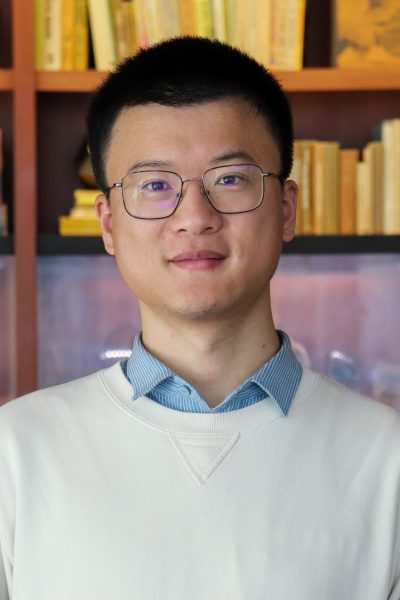 Dapeng Feng, a hydrologist exploring the Earth’s water and its interactions with the environment, has joined the Jackson School of Geosciences Department of Earth and Planetary Sciences as an assistant professor.
Feng’s approach to hydrology research involves combining artificial intelligence methods and physical models to improve simulations and understandings of the terrestrial water cycle. His framework integrates these two methods, which reflect different but complementary modeling philosophies.
Many AI methods are primarily data-driven and lack physical interpretability, while physical models are grounded in theoretical understandings of how processes work. According to Feng, the geosciences is a promising field to blend these two approaches.
“We have big data processes in geoscience, which is very appropriate for AI, for machine learning methods. However, we also have many small data processes in geoscience, which need physical modeling,” he said.
Feng uses these modeling methods and satellite observations to better understand complex questions at the intersection of hydrology and ecology, such as how water content in vegetation varies over time and how different ecosystems respond to water stress.
His current project analyzes the water cycle through a wide lens; Feng is working on a next-generation hybrid AI and physics model to simulate and understand the terrestrial water cycle for the entire globe.
“This framework can be further extended to a wide range of practical applications, such as drought monitoring, flood forecasting, and understanding how our ecosystems will respond when you don’t have enough water in the soil, or how vegetation will respond to a heat wave,” Feng said.
Feng joins a cohort of geoscientists at the Jackson School using AI to tackle big questions about Earth processes. He was hired along with Assistant Professor Fa Li with the intention of bolstering that strength.
“The faculty members I looked up to as a student are now my colleagues,” Feng said. “This is a great school with so many opportunities and resources. It’s a very big geoscience community and a very supportive environment to my research.”
Peter Flemings, interim chair of the Department of Earth and Planetary Sciences, said Feng has already been a wonderful addition to the department’s faculty. Feng is bringing the country’s leading meeting on machine learning for hydrology, HydroML, to the university this May. The Jackson School and Oden Institute for Computational Engineering & Sciences are co-hosting the event.
“Dapeng is leading the department in new and innovative directions by combining machine learning with physics-based insights in hydrology. His work will impact the state of Texas as we grapple with extraordinary demands on our water resources,” Flemings said. “Faculty and students are eager for Dapeng’s new courses, which will lie at the interface of hydrology and machine learning.”