Tim Goudge to be Promoted to Associate Professor with Tenure
March 4, 2026
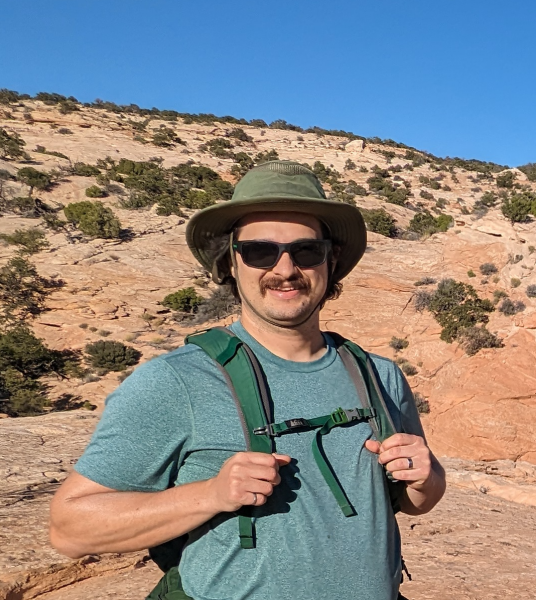 Tim Goudge, an assistant professor in the Department of Earth and Planetary Sciences at the Jackson School of Geosciences, will be recommended for a promotion to associate professor with tenure to The University of Texas System Board of Regents in August.
Goudge uses remote sensing to study how water transforms landscapes over time — be it on Earth in the present day or on Mars billions of years ago. This work addresses fundamental questions about the history of water on Mars, informing what scientists know about its climate, atmospheric conditions, and habitability.
Peter Flemings, the interim department chair, said that Goudge’s research highlights are many.
“However, the greatest impact is Tim’s interdisciplinary work documenting the remarkable role of water on ancient Mars,” Flemings said. “He links sedimentology, hydrology, stratigraphy, and geomorphology to illuminate the role water has played in sculpting the surface of ancient Mars.”
Goudge’s research is also important for understanding how changing landscapes may affect hazards such as river flooding or coastal retreat on Earth, for which his group has led new approaches using drones for monitoring the Earth’s surface.
In addition to research, Goudge teaches three classes at the Jackson School: GEO 416M “Sedimentary Rocks,” GEO 455S “Introduction to Remote Sensing for Geoscientists,” and GEO 311D “Geodata.”
He gets a lot out of teaching. Witnessing students connect a topic they discussed in his class to a lecture from another course they’ve taken, or approach an interesting question from a completely different angle than Goudge would have taken, are the kind of things that he said keeps his job interesting and fun. Sometimes students will ask questions that he has never encountered before. More than once he’s had to Google for answers during a class break.
“The reason I went into grad school in the first place is because I really love learning new things,” Goudge said. “Through teaching and mentoring, you learn way more than you might first anticipate. It’s just an exponential growth in terms of your exposure to ideas.”
The road to tenure is well-known to be long and intensive. Beyond the actual research, teaching and service that it requires, faculty members must compile it all to build a case for their promotion. But now that it’s done, Goudge said he has a new sense of pride in what he and his research group have accomplished together. And he’s grateful to have had so many fellow faculty members supporting him along the way.
“To have so many people I can reach out to has made the world of difference,” Goudge said. “It is definitely a team sport, and it’s great to be on a good team.”