
North America is Dripping from Below, Geoscientists Discover
February 16, 2026
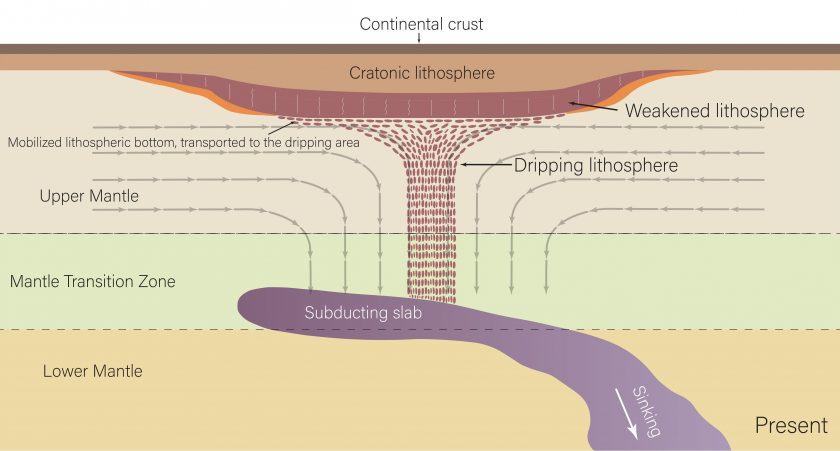
Researchers have discovered that the underside of the North American continent is dripping away in blobs of rock — and that the remnants of a tectonic plate sinking in the Earth’s mantle may be the reason why.
A paper published in Nature Geoscience describes the phenomenon, which was discovered at the Jackson School of Geosciences. It may be the first time that cratonic thinning has been captured in action.
Cratons are very old rocks that are part of Earth’s continents. They’re known for their stability and ability to persist for billions of years. But sometimes cratons undergo changes that can affect their stability or that remove entire rock layers. For example, the North China Craton lost its deepest root layer millions of years ago.
What makes the discovery of cratonic dripping special, said the researchers, is that it’s happening right now. This allows scientists to observe the cratonic thinning process as it occurs. The dripping is concentrated over the Midwest of the United States.
There’s no need to worry about the continent hollowing out or the dripping changing the landscape anytime soon, the researchers assure. The mantle processes driving the dripping can influence how tectonic plates evolve over time — but they’re very slow going. What’s more, the dripping is expected to eventually stop as the remnants of the tectonic plate sink deeper into the mantle and its influence over the craton fades.