
Zama Basin Sands Made by Drive-By Microcontinent
December 13, 2025
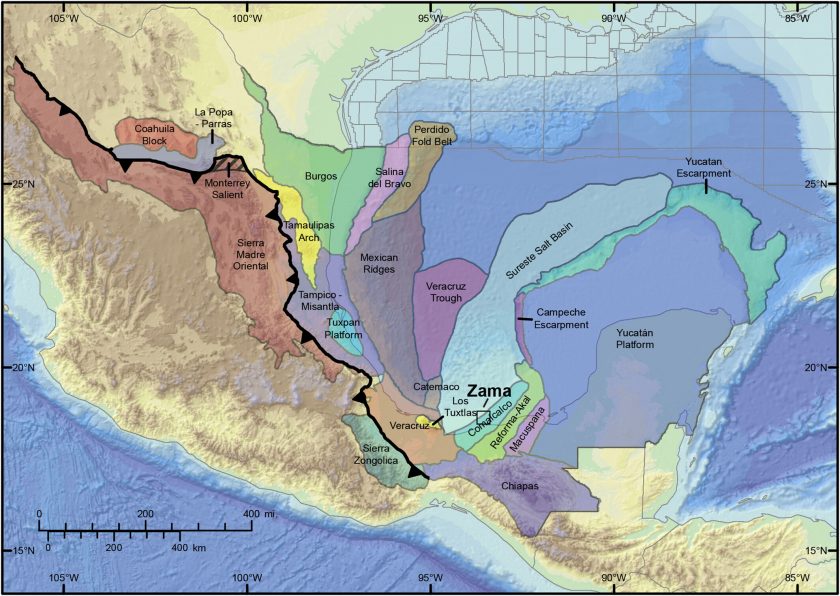
An errant piece of a continental fragment that now makes up modern-day Central America played a key role in making Zama Basin the prospective deepwater oil field that it is today.
Researchers found that the high-quality sands that make up the oil reservoirs in the Zama Basin in the Gulf of Mexico came from a chunk of a granitic continent that tacked itself onto the mainland near Chiapas, Mexico, before moving on to become what is now Honduras and Nicaragua.
This landmass gave a small river — the 10 million-year-old equivalent of the modern day Grijalva River — that wound through the area a much larger drainage basin to supply sediments before heading to the sea. The sand flowed into the basin for about 1 million years — an extremely short timeframe, geologically speaking. When the microcontinent continued its journey, the river was cut off at its head and collapsed down to its original size.
The researchers used zircons extracted from exploratory wells to uncover the origin of Zama’s sands. Zircons act as geologic fingerprints. Research conducted at the UTChron Lab revealed that they did not originate in Mexico. Permission to study the samples was provided by Talos, the oil company that found the Zama Basin — a discovery equivalent to 600 million-1 billion barrels of oil.
Research by Research Professor John Snedden; Chair and Professor Danny Stockli
University of Texas Institute for Geophysics; Department of Earth and Planetary Sciences
The two-part study was published in the journal Basin Research.