
Swaying Moons Could Mean Hidden Oceans
December 13, 2025
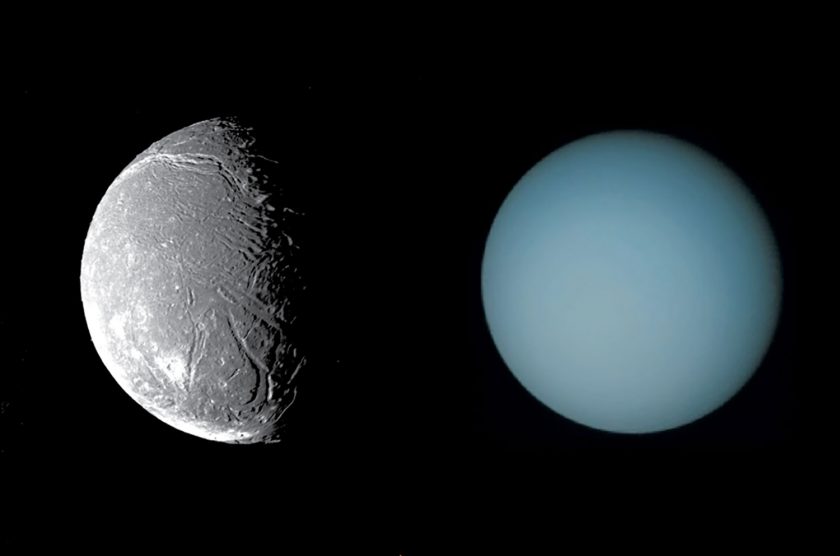
When NASA sends another spacecraft to Uranus’ moons, wobbles in their orbit could reveal whether they are hiding liquid water oceans beneath their icy surface.
The NASA mission is still in an early planning stage, but researchers are already building a new computer model that could be used to detect oceans beneath the ice using just the spacecraft’s cameras.
The new computer model works by analyzing small oscillations in the way a moon spins as it orbits its parent planet. From there, researchers can calculate how much water, ice and rock is inside. Less wobble means a moon is mostly solid, while a large wobble means the icy surface is floating on a liquid water ocean. When combined with gravity data, the model can compute the ocean’s depth as well as the thickness of the overlying ice.
Research by Research Professor Douglas Hemingway,
University of Texas Institute for Geophysics
Research published September 2024 in Geophysical Research Letters
Back to the Newsletter