
Southwest Megadrought Could Last Much Longer
December 13, 2025
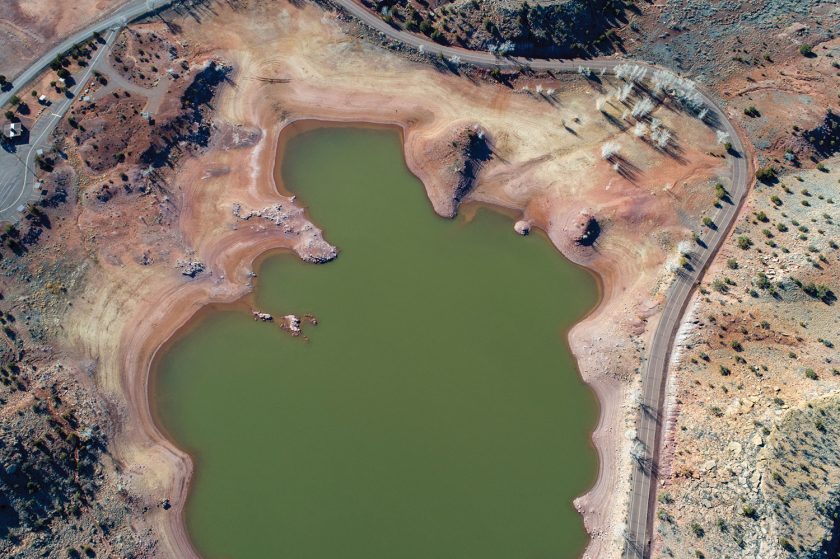
The southwestern United States is facing its worst megadrought of the past 1,200 years. According to new research, the drought could continue at least until the end of the century.
Some scientists anticipate that natural climate variability will bring relief, but this research suggests that ongoing warming could be disrupting the natural rhythm of an important climate cycle that brings needed rain to the region.
Much like the seven-year El Niño and La Niña climate patterns, the Pacific Decadal Oscillation has been a dependable ocean climate cycle that alternately brings long phases of drought and rains to the Southwest every 20 to 30 years. However, researchers who analyzed lake sediment cores collected in the Rocky Mountains, which preserve traces of ancient climate conditions going back for millennia, posit that this is not necessarily the case.
They found that during the last period of hemispheric warming some 6,000 years ago, the Pacific Decadal Oscillation was forced out of rhythm, leading to a drought that lasted for thousands of years. Now, as the world warms under the effects of climate change, it appears to be happening again. Researchers came to this conclusion after they compared simulations of the ancient warming with climate projections for the future.
Research by Doctoral Student Victoria Todd; Associate Professor Tim Shanahan
Department of Earth and Planetary Sciences
Research published in July 2025 in Nature Geoscience
Back to the Newsletter