
Scientists Capture Slow-Motion Earthquake in Action
December 17, 2025
Scientists for the first time have detected a slow slip earthquake in motion during the act of releasing tectonic pressure on a major fault zone at the bottom of the ocean.
The slow earthquake was recorded spreading along the tsunami-generating portion of the fault off the coast of Japan, behaving like a tectonic shock absorber.
Slow slip earthquakes are a type of slow-motion seismic event that take days or weeks to unfold. They are relatively new to science and are thought to be an important process for accumulating and releasing stress as part of the earthquake cycle. The new measurements, made along Japan’s Nankai Fault, appear to confirm that.
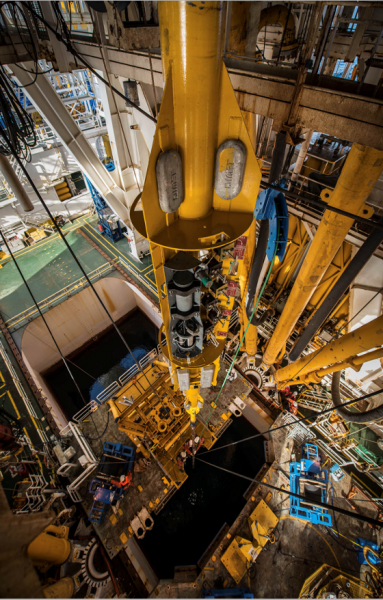
This breakthrough research was made possible by borehole sensors that were placed in the critical region far offshore, where the fault lies closest to the seafloor at the ocean trench.
The slow slip earthquake, captured by the team’s sensors in the fall of 2015, travelled along the tail of the fault — the region close to the seafloor where shallow earthquakes can generate tsunamis — easing tectonic pressure at a potentially hazardous location. A second slow tremor in 2020 followed the same path.
Research by doctoral student Joshua Edington and UTIG Director and Professor Demian Saffer
University of Texas Institute for Geophysics; Department of Earth and Planetary Sciences
Published in June 2025 in Science