
On Display: Ore Minerals From Mexico and Meteorites
December 13, 2025

Sparkling in inky blues and vibrant greens, you don’t need to be a geologist to be dazzled by the 40 new minerals that recently joined the Henry R. and Ann H. Hamman Gem and Mineral Gallery at the Jackson School of Geosciences. But for the geologically informed, this world-class collection of ore minerals from Mexico is really something special.
Most of the minerals are azurite and malachite collected from the Milpillas Mine of Sonora, Mexico, a commercial copper ore mine that operated for 13 years before closing in 2020. There are minerals from each of the four main working levels of the underground mine — offering a view of the unique geological environment of each level. One specimen even records a geological transition zone, morphing from blue azurite to green malachite in the scope of a single mineral.
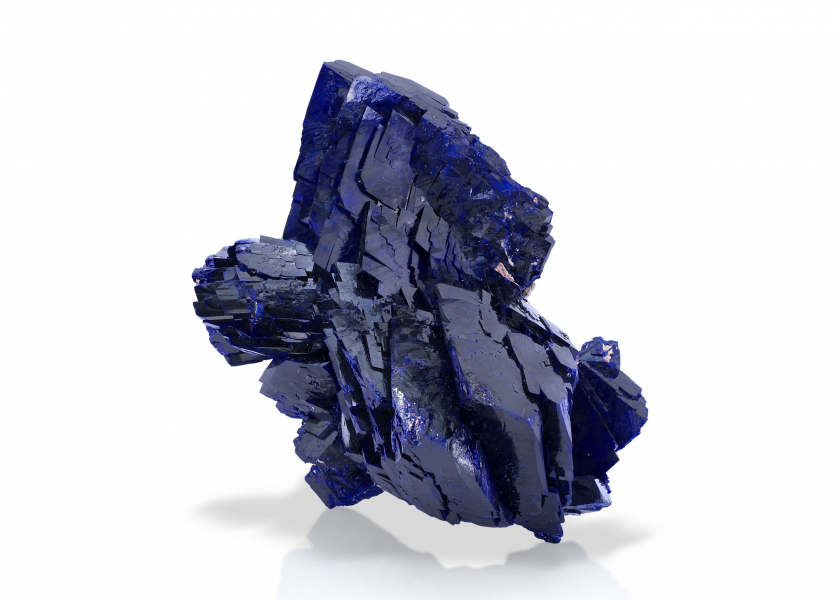
Another notable specimen is an azurite that received the 2022 Miguel Romero Memorial Award, an honor that recognizes the single best Mexican mineral at the Tucson Gem and Mineral Show, which is the largest and most prestigious show of its kind in the world.
Just a few display cases over, visitors can gaze upon otherworldly specimens that recently joined the gallery. They consist of three large meteorites: a shiny iron-nickel specimen found in Campo del Cielo, Argentina; an etched slab of Muonionalusta iron-nickel meteorite; and a Pallasite meteorite.
The Jackson School’s thumbnail collections are also on display for the first time. These are mini mineral samples arranged in rows in rainbow order.
The Mexican ore minerals were donated to the Jackson School from the personal collection of Eric Long and his wife, Tracy Walsh. The meteorites were donated by Paul Bierman, a Memphis medical doctor and a fan of the Jackson School’s mineral collection. They are on public view at the Henry R. and Ann H. Hamman Gem and Mineral Gallery in the Jackson Geological Sciences Building on The University of Texas at Austin campus.
Back to the Newsletter