
North America Is Dripping from Below
December 13, 2025
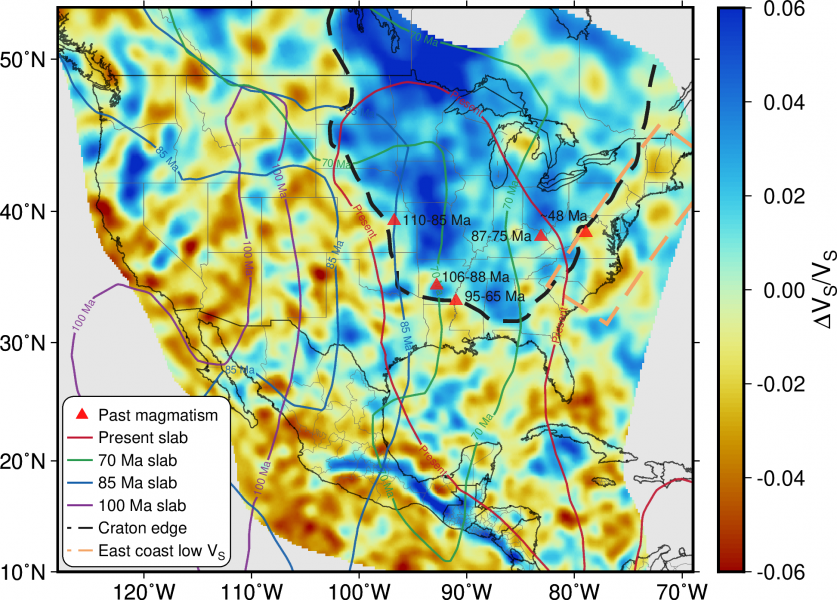
Researchers have found that the underside of the North American continent is dripping away in blobs of rock — a phenomenon known as “cratonic thinning.”
Cratons are very old rocks that are part of Earth’s continents. They’re known for their stability and ability to persist for billions of years. But sometimes cratons undergo changes that can affect their stability or that remove entire rock layers. According to the researchers, this is the first time that cratonic thinning may have been captured in action.
The discovery came from analyzing seismic data collected by the EarthScope project to create a seismic tomographic model of North America. This model revealed new details about the geologic processes happening in the crust and mantle underlying North America.
The dripping appears to be driven by the subduction of the Farallon Plate, an oceanic tectonic plate that has been subducting under North America for about the past 200 million years. The dripping is expected to eventually stop as the remnants of this plate sink deeper into the mantle.
Research by Postdoctoral Fellow Junlin Hua; Professor Emeritus Stephen Grand; Professor Thorsten Becker; Doctoral Student Chujie Liu
University of Texas Institute for Geophysics; Department of Earth and Planetary Sciences
Research published in March 2025 in Nature Geoscience
Back to the Newsletter