
New Technology Improves Oil Production and Carbon Storage
December 13, 2025
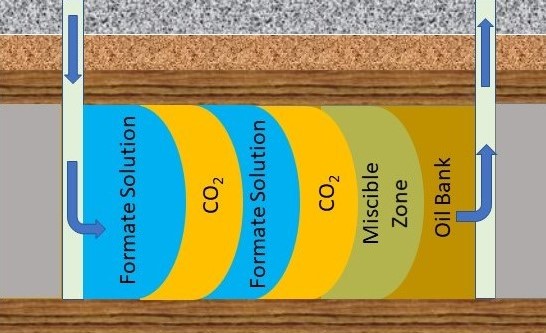
A new method for enhanced oil recovery is showing promising results in modeling studies — producing more oil, storing more carbon, and doing so more safely than conventional enhanced oil recovery methods.
Researchers looked at the performance of alternative carbon carriers — chemical compounds engineered to store larger quantities of carbon molecules in subsurface formations. They found that when these compounds are synthesized from carbon dioxide (CO2), they can help optimize the transportation, utilization, and storage of this greenhouse gas.
They applied the technology to enhanced oil recovery scenarios and found that the new carbon carrier method recovered up to 19.5% more oil and stored up to 17.5% more carbon than conventional enhanced oil recovery methods.
Researchers converted the CO2 into formates (like sodium formate or potassium formate), which are carbon-based molecules that can be synthesized from CO2 gas. They found the formate compounds were more readily stored in the rock pores than a comparable quantity of CO2 gas. Moreover, water-based solutions of formate compounds were also more viscous than CO2, which helped improve efficiency when recovering remaining oil and storing carbon in the formation.
Research by Research Assistant Professor Abouzar Mirzaei-Paiaman; Professor Ryosuke Okuno
Bureau of Economic Geology; Cockrell School of Engineering
Research published in July 2025 in Energy & Fuels