
Lowery Wins Prestigious Prize for Work on Mass Extinctions
December 13, 2025
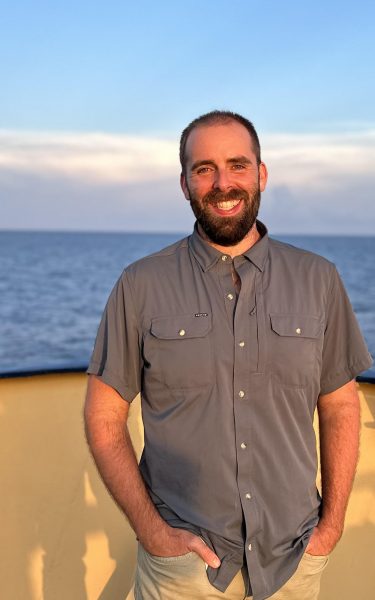
From plate tectonics to the dinosaur extinction, scientific ocean drilling has led to major discoveries about the planet’s history and evolution. Now, the field has a new rising star in Chris Lowery, who was named the 2024 Asahiko Taira International Scientific Ocean Drilling Research Prize recipient by the American Geophysical Union.
The prize, which recognizes an “outstanding, transdisciplinary research accomplishment,” is the highest honor available for early- to mid-career scientists in the field of scientific ocean drilling.
Lowery is a research assistant professor at the University of Texas Institute for Geophysics and teaches in the Department of Earth and Planetary Sciences.
One of Lowery’s most substantial contributions has been a series of papers on how life responded to the mass extinction event that wiped out the dinosaurs. His current focus is on the Gulf of Mexico Loop Current, an ocean circulation pattern that flows directly into the Gulf Stream and has effects worldwide. He has led two geophysical surveys of the seafloor where the Loop Current’s imprint is most visible and hopes to soon lead a major drilling expedition there to uncover whether the current was vulnerable to collapse during past global warming.
“It’s right in our backyard, it affects fisheries and offshore infrastructure and sea-level rise in the Gulf of Mexico, and it directly feeds into the Gulf Stream, which is really important for climate and weather, not just for the eastern U.S. but the entire Northern Hemisphere,” Lowery said.
Lowery received the Asahiko Taira International Scientific Ocean Drilling Research Prize at AGU’s Fall Meeting in December 2024 in Washington, D.C., where he also delivered a lecture on his Loop Current drilling project.
Back to the Newsletter