
Liquid Core Explains Mars’ Lopsided Magnetic Field
December 13, 2025
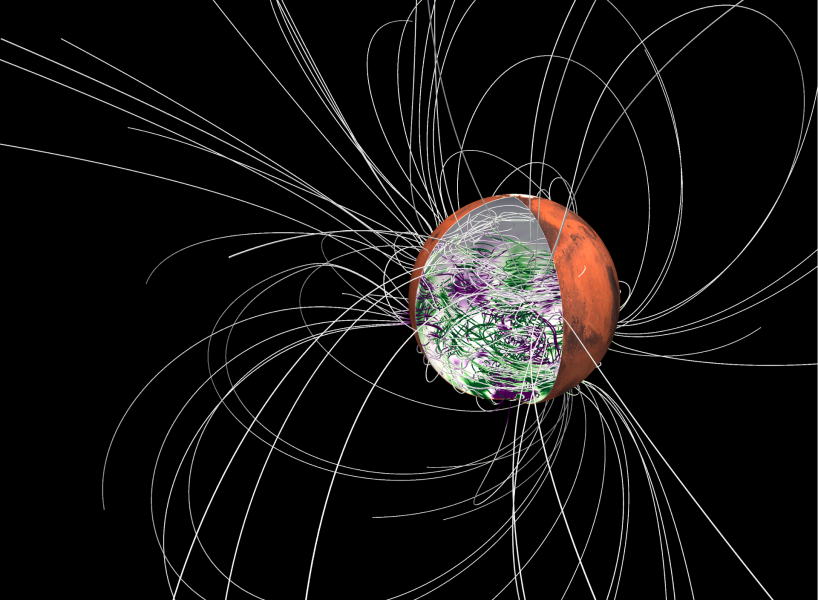
It’s long been a mystery why signs of Mars’ ancient magnetic field show up on only one side of the planet. Geophysicists think they may have solved the problem with a new model that shows that a fully molten core could have caused a lopsided magnetic field on early Mars.
Until now, most studies of early Mars relied on magnetic field models that gave the red planet an Earth-like solid inner core. But researchers were inspired to simulate a completely liquid core after NASA’s InSight lander found that Mars’ core was made of lighter elements than expected. That means the core’s melting temperature is different from Earth’s and therefore quite possibly molten. And if Mars’ core is molten now, it may have been molten 4 billion years ago when Mars’ magnetic field is known to have been active.
To test the idea, the researchers ran supercomputer simulations of early Mars with a liquid core, making the northern half of the mantle hotter than the southern. Because of the temperature difference, heat escaping from the core could do so only at the southern end of the planet. Channeled in such a way, the escaping heat was able drive a dynamo and generate a strong magnetic field in the southern hemisphere.
Research by Chi Yan, research associate
University of Texas Institute for Geophysics
Research published in February 2025 in Geophysical Research Letters
Back to the Newsletter