
Lake Travis Temperature Stratification Changed After July Floods
December 17, 2025
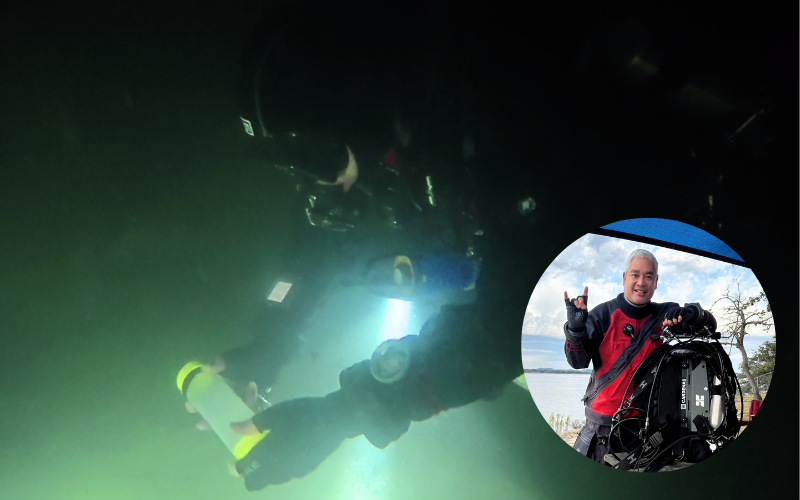
Professor M. Bayani Cardenas has documented a change in the temperature profile of Lake Travis since the July 4 floods that struck Central Texas.
Cardenas, with the help of a team of students and divers, has been diving to the bottom of Lake Travis for years to collect water samples to study the lake’s temperature and chemistry. During a dive in early August, he found the lake’s temperature stratification had changed from previous years. He suspects that this is related to the floods that raised Lake Travis by more than 30 feet in a matter of days.
He found the changes in the thermocline, which is a temperature transition zone between a warmer top layer of water and a cooler bottom layer in a stratified lake. Lake stratification and the size of the transition zone influence water chemistry and ecology.
In previous years when the lake’s water level was high, the thermocline was sharp — going from warm to cool in about 5-15 feet. After the floods, Cardenas reports that it’s deeper and more diffuse — going from warm to cool in about 15-20 feet.
He said he will continue to track how the thermocline and water chemistry change on future dives.
Research Professor M. Bayani Cardenas
Department of Earth and Planetary Sciences