
Jackson School’s Enrollment at an All-Time High
December 13, 2025
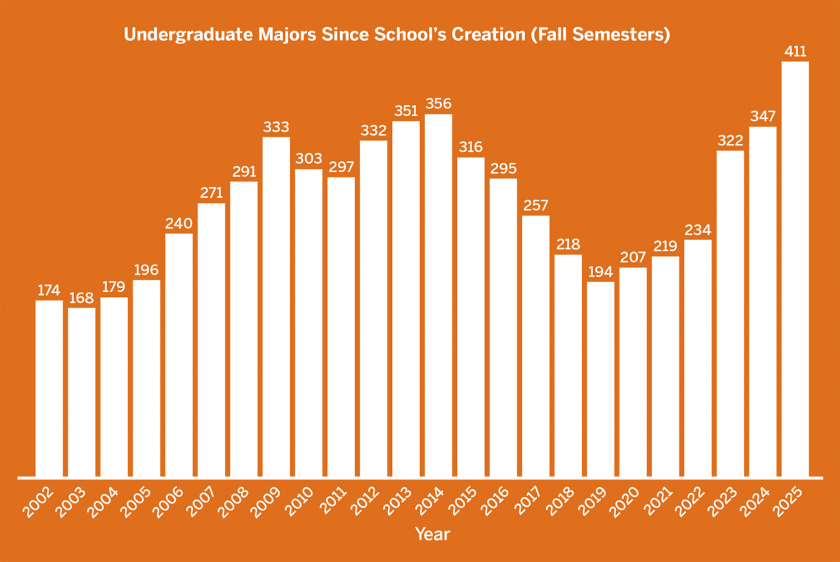
For the first time since the Jackson School of Geosciences was founded in 2005, undergraduate enrollment has surpassed 400 students.
This record growth puts the Jackson School in a select group of programs amid a global decline in geoscience enrollment. U.S. geoscience enrollment fell 30% from its peak in 2015, according to the American Geosciences Institute, with a small number of schools recently seeing a significant rebound.
Department Chair Danny Stockli attributes the school’s growth to a number of strategic moves. For example, the Department of Geological Sciences was renamed the Department of Earth and Planetary Sciences to emphasize the disciplinary breadth of the school. The curricula for all of the majors were revised to be more modern and flexible for students seeking to transfer to a different degree within the school. Climate System Science was added as a new major. The enrollment cap was lifted for the popular Environmental Science degree. And there has been newfound strategic and operational collaboration between the Student Affairs Office and the department, Stockli said.
“This is a success story that bucks the national trend, and it is no coincidence,” Stockli said. “It takes a shared vision, and we are all pulling in the same direction together.”
Student enrollment has been on the rise at the Jackson School for the past six years. During that time, it has more than doubled, from 194 students in 2019 to 411 currently. University-wide, enrollment is also at an all-time high, climbing to 55,000 students in Fall 2025. This follows a 24% bump in first-year student applications over the year prior.
Tim Weiss, the Jackson School’s director of Student Affairs, said that the school is now nearing its limit for undergraduate enrollment, and that if applications continue to rise at this clip, admissions probably will need to become even more selective.
Under his care, the Student Affairs Office has strived to welcome and assist students through their entire journey as undergraduates, from recruitment to admissions, enrollment to orientation, and academic advising to graduation.
“We’ve got the right people in the right places. We’re being responsive to our students’ needs. And collectively as a school, it feels like we’re all rowing in the same direction,” he said.
Claudia Mora, dean of the Jackson School, noted that at large research universities, undergraduate programs can sometimes get lost amid other priorities. UT Austin is notable in its commitment to strong undergraduate programs, she said.
“I am very proud of the Jackson School’s thriving student ecosystem and the high-quality, high-opportunity education it enables,” Mora said. “The foundation of that ecosystem — its ‘primary producers’ — is the commitment, talent and collaboration of our faculty and staff.”
Back to the Newsletter