
Geochemistry Lab Expands Footprint
December 13, 2025
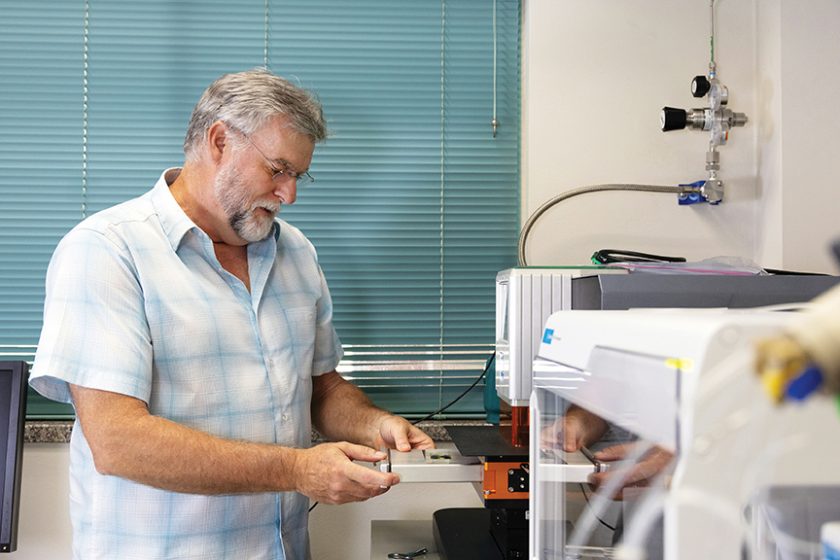
This year, the Department of Earth and Planetary Sciences modernized and expanded its capabilities in laser ablation and inductively coupled plasma mass spectrometry (ICP-MS), an analytical technique that can rapidly measure trace elements at very low detection limits.
Nate Miller, a lecturer and research scientist for the department, runs the lab, which moved to the Moffett Molecular Biology Building and is now called the Plasma Elemental Analysis CorE, or PEACE Lab. The space is outfitted with two state-of-the-art triple quadrupole ICP-MS instruments, each with a 193-nanometer laser system, among myriad other equipment. The space was also designed for teaching small classes, with hands-on learning in mind.
“It’s a lab the Jackson School can be proud of and should be a key stop for touring by prospective students and visiting speakers/researchers,” Miller said. “It is 580 steps from the JGB. Close in and far out!”
The ICP-MS lab moved from its previous home on the first floor of the Jackson School building, where it had been since May 2016.
Back to the Newsletter