
Dinosaurs Were Picky Eaters
December 13, 2025
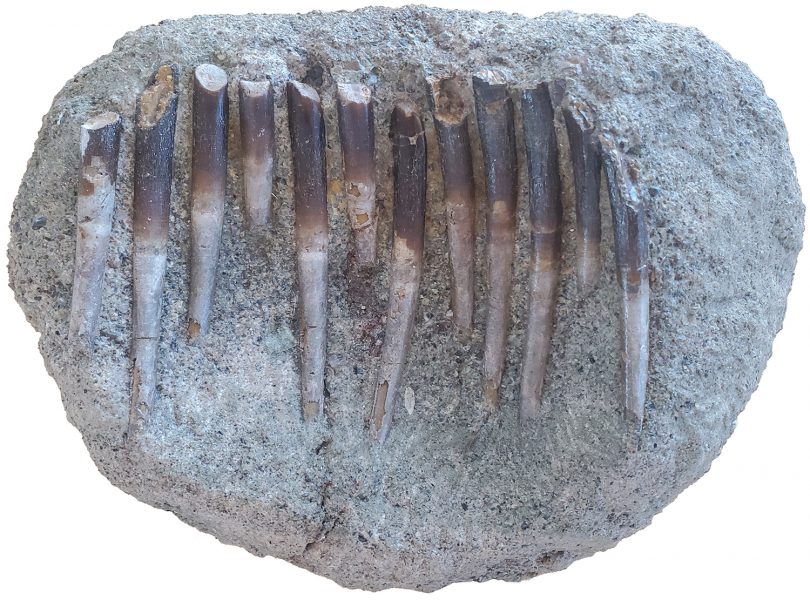
You are what you eat, it turns out — even if your last meal was 150 million years ago.
While the grub itself may be long gone, a record of dinosaurs’ favorite foods has been stowed away in their ancient tooth enamel during the past eon. When researchers at the Jackson School of Geosciences took a close look, they discovered that some dinosaurs were discerning eaters, with different species preferring different plant parts.
Tooth enamel contains calcium isotopes that reflect the range of foods the dinosaurs ate; different types of plants have different chemical signatures, and discrete parts of trees — from buds to bark — can also have unique signatures. According to Liam Norris, the study’s lead author, the results help explain how so many behemoths lived together in the same area at the same time.
Norris examined teeth from four dinosaur species and one crocodyliform, representing both herbivores and carnivores. The bones and teeth of these ancient creatures were all found in the Carnegie Quarry deposit in northeast Utah.
He found that the long-necked Camarasaurus ate mostly conifers, with a preference for woody plant tissues. The short-armed Camptosaurus preferred softer, more nutritious plant parts such as leaves and buds. The trunk-legged Diplodocus ate more of a mixed diet that included soft ferns and horsetail plants lower to the ground, as well as tougher plant parts.
The meat-eaters are the bipedal Allosaurus and the comparatively small, crocodile-like Eutretauranosuchus. The Eutretauranosuchus is more likely to have eaten fish, while the Allosaurus primarily ate herbivorous dinosaurs — possibly including the three other dinosaur species mentioned in this study.
Research by Liam Norris (Ph.D. 2025); Associate Professor Rowan Martindale; Laboratory Manager Aaron Satkoski; Professor John Lassiter
Department of Earth and Planetary Sciences
Research published October 2025 in Palaeogeography, Palaeoclimatology, Palaeoecology.