
Closing the Loop on Martian Water Cycle
December 13, 2025
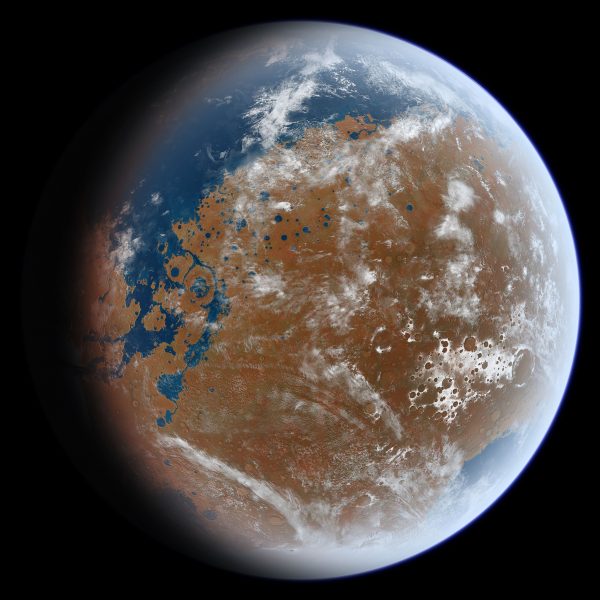
Billions of years ago, water flowed on the surface of Mars. But scientists have an incomplete picture of how the red planet’s water cycle worked.
Two doctoral students have developed a computer model that helps sharpen that picture, calculating that it took from 50 to 200 years for water to sink from the Martian surface to the aquifer, which is about a mile underground. On Earth, where the water table in most places is much closer to the surface, the same process typically takes just a few days.
The researchers also determined that the amount of water caught between surface and aquifer significantly reduced the water supply at the surface.
The findings add to an alternative picture of early Mars. Instead of being a wet world, Mars may have had little water evaporating into the atmosphere and raining down to refill oceans, lakes and rivers — as it would have on Earth.
Research by Mohammad Afzal Shadab (Ph.D. 2024); Eric Hiatt (Ph.D. 2025); Professor Marc Hesse
University of Texas Institute for Geophysics; Department of Earth and Planetary Sciences; Center for Planetary Systems Habitability; Oden Institute
Research published April 2025 in Geophysical Research Letters
Back to the Newsletter