
Closing an Evolutionary Gap With Zircons
December 13, 2025
In 1984, an amateur paleontologist in Scotland found a remarkable specimen: a nearly complete fossil of what looked to be a lizard or salamander. This small creature, called Westlothiana lizziae, ended up being one of the earliest examples of a four-legged, land-dwelling animal that had evolved from ancestors that lived underwater.
However, despite its significance, it lacked a precise age for decades. Thanks to Jackson School scientists who were willing to take a chance on a zircon analysis, it’s now known that this lizard-like creature dates to 346 million years ago — helping to fill a hole in the fossil record known as Romer’s Gap.
The gap spans from 360 million to 345 million years ago, a critical period when some lineages of water-dwelling life were growing lungs and making the transition to land. However, for reasons that scientists aren’t exactly sure of, few fossils have been found from this time.
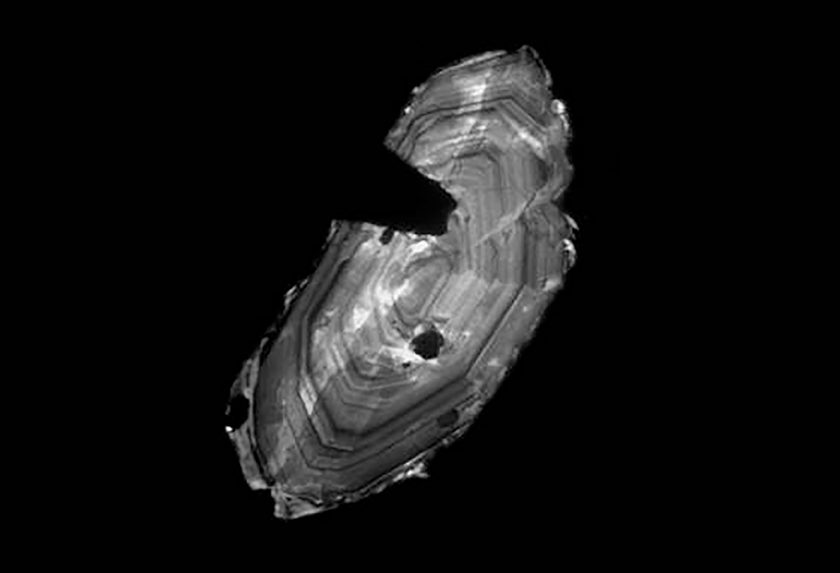
The site in Scotland where Westlothiana lizziae was discovered is a setting where zircons rarely form, and fellow scientists warned that the research might be fruitless. But the researchers got lucky: As mud cascaded down from the volcanoes, the flowing lava and debris eroded sediment that contained zircons. These zircons got swept into the same lake where the limestone that entombed the creature was forming.
Scientists X-rayed the rock sample and were able to extract zircons from the rock surrounding the fossils. From there, they conducted uranium-lead laser dating on the zircons to determine its age.
Research by Doctoral Student Hector Garza; Associate Professor Elizabeth Catlos; Professor Julia Clarke
Department of Earth and Planetary Sciences
Research published in April 2025 in PLOS One