
Change in Ocean Calcium Shaped Sea Life
December 13, 2025
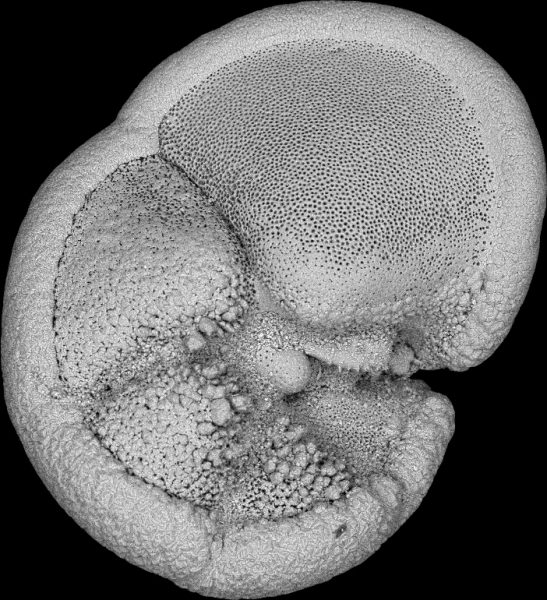
A change in calcium carbonate dynamics in Earth’s oceans appears to have influenced the evolutionary trajectory of tiny but mighty sea creatures: foraminifera, or forams for short.
Forams have called Earth’s oceans home for hundreds of millions of years and are a critical part of the food chain. But on the individual level, forams are very small. Each one is just a single cell surrounded by a shell-like skeleton, which can be made from calcium, sediments or organic matter.
In a study, researchers tracked the diversity of forams over the past 541 million years — a period known as the Phanerozoic — analyzing how forams with different skeleton types fared during big changes in Earth’s environment. This included multiple bouts of ocean acidification and five mass extinctions. The researchers then compared this data with changes in ocean chemistry over time.
They found that calcareous forams — which build their shells by secreting calcium carbonate — started to flourish once calcium carbonate became widely available in Earth’s oceans. They went on to become the dominant type of foram living today.
Research by Katherine Faulkner (B.S. 2023); Research Assistant Professor Chris Lowery; Associate Professor Rowan Martindale
UT College of Natural Sciences; University of Texas Institute for Geophysics; Department of Earth and Planetary Sciences
Research published April 2025 in Proceedings of the Royal Society