
Better Understanding Ice Layer Formation and Sea Level Rise
December 13, 2025
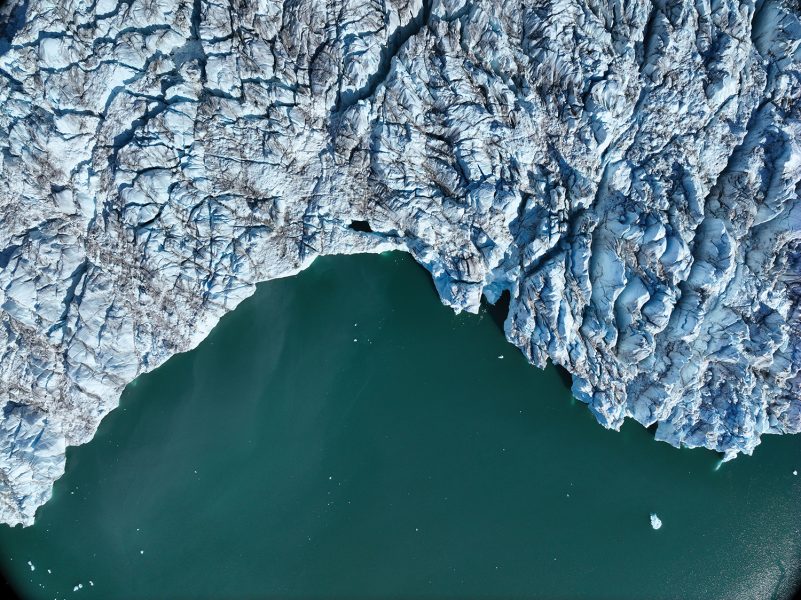
A newly discovered mechanism for the flow and freezing of ice sheet meltwater could improve estimates of sea level rise around the globe.
The new mechanism explains the process of how impermeable horizontal ice layers are formed below the surface, a process critical for determining the contribution of ice sheet meltwater to sea level rise.
The world’s two largest freshwater reservoirs, the Greenland and Antarctica ice sheets, are covered in old snow, known as firn, that has not yet compacted into solid ice. Because the firn is porous, melted snow can drain down into the firn and freeze again rather than running into the sea. This process is thought to decrease meltwater runoff by about half.
However, it’s also possible to form impermeable ice layers that can serve as barriers for meltwater — and divert meltwater to the sea. The potential for glacial meltwater to freeze in firns or flow off existing ice barriers makes understanding freezing dynamics within the firn layer an important part of estimating sea level rise.
This new research presents ice layer formation as a competition between two processes: warmer meltwater flowing down through the porous firn (advection) and the cold ice freezing the water in place by heat conduction. The depth where heat conduction begins to dominate over heat advection determines the location of where a new ice layer forms.
Mohammad Afzal Shadab (Ph.D. 2024); Professor Marc Hesse; Research Assistant Professor Cyril Grima
Oden Institute for Computational Engineering and Sciences, Department of Earth and Planetary Sciences, University of Texas Institute for Geophysics
Research published in August 2024 in Geophysical Research Letters
Back to the Newsletter