


GeoFORCE at AGU 2025
January 30, 2026
This past December, a couple dozen students from the GeoFORCE 12th Grade Research Academy were selected to attend the annual American Geophysical Union (AGU) National Conference. AGU is the largest gathering of scientists in the world and AGU25, hosted in New Orleans, Louisiana, brought together over 25,000 attendees from over 100 different countries. Throughout the week-long conference, GeoFORCE students and staff presented their research projects to their peers and were able to share the impact that GeoFORCE is making in the scientific community.
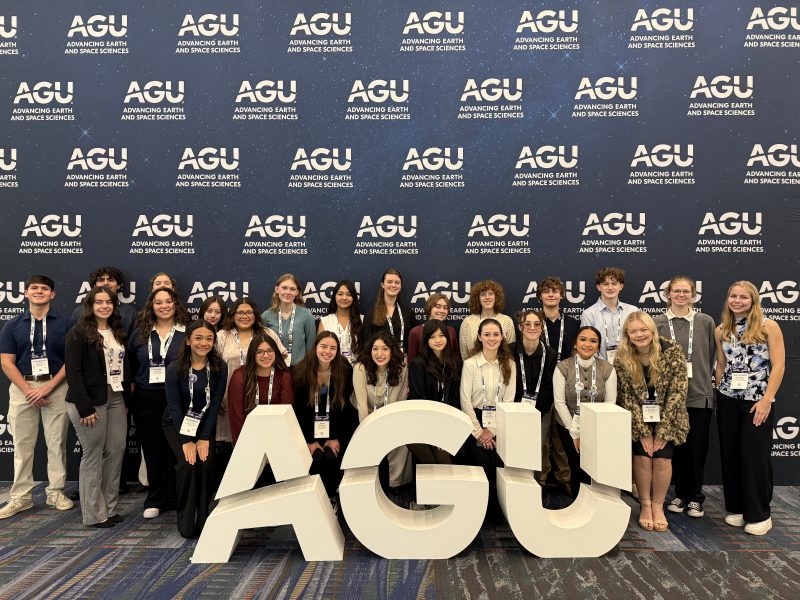
Out of the 106 students that participated in the 12th Grade Research Academy, 25 joined us on this mini-academy to participate in AGU’s BrightSTaRS program. The BrightSTaRS program is specifically for middle and high school students and gives them the experience of presenting research at a professional conference. One of our students, Julia Alvarado, who presented her research group’s poster titled The Effect of Climate Change on Central Texas Shrew Diversity in the Pleistocene, said the experience “was great! I loved being able to talk to so many people about my group’s research.”
Below is a list of all of the GeoFORCE students who presented as well as the titles of their posters and the research mentor that led their group during the 12th Grade Research Academy.
| GeoFORCE Students | Poster Title | Research Mentor |
| Elaina Esquivel Aubrey Orf Mallory Solomon | The Importance of Understanding the Highland Lakes of Central Texas through the Use of Sonar Technology and Sedimentary Analysis | Dr. Jamie Austin |
| Nolan Benet | Effects of Manmade and Environmental Factors on Central Texas’ Highland Lakes Water Quality | |
| Natalia Frost | The Influence of Temperature Rise on Reservoir Evaporation Trends Near Major Texas Cities | Dr. Sarah Fakhreddine |
| Vanessa Martinez Luna | Accelerated Evaporation Rates and their Far-Reaching Effects on Texan Reservoirs | |
| Carissa Morin | Utilizing UAVs to Monitor Coastal Change | Dr. Tim Goudge |
| Alexandra Chapa | Analyzing the Effectiveness of Topographical Mapping Methods to Determine an Optimal Way to Observe Texas Coastline Changes | |
| Amelia McRoberts | Effective Methods for Monitoring Short-Term Coastal Changes | |
| Anna Edwards Audrey Murdock | Financial Viability of Carbon Capture and Storage as a Climate Change Mitigation Tool: A Close Look at Deep Well Injections off the Texas Coast | Dr. Sue Hovorka |
| Alexander Curi | The Effect of Impurities on Sublimation and Flow Rate in the Himalayan Glaciers and its Impact on Surrounding Communities | Dr. Benjamin Keisling |
| Kayla Trejo | Comparing the Geographic, Ecological and Political Impacts of Sea-Level Rise Contributions from Greenland and Antarctica | |
| Lela Thornhill | The Pursuit of Earthquake Precursors through the Lens of ECOR | Isabelle Lambert |
| Zaydin Sanchez | Shaking Up Seismology: Exploring Earthquakes through ECOR | |
| Sierra Mickler | Radiometric Dating and Isotope Geochemistry to Explore the Possibility of Pannotia | Dr. Staci Loewy |
| Eden Bui | Coats Land, Antarctica and West Texas: The Potential Precambiran Link | |
| Callie Doubrava Kaydin Garza Stefani Ortiz | Fostering Community Conversation Through Austin’s Favorite Pool: Barton Springs | Linda McCall |
| Mea Van der Steur | Investigating the Relationship Between Climate Change and Pleistocene Shrew Fossils in Central Texas | Dr. John Moretti |
| Julia Alvarado | The Effect of Climate Change on Central Texas Shrew Diversity in the Pleistocene | |
| Davis Mullins | Using Ancient Corals to Assess Climate Simulations of El Niño Events in the Past and Future | Dr. Jud Partin |
| Elijah Gonzales | From Digital to Physical: Modeling Porosity and Permeability Using 3D Printing | Dr. Masa Prodonavic |
| Sophia Howes | Synthesizing KREEPy Rocks & Analyzing Elemental Components of Lunar Geology | Dr. Chenguang Sun |
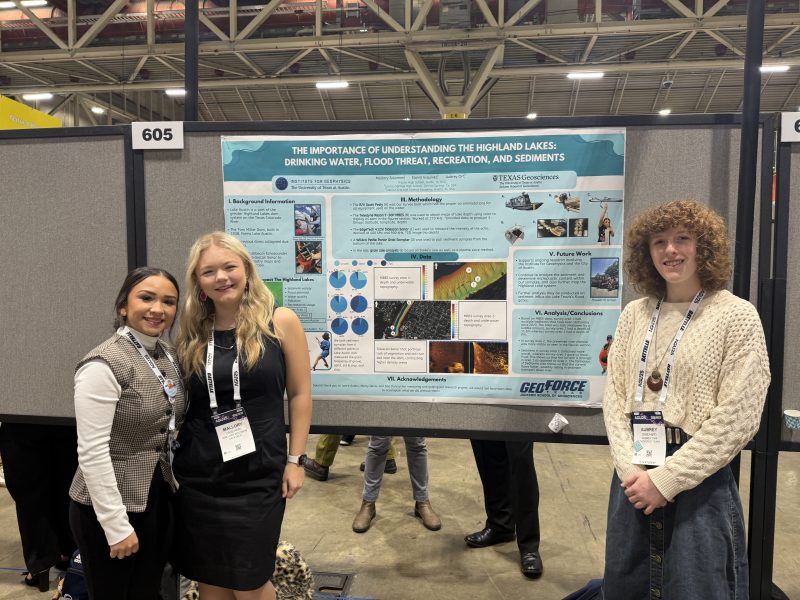
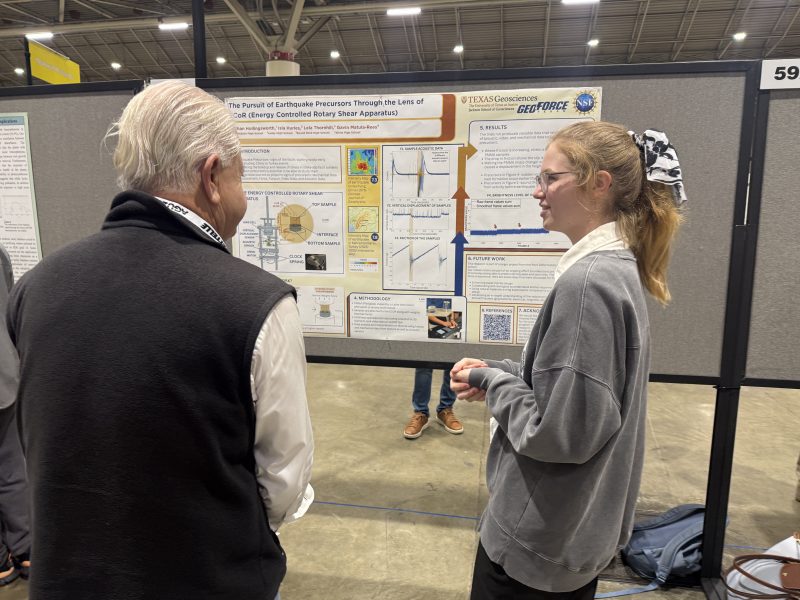
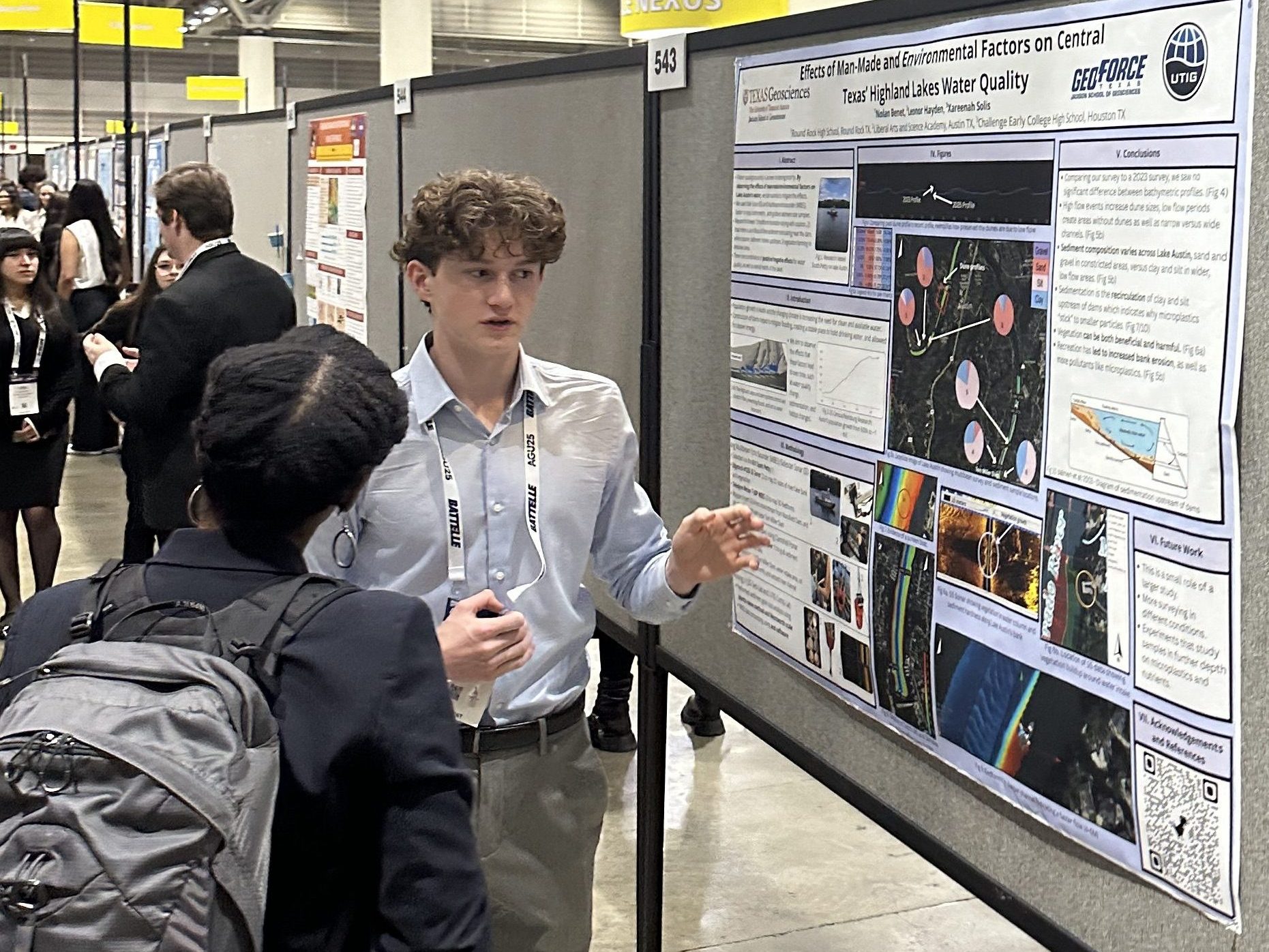
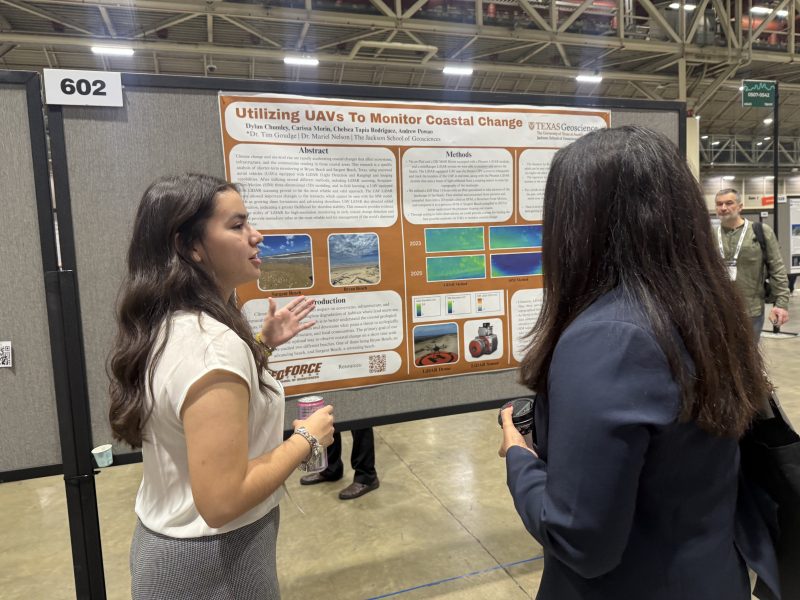
Along with presenting their posters, students also got to roam the poster hall to see what other students and Earth science professionals have researched in the past year. Kayla Trejo, a GeoFORCE student, said that was her favorite part of the conference. “The people at AGU were all very kind and willing to help or give advice as well as present. No matter your education level they were able to effectively adjust their presentation to meet your needs.”
Along with our students and countless other researchers, GeoFORCE coordinators presented at AGU25 as well. Eleanor Cote, our digital media coordinator, presented her poster titled Using Newsletters to Reach Stakeholders in an Educational Youth Outreach Program. Jennifer Peña, our alumni coordinator, presented her poster titled Empowering Students and Their Communities Through Geoscience Outreach. Their presentations spoke about the broader impact of GeoFORCE beyond student research and emphasized the importance of outreach in geoscience education.
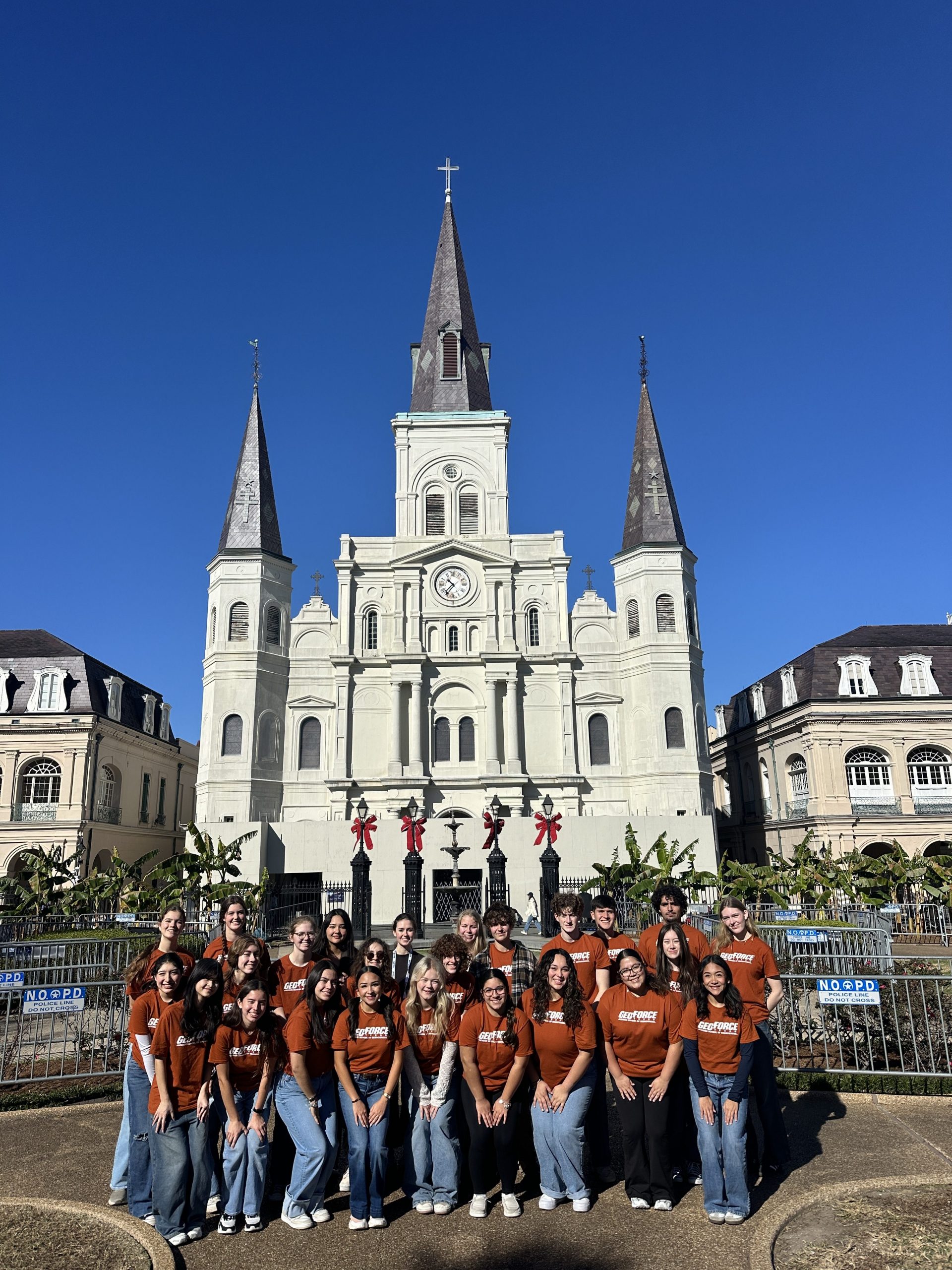
Following the conference, our students got to explore New Orleans – a majority of them for the first time. We dined at many local restaurants for the authentic Creole cuisine, including on beignets from the legendary Cafe Du Monde. We also walked through Canal Street, Jackson Square and the French Market to see the city on foot and collect souvenirs. We ended our mini-academy with a historic pedal boat tour down the Mississippi River to the Chalmette Battlefield, the site of the War of 1812’s Battle of New Orleans where our amazing tour guides taught us about the history of New Orleans before we had to head back to Texas.
Overall, the experience was amazing and we are so proud of our students. We hope to return to AGU26 next year with new research projects and more to share with the Earth science community!
Written by Jas Atobajeun