

Reconnecting with GeoFORCE Alaska
February 4, 2026
It’s a sunny morning at Glen Canyon Dam. I’m sitting on the grass while half of the GeoFORCE group listens as our instructor explains hydroelectric power. The other half has just gone inside the Visitor Center to explore the exhibits for the next forty-five minutes, so you can imagine my shock when a large group of sophomore-aged students walks out only a few minutes later, all wearing GeoFORCE lanyards, with staff members in GeoFORCE shirts accompanying them. And yet, I don’t recognize a single face.
Just then, my fellow coordinator bursts out of the Visitor Center and exclaims, “GeoFORCE Alaska is here!”
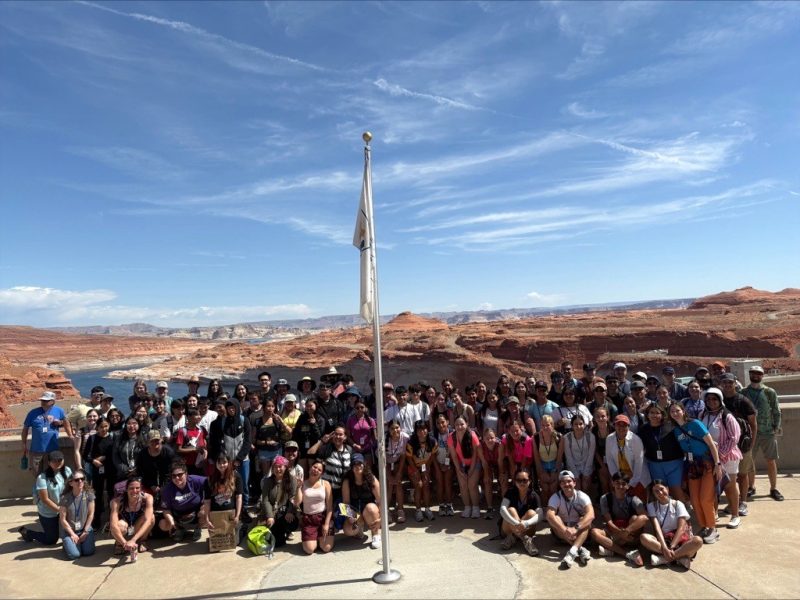
As a student-turned-alumni-turned-coordinator, GeoFORCE Alaska has always been something I knew existed. Until that moment, though, it remained something of a mystery. What did their academies look like? How had their program evolved since it began? I soon had the opportunity to sit down with Dr. Sarah Fowell and Justine Schmidt of the GeoFORCE Alaska team and ask all my burning questions.
Dr. Sarah Fowell, Director of GeoFORCE Alaska, has been with the program since its inception in 2012. As a faculty member at the University of Alaska Fairbanks, she served as an instructor during the program’s first year, before transitioning into the director role the following year. More than a decade later, she remains in that position and still instructs many of their academies.
Justine Schmidt serves as GeoFORCE Alaska’s Program Coordinator and manages all logistical aspects of the academies. She has been in this role for three years. Although Dr. Fowell and Schmidt are originally from Wisconsin and California, respectively, both have lived in Alaska for over a decade and have spent that time serving Alaskan students in some capacity.
One of the most significant differences between GeoFORCE Alaska and GeoFORCE Texas is the number of cohorts run. GeoFORCE Alaska recruits students at the 8th and 9th grade levels once every four years, forming a single cohort that remains together for the full four-year program. Because recruitment occurs only once per cycle, cohorts often include students whose ages span two to two and a half years from one another. Once that group finishes their fourth academy, they begin the recruitment process again.
The actual recruitment efforts also differ from the recruitment efforts of GeoFORCE Texas. Rather than driving a couple of hours to a school, the GeoFORCE Alaska staff must fly into the remote communities where they recruit.
“The trip can take most of the day,” Schmidt explains. “The location we are going to may only be a couple hundred miles away from Fairbanks, but it can take all day on regional flights, and it’s [often] weather dependent.”
Since expanding the regions they recruit from, the team has switched to virtual formats for recruitment, although sponsors still fly Schmidt to recruitment locations from time to time.
Beginning with only students from the North Slope, GeoFORCE Alaska now has students from the North Slope, Northwest Arctic, Interior, and Southwest regions of the state.
With how remote the students are, and how far their villages are from each other, one of the most difficult days for the GeoFORCE Alaska staff is drop off. Getting students to Fairbanks to begin the academy together is a test of logistics that GeoFORCE Texas has yet to experience. Students independently fly to a hub community, where they group up with other GeoFORCE students and staff.
“The students fly on regional airlines, [taking] small planes – Cessna caravans – and meet at a hub location: Utqiagvik (Barrow), Kotzebue, Bethel, Fairbanks ([which]is convenient because the kids can just come here). From those hubs, the kids can get on Alaska Airlines.”
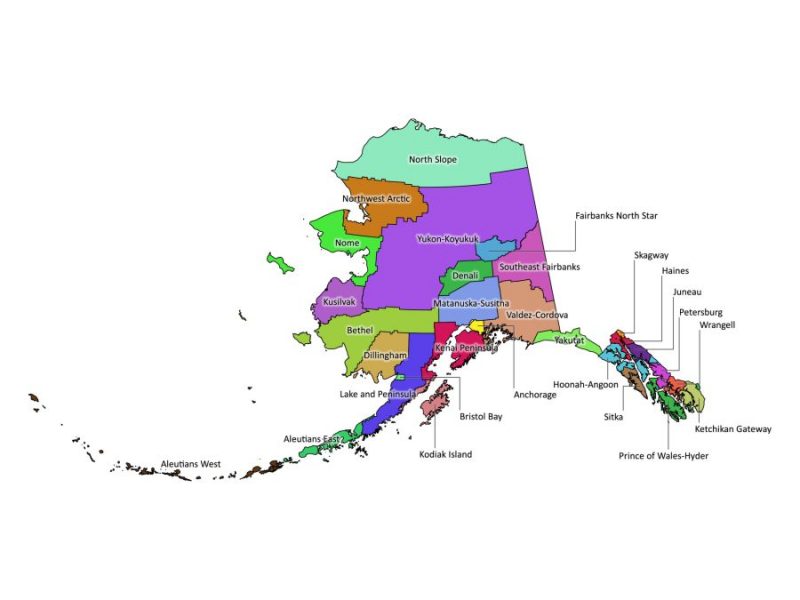
On the regional flights, the students are usually alone, but once they reach the hubs, they meet up with other peers, staff, and sponsors. For the first years, there is typically a lot more staff involvement in getting students from their rural villages to Fairbanks, but as the years progress, students can travel independently.
“The most stressful day is everyone showing up, and it takes nearly 36 hours for everyone to get here.” said Schmidt. “Then we have to do it in reverse [at the end of the academy].”
Despite these logistical differences, the academies follow a familiar progression. The first-year academy takes place entirely in Alaska, beginning in Fairbanks and traveling south through Denali National Park, ending in Anchorage. The academic focus is on agents of erosion and deposition, with students examining Alaska’s primary agents: rivers and glaciers. For their second year, students travel to the American Southwest, visiting GeoFORCE staples such as Zion National Park, Glen Canyon, and the Grand Canyon. The third year takes them to Oregon and Washington, where they explore Mount Hood, Crater Lake, and spend a day along the coast. Their fourth and final year deviates from GeoFORCE Texas, taking students to the Rocky Mountains. This trip serves as the capstone, where students are tasked to create a geologic map.
Thinking back to the moment we crossed paths at the Glen Canyon Visitor’s Center, I recall students interacting with one another. GeoFORCE Alaska students commenting about the high temperatures while GeoFORCE Texas students comment about how pleasant the dry heat is compared to Texas’s humidity. Excitedly chatting about their experiences so far on the academies, comparing locations traveled and content covered. It was so special to witness two groups of students from vastly different backgrounds, brought together, in Page, Arizona, by the GeoFORCE Program.
What began as a moment of confusion outside the Visitor Center truly became a reminder that the GeoFORCE impact extends beyond state lines. Though GeoFORCE Alaska and GeoFORCE Texas have differences in practice, we share a common goal: opening doors, providing experiences, and inspiring students.