
Collections History
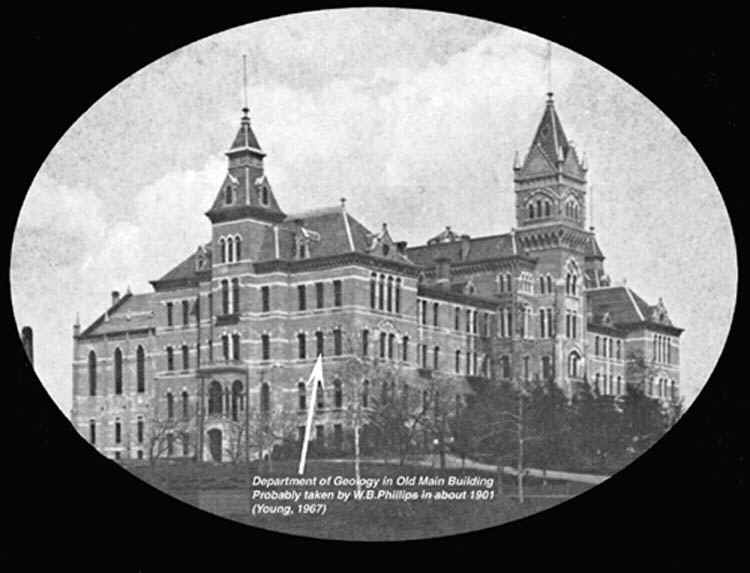
The collections were derived from many different sources. Many have also been moved around the campus of UT, and were finally relocated at the J.J. Pickle Research Campus.
Historic
Most of the original specimens from the earliest collecting of Roemer were sent to Europe and can be studied in the museums of Bonn and Wroclaw. Casts of many of type specimens included in that material are available for study here.
The Dumble Collection:
This collection is the oldest and includes specimens that were collected during the Third Geological Survey of Texas – The Dumble Survey – under the leadership of Edwin T. Dumble. Many specimens are of Paleozoic age and were described by F. W. Cragin and illustrated by line drawings. Part of the Dumble collection went back to Wroclaw (Warsaw) with Roemer, who was paleontologist with the survey prior to Cragin.
The Rio Bravo Collection:
After the Third Survey was disbanded, Dumble moved into industry, helping to develop the oil branch of the Southern Pacific Properties – The Rio Bravo Company. This collection stems from the research of that Company. It consists largely of Cretaceous and Tertiary fossils from Texas and Mexico. The specimens, about 4000 lots from 750 localities, were transferred to the BEG in 1931. [A lot number may refer to a single specimen or to numerous specimens from one locality]
The Galveston well Collection:
This was a continuous core 3000 ft in length from the deep-water well drilled for Galveston. The preliminary report on the well was written by J.A. Singley. Fossils from this core were first discussed by E.T. Dumble and G. D. Harris in 1893.
The El Aguila Collection:
Specimens from El Aguila (Compania Mexicana de Shell) were acquired by Walter S. Adkins before the expropriation of 1936. Specimens are cataloged in both the Adkins (WSA) and the UT collections.
The WPA-State Survey Collection:
A significant terrestrial plant collection covering the Late Paleozoic of North-Central Texas, collected by the Works Progress Administration (WPA) Statewide Paleontologic and Mineralogic Survey, which was active from 1939 to 1942. These projects were also collecting vertebrate fossil specimens.
Departmental
The BEG collection:
This collection includes a variety of specimens from all geological ages, almost exclusively from Texas. It is the result of collections made during the geologic mapping of the state by the Bureau of Economic Geology (BEG). The collection is arranged stratigraphically by county. Many of the Paleozoic collections of Frederick B. Plummer and R. H. King are included. The combined BEG catalogs include about 60,000 lots.
The Adkins collection:
This collection includes a wide range of specimens from the research of Walter S. Adkins and his students as well as material acquired from other sources. The collection was catalogued by Keith Young and includes about 20,000 lots.
The UT collection:
A wide ranging collection is largely the product of research within the Department of Geological Sciences. Many of the specimens collected by Francis L. Whitney and his students are included here. The Engerrand-Chantegrain and the Singley-Askew collections are catalogued under UT numbers. The collection of more than 50,000 lots was catalogued by Keith Young.
The TNSC collection:
This collection includes specimens collected by the research staff at the Texas Natural Science Center. There is an extensive Paleozoic plant and arthropod collection stemming from the work of Christopher J. Durden. New type material described by members of the Jackson School (JSG) is housed in this collection. Many new Paleozoic species have been added by James T. Sprinkle and his students.
Individual
The Engerrand-Chantegrain Collection:
This is a beautiful collection from classic French and Belgian Eocene and Paleocene sites. George Engerrand was the first head of Anthropology at UT. He bought this collection from S. Chantegrain while he was in France. He apparently sold the collection to BEG in 1927 and is reputed to have used the funds to support the Mexican Revolution. Additional specimens form this collection were held at Texas A&M and have recently been transferred to UT. This collection is probably the finest Tertiary collection from type localities in western Europe outside of the National Museum. It is cataloged in the UT, BEG and NPL collections and includes about 3000 lots.
The King Collection:
Ralph Hughes King provided about 2000 specimen lots of Pennsylvanian age. The material includes a range of taxonomic groups but especially brachiopods and sponges. King described new species in both groups and those specimens are in the type collection.
The Irving and Steussey Collection:
A small collection of fossil plants.
The Sellards Collection:
An important collection of Permian insects by Elias H. Sellards.
The Singley-Askew Collection:
Both J.A. Singley and H.G. Askew were collectors of Recent shells. The collection is worldwide and provides a pre-industrial reference collection for freshwater and marine molluscs. Askew’s unionid bivalve collection is one of the finest.
The Stenzel Collection:
A largely Tertiary collection from Texas, including molluscs, echinoderms, and arthropods (particularly crabs) collected by Henryk Stenzel. This collection includes specimens from the Brazos River locations of the Cretaceous-Tertiary boundary. Much of this collection, over 8000 lots, was tagged with locality numbers and has now been assigned ‘NPL’ numbers. Stenzel also created an important genotype collection to help him identify and catalog early Tertiary fossils. The catalog of his fossil images and descriptions is now available online.
The Wells Collection:
John West Wells was a student of Francis L. Whitney. His collection includes Cretaceous corals. These have been of particular importance to recent research into the evolution of hermatypic corals. Most of his specimens are in the type and figured collection.
Orphaned
The Hedberg Collection
A collection of South American (Venezuelan) specimens were transferred to TMM after Gulf Oil Company closed one of its paleontological laboratories. Early in his career Hollis Dow Hedberg worked in eastern Venezuela describing both Cretaceous and Tertiary stratigraphic sections.
The Kemp Collection
Augusta Hasslock Kemp was a high school teacher in Abilene, Texas, collecting fossils from the late 1920’s until the 1960’s . She and her students made extensive collections of Pennsylvanian and Permian specimens mainly, but not exclusively, from Baylor County. After completing her college studies (M.S., 1910) under Samuel Wendell Williston at the University of Chicago, A.H. Kemp moved to Seymour, Texas, and gradually built up this very important collection. She donated her collection of about 5000 specimens to the BEG shortly before her death in 1963. Learn more about her research in the Journal of Paleontology, #31(3). (May, 1957), pp. 591-594.
The Ball Collection
The Oscar M. Ball collection was moved from Texas A&M University to the Houston Museum of Natural Science and thence to TMM in 1979. It is an important collection largely composed of Eocene plant material. O.M. Ball worked on these specimens during the 1930’s publishing several monographs and papers. The collection contains type and figured specimens. View the O.M. Ball Collection catalog.
The ETSU Collection
This collection, formerly held by Joan Echols at East Texas State University( now Texas A&M University–Commerce ), was adopted by Texas Memorial Museum upon Echols’ retirement. The collection includes Mesozoic and Cenozoic vertebrates, now held by the VPL, and Mesozoic invertebrates now held by NPL. One especially important aspect of the invertebrate collection is its beautiful ammonite specimens. Upon her death in 2013, Echols bequeathed her entire collection to the Jackson School of Geosciences.