

Eclectic Rocks Influence Earthquake Types
RESEARCH HIGHLIGHT
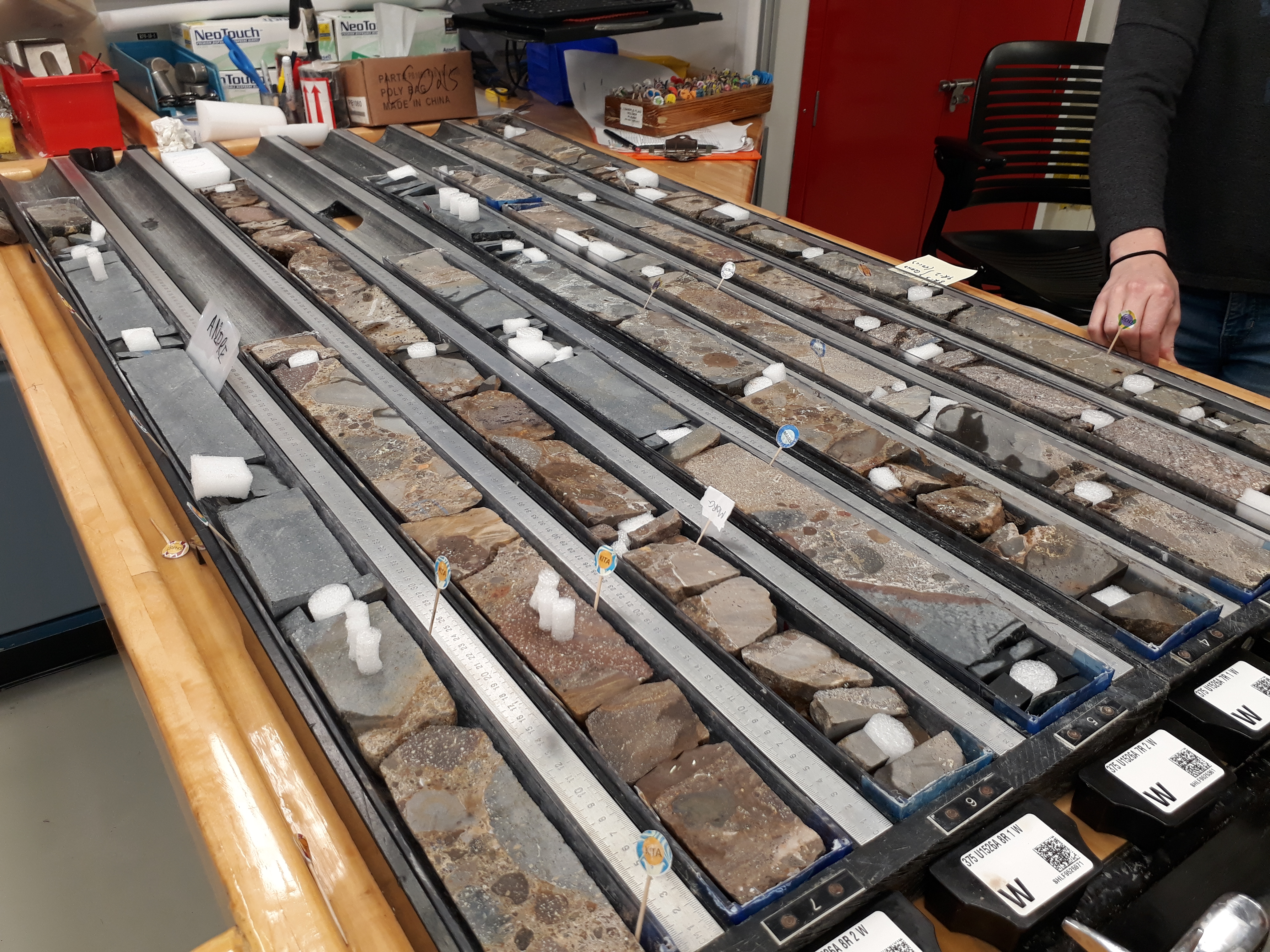
Volcanic pieces; chunks of carbonates; clay-like mudrocks; and layers and layers of sediment. This eclectic rock collection is part of a core pulled from a seamount along New Zealand’s largest fault.
The fault is a subduction zone and is known to generate a spectrum of seismicity – from slow-motion earthquakes known as “slow slip events” to destructive, tsunami-generating tremors. According to research led by a global team of scientists, the jumble of mixed-up rocks could help explain how one fault can host so many different types of earthquakes.
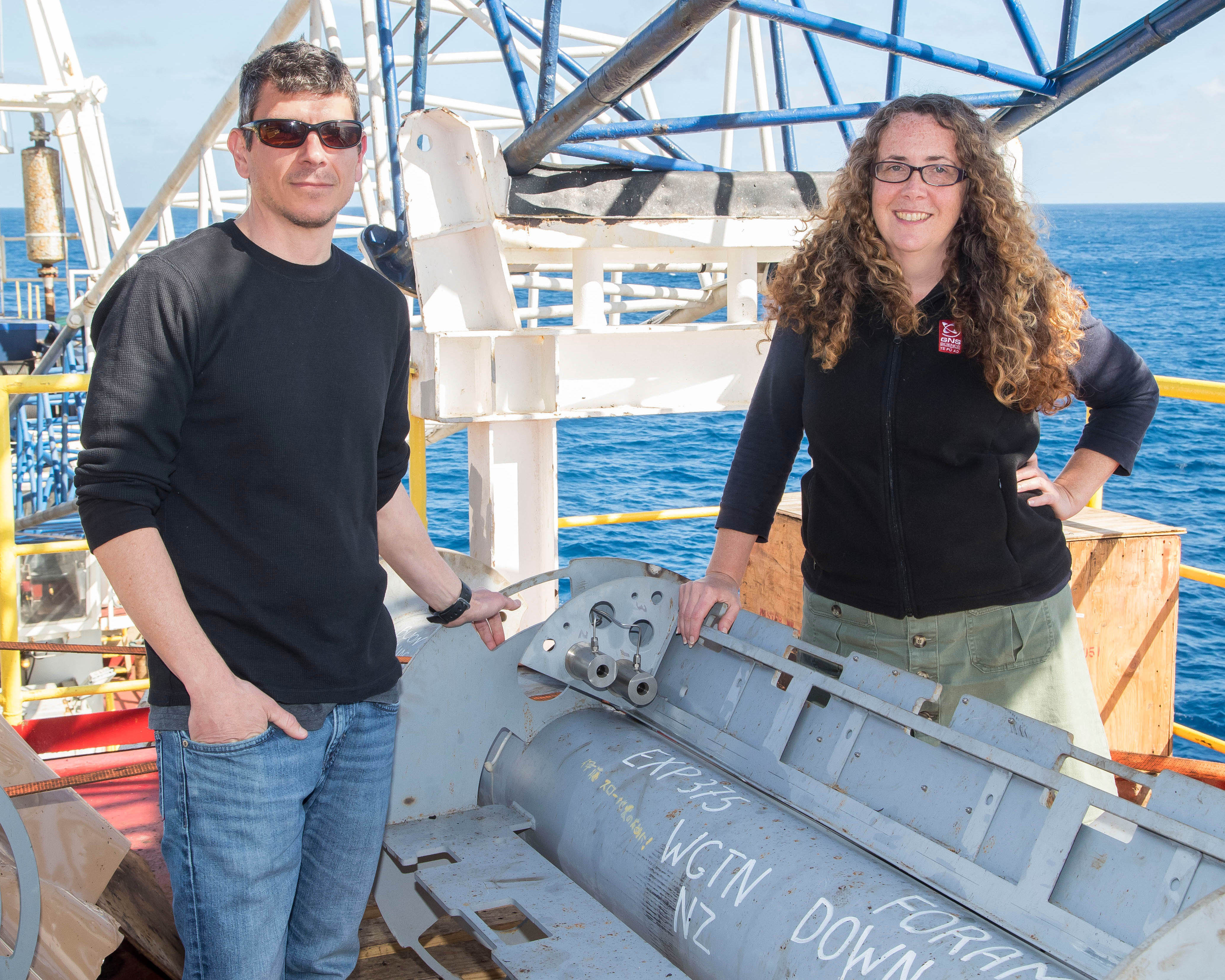
“These rocks that are being mashed up together all behave very differently in terms of their earthquake generating potential,” said Laura Wallace, a research scientist at the University of Texas Institute for Geophysics (UTIG) and co-chief scientist on the 2018 expedition that retrieved the rock samples.
UTIG is a research unit of The University of Texas at Austin Jackson School of Geosciences.
The finding was described in a paper published March 25, 2020, in Science Advances. It is the latest discovery to emerge from two scientific drilling expeditions conducted from 2017- 2018 in New Zealand and led by scientists at UT and colleagues at institutions in New Zealand.
Subduction zones—places where one tectonic plate dives beneath another—are where the world’s largest and most damaging earthquakes occur. Scientists have long debated why quakes are more powerful or more frequent at some subduction zones than at others, and whether there may be a connection with the slow slip events, which can take weeks or months to unfold. Although they are not felt by people on the surface, the energy they release into the Earth is comparable to powerful earthquakes.
“It has become apparent only in the last few years that slow slip events happen at many different types of faults, and some at depths in the Earth much shallower than previously thought,” said the paper’s lead author, Philip Barnes of the New Zealand Institute for Water and Atmospheric Research (NIWA). “It’s raised a lot of big questions about why they happen, and how they affect other kinds of earthquakes.”
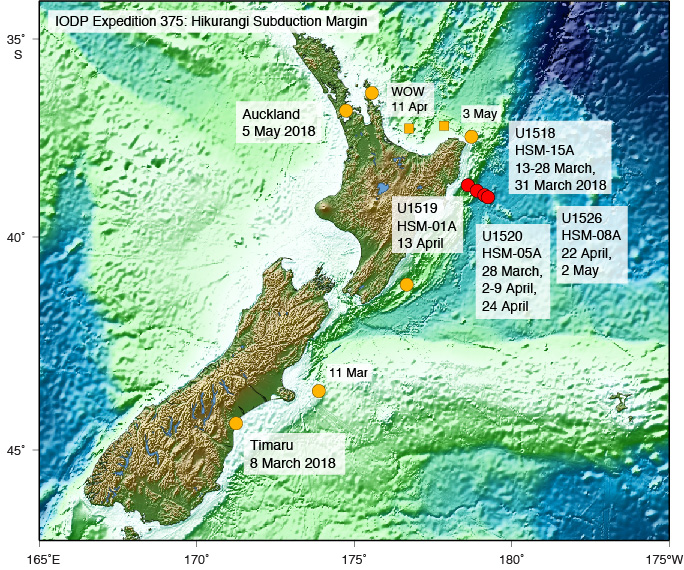
To answer these questions, Barnes, Wallace and UTIG Director Demian Saffer led scientific ocean drilling expeditions, to a region off the coast of New Zealand, where they recovered rocks from the vicinity of the tremors’ source.
“The earthquake and geological science community has speculated about what goes into a subduction zone where slow earthquakes occur, but this was the first time we’ve literally held those rocks—and physical evidence for any of those ideas—in our hands,” said Saffer, who was co-chief scientist on the 2018 expedition.
The team drilled into the remains of a buried, ancient sea mountain where they found a diverse array of rocks in a range of shapes, sizes, compositions and origins.
Kelin Wang, an expert in earthquake physics and slow slip events at the Geological Survey of Canada, said that the paper was effectively a breakthrough in understanding how the same fault can generate different types of earthquakes.
“In addition to helping us understand the geology of slow slip events, this paper also helps explain how the same fault can exhibit complex slip behavior, including tsunami-generating earthquakes,” said Wang, who was not part of the study.
Efforts to understand the connection between slow slip events and more destructive earthquakes are already underway. These studies, which are being led by other UTIG researchers, include detailed seismic imaging—which is similar to a geological CAT scan—of the slow slip zone in New Zealand, and an ongoing effort to track the behavior of subduction zones around the world by installing sensors on and beneath the seafloor. The goal of the work is to develop a better understanding of the events that lead up to a slow slip event versus a tsunami-generating earthquake.
“The next needed steps are to continue installing offshore instruments at subduction zones in New Zealand and elsewhere so we can closely monitor these large offshore faults, ultimately helping communities to be better prepared for future earthquakes and tsunami,” said Wallace, who also works at GNS Science, New Zealand’s government-funded geosciences research institute.
The research was supported by the International Ocean Discovery Program, which is sponsored by the National Science Foundation and other participating countries. Support for the research also came from New Zealand’s Ministry for Business, Innovation, and Employment, NIWA and GNS Science.
The University of Texas at Austin
Web Privacy | Web Accessibility Policy | Adobe Reader