
Climate Modeling, Law School, Energy Startups — Learn Where the Class of 2026 is Heading Next
The caps, gowns and stoles have been purchased and pressed. Final exams turned in, and research projects wrapped up. For the Class of 2026, their time at the Jackson School of Geosciences has come to a close, but their lifelong journeys as geoscientists are only beginning!
There are 67 undergraduates and 51 graduate students set to cross the Jackson School’s commencement stage this Friday. Meet seven of them here.
They’ve studied Texas’ land and water, artificial intelligence applications across the geosciences, land-atmosphere interactions — and everything in between. These students reflect the depth and breadth of the science that takes place at the Jackson School every day. And where they’re going next shows that there is no single path to take from the Forty Acres to the wider world.
Congratulations, Jackson School of Geosciences Class of 2026!
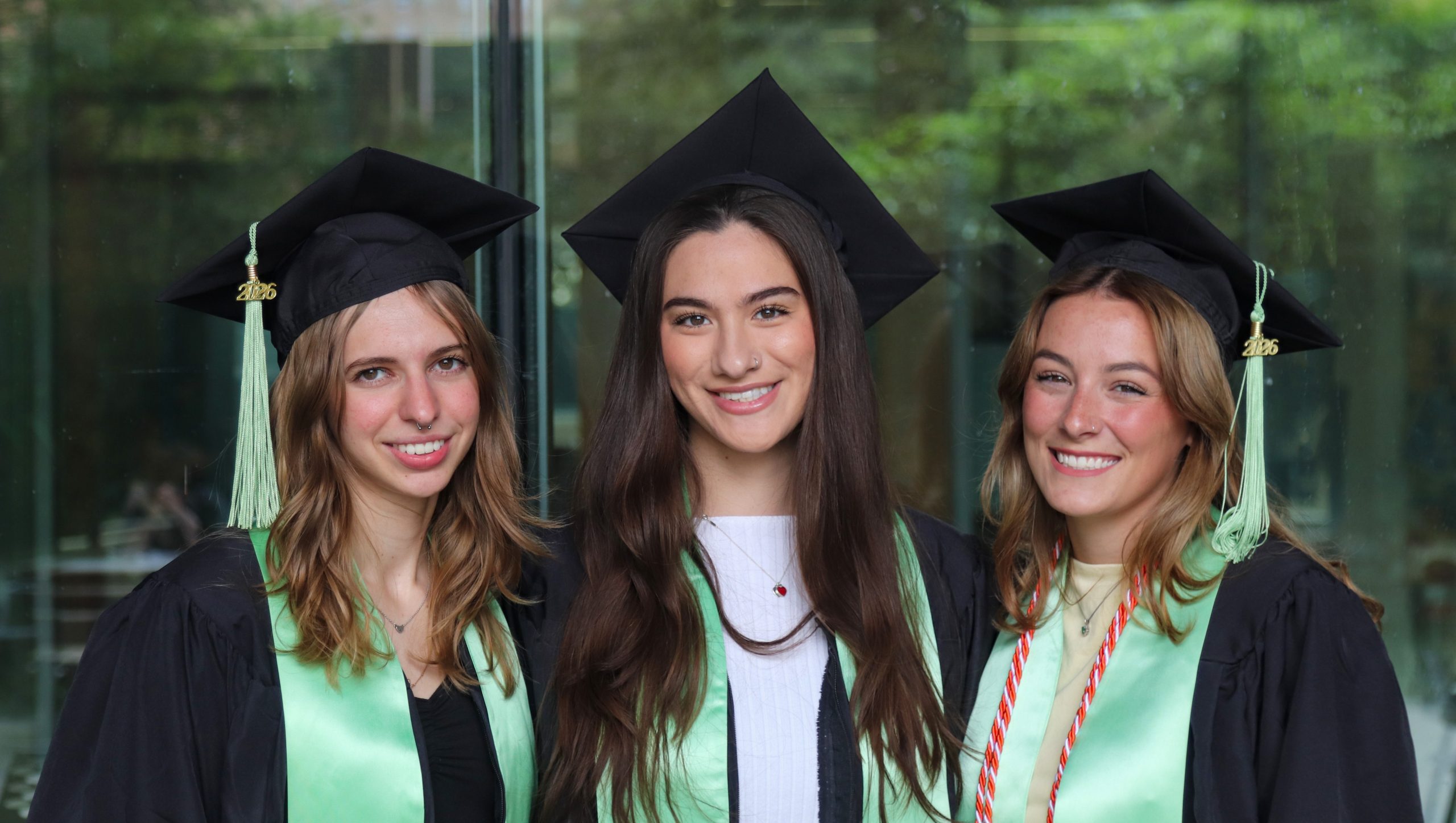
Inaugural Class of Climate System Science Majors
Taylor Roberts, Kaya Roeder and Trinity Ivy
B.S. Climate System Science
The climate system science major, the first of its kind in Texas, launched at the Jackson School two years ago. Now, its first cohort of students are set to graduate. Trinity Ivy, Taylor Roberts and Kaya Roeder discuss what drew them to this field of study, and what they want to do next. For Ivy, that answer only solidified after spending the spring semester as a weather intern at the local Austin news station KXAN. After graduation, she plans to pursue broadcast meteorology as a career. Roeder and Roberts plan to take some time off before applying to climate science graduate programs.
Q: What does it feel like to be part of the Jackson School’s very first class of climate system science majors?
Taylor Roberts: I’m excited about the direction that the whole department is going by becoming the Department of Earth and Planetary Sciences, and then also introducing this degree. But I’m also surprised it took this long, honestly, because I feel like it’s such an important topic and field of study that more people need to go into. There are a lot of incoming freshmen and younger people who are really excited and really interested in this degree. I’m excited to be the first step of that.
Q: Trinity, do you feel like the climate major has given you the tools you need to do broadcast meteorology?
Trinity Ivy: Yeah. It’s prepared me a lot, also just in terms of critical thinking and thinking on my feet. Weather modeling is something that we talk about here a little bit, and I just dove deeper into it at KXAN. And also, part of the reason I got the internship at KXAN is because Dr. (Kerry) Cook also used to teach their chief meteorologist. So she was a connection that got me that internship, and she’s been a great mentor for me throughout this degree program.
Q: What was your favorite class at the Jackson School?
Kaya Roeder: Climate Data with Dr. (Geeta) Persad. I feel like it’s been the most helpful in visualizing the climate system, and it’s a skill we can translate into the workforce or even into research. It’s a lot of data processing and figure generation and skills that you go over in your other classes, but it’s really interesting to apply it to climate science specifically. That’s what we’re focused on. It’s just really fun to be able to get your hands in it. With geology, you would go in the field and collect data. For us, we get to be on the computer doing the same thing, but for climate science.
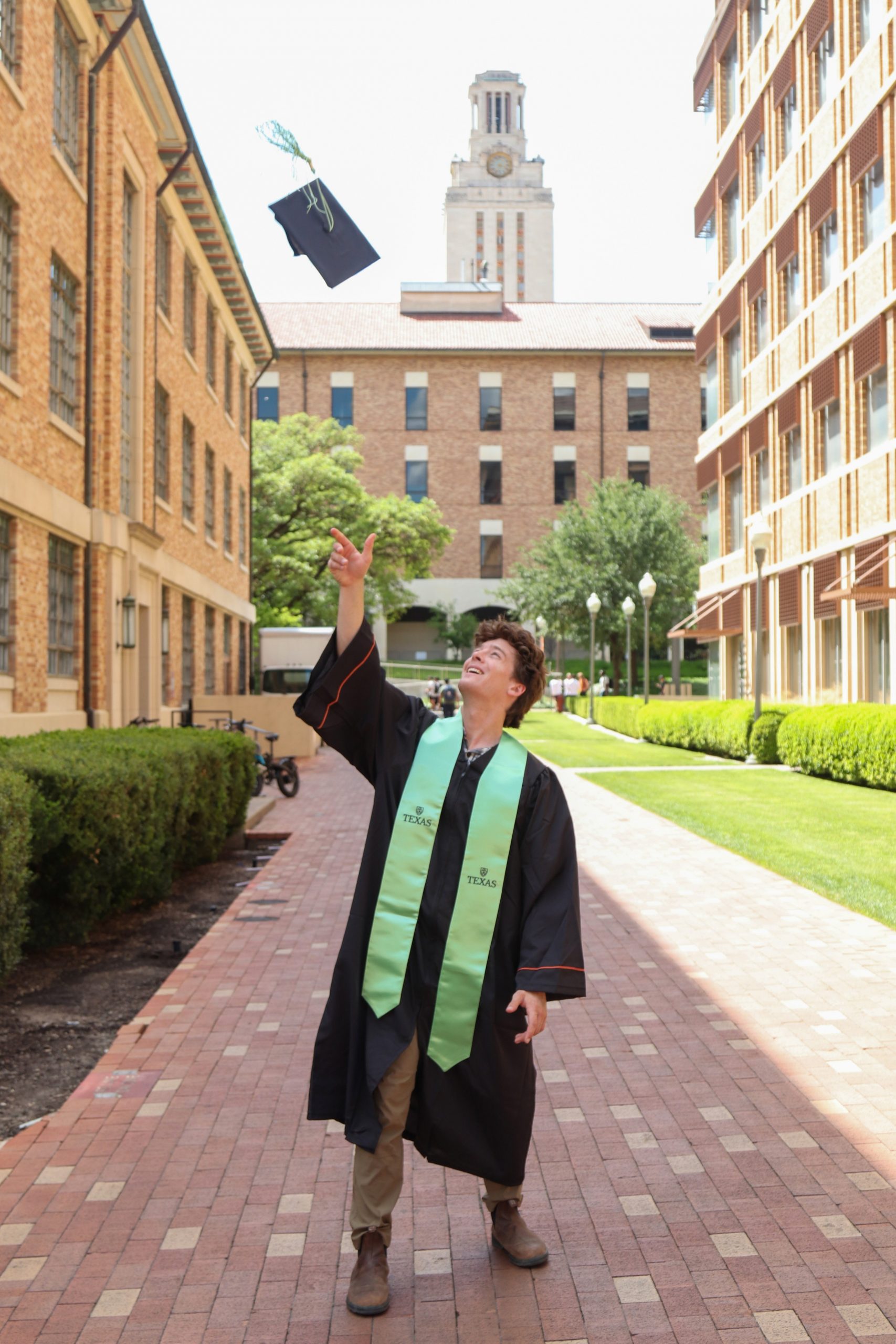
Tracking Texas’ Water
Will Eagle
B.S. General Geology
Come August 1, Will Eagle will start work as a post-baccalaureate researcher with Marcus Gary, a research associate professor at the Jackson School’s Bureau of Economic Geology. They’ll be investigating groundwater interaction in Texas, namely in the Hill Country, west toward the Devil’s River and further west near Big Bend. As Texas’ water becomes an increasingly precious resource, this research will help policy makers and planners make more informed decisions about its use.
Q: What specifically will you be studying in this post-bac?
A: How surface water and the groundwater interact. There are some places where the rivers drop completely underground and feed into the aquifers, and then that flows through the ground and comes back out at springs. And it’s important to understand that because they’re managed separately at the state level, and they’re not often incorporated into water planning as an integrated system. We’re trying to understand everything about this system — how much water is going into the ground, where it’s going into the ground, where it’s coming back out, and how much is coming back out.
Q: How did your Jackson School education prepare you for this path?
A: I think the focus on applied skills has been super helpful. I’m coming out of this with all the field work skills for both geology and hydrogeology, and then a lot of GIS and programming skills. Also, just the people it puts you next to and the network that you can build while you’re here is — it’s a little insane. Especially for Texas water stuff, it’s hard to beat the Jackson School for that.
Q: What is your favorite class that you took while you were here?
A: I really enjoyed Structural Geology with (Assistant Professor) Craig Martin. I thought that was a really neat class, and I was taking it at the same time as I took Groundwater Hydrology (with Associate Professor Daniella Rempe). Those two classes together — it was a hard semester, but I think they can inform each other quite a lot. Because especially around here, it’s the big fracture systems and faults that control a lot of the flow paths that the water goes through. Those classes gave me an intuition for what’s really important when you go out and try to figure out how these systems work. I would go from one class to another and think, “Whoa, these go so well together.”
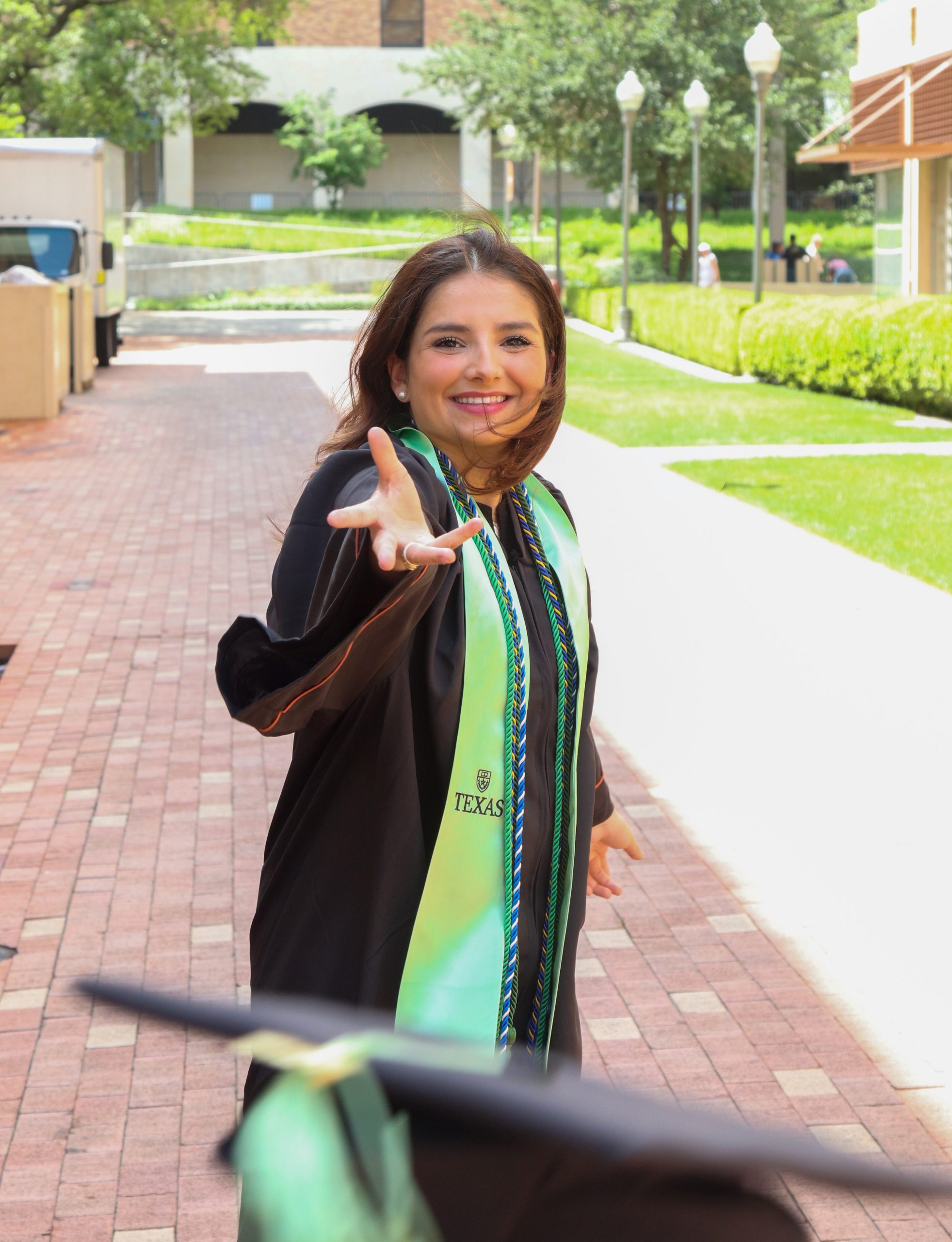
Law of the Land
Sofia White
B.A. Geological Sciences
Early on in her time at the Jackson School, Sofia White realized that research and field work weren’t for her. Still, she loved learning about the Earth and its processes. After speaking with representatives from a few companies at Jackson School career fairs, she learned that earning a law degree could complement a geosciences degree well. And while working an internship at Chevron, she learned more about the specific career avenues for a geoscience and law degree combination. Come August, White will be embarking on this path at Texas Tech University’s School of Law. She aspires to negotiate and structure leases for drilling and acquiring mineral rights.
Q: How do you plan on using your geosciences knowledge — either in law school or once you graduate from law school?
A: At Chevron, I saw how everyone was intertwined — geologists, geotechnologists, landmen, attorneys. I was a geotechnologist intern, and geotechnologists were my mentors, so I saw firsthand how to make maps for the landmen, and saw how the different professions connect. A lot of the landmen have law degrees. So, say I wanted to become a landman — I could make my own maps. I have those skills. Also, when I work with geologists, I’ll understand what they’re talking about.
Q: What are you going to miss the most about the Jackson school?
A: The closeness. I come from a small town, and I had heard about how cutthroat other schools are. Jackson is competitive, but we help each other. We all have to survive together. I liked that, and how approachable professors were. I remember my first year, they wanted me to call them by their first name. I did not. I couldn’t do it. “You have a Ph.D. I’m not just calling you by your first name.”
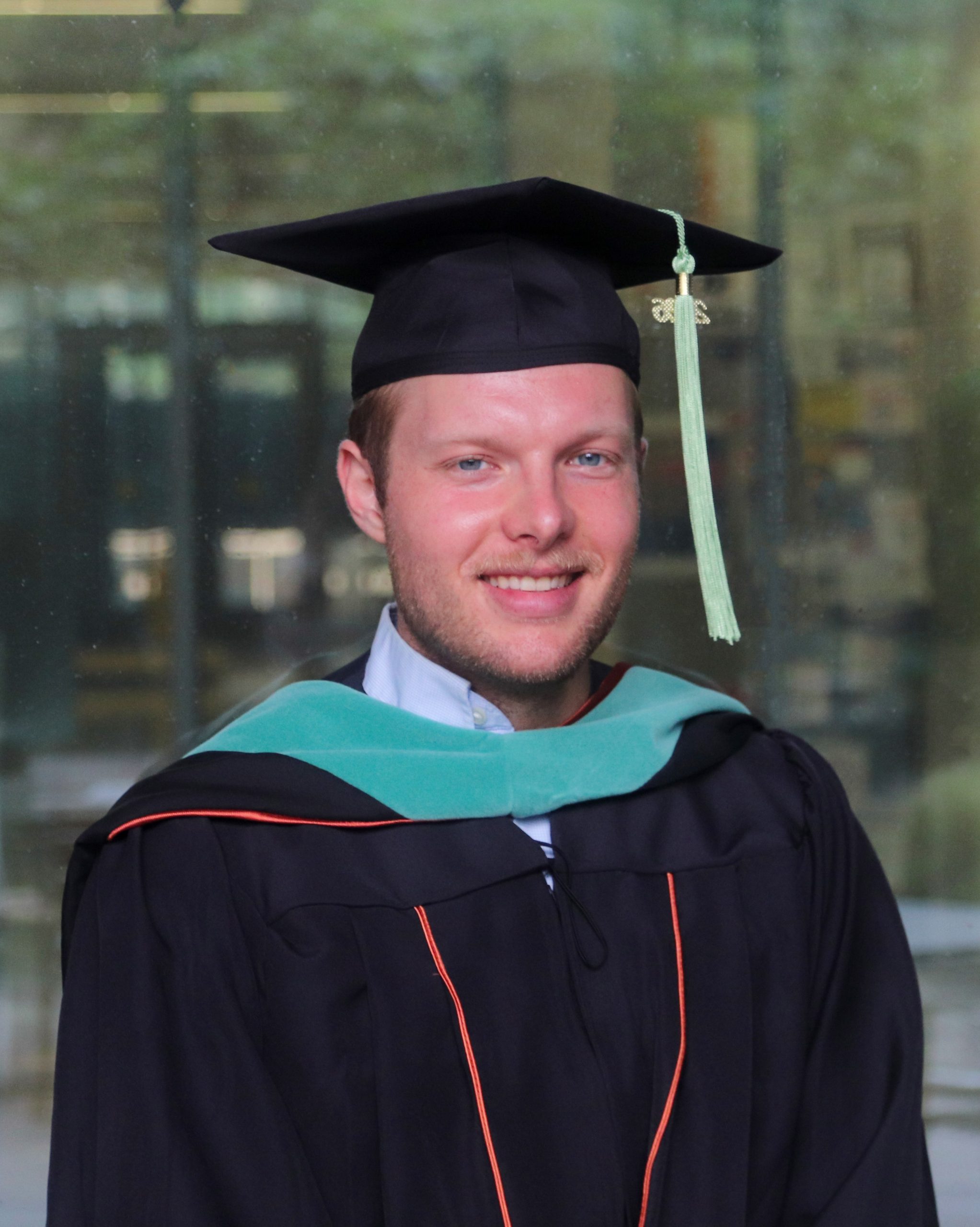
Predicting Electricity Use with Machine Learning
Christian Fogerty
M.S. Energy and Earth Resources
Not long after moving to Austin in 2020, Christian Fogerty became interested in studying energy and climate. Then, after witnessing Winter Storm Uri devastate Texas’ power grid, he began to research graduate programs where he could focus his education on energy with an interdisciplinary approach. Fogerty landed on the Energy and Earth Resources program, where he went on to study how machine learning forecasting impacts decision-making and organizational structures in the electricity system. After graduation, he’ll be starting a new job at an artificial intelligence energy startup called Halcyon, where he’ll be working on a platform energy professionals use to research regulatory data.
Q: What got you interested in studying AI forecasting for the electric grid?
A: Well, in the first semester, I took a course in AI, and that was when AI started taking off in a really hyped kind of way. And I think it’s a mix of over-hype and under-hype. I realized that this was going to be my time to study and understand this material, because it’s going to be really important when I graduate and for the rest of our lives.
Machine learning forecasting is basically just using advanced statistical methods to forecast things like: What’s the generation output of a solar farm going to be tomorrow? Or what’s the demand of the Jackson School? What’s the electricity demand going to be in a week from now? And there’s all sorts of little use cases like that in the electricity system.
Q: What was your most memorable experience in your two years here?
A: I got to go to Germany during the summer last year for an exchange program. It was at the Technical University of Munich, and it’s called the Sustainable Transitions Exchange Program. I got to take a couple courses on energy economics in Europe and climate policy and travel a bit around Europe. And I also learned German — or tried to learn German.

Refining Weather Models — from Noah to NOAA
Harsh Kamath
Ph.D. Geological Sciences
Doctoral student Harsh Kamath has spent his time at the Jackson School working to improve land surface models, which simulate interactions between the land and the atmosphere to predict weather events. Specifically, Kamath has been working on the Noah-MP model, which Jackson School Professors Liang Yang and Dev Niyogi developed in 2010. In the coming weeks, Kamath will be moving to Boulder, Colorado, to start a job as a research scientist at the other NOAA — the National Oceanic and Atmospheric Administration — where he’ll be continuing his work on the Noah-MP model.
Q: What is it about studying the Earth system that appeals to you?
A: It’s fascinating, first of all. These are the processes of what we experience every day. It’s also an immediate win situation for me, because we forecast something and then we see whether it works out or not.
The other thing that I like about this is that there are some unresolved problems from the 1950s, 1960s that people are still working on, and I’m one of them. With the Noah-MP model development, it is just one step forward. It’s a better model compared to what we had, but it’s still not there.
Q: What will you miss most about the Jackson School?
A: I really enjoyed the campus, and because I come from India, I really like this kind of climate — hot and humid. And I like staying after hours. That’s where most of my work happened. A bunch of my friends and postdocs here — we used to have a lot of intellectual discussions. And then we used to walk and get our dinner and come back to the Jackson School and work until late at night, sometimes until 12 or 1. I will really miss that part.
The University of Texas at Austin
Web Privacy | Web Accessibility Policy | Adobe Reader