
The Big
SIP
The Jackson School's new plan for investing in bigger, bolder science
By Anton Caputo
It’s been 20 years since Jack and Katie Jackson gave their life’s fortune to create the Jackson School of Geosciences. Their charge was to be great and make a difference.
During the two decades since, researchers at the distinct units that make up the school — the Bureau of Economic Geology (BEG), the Department of Earth and Planetary Sciences (EPS) and the Institute for Geophysics (UTIG) — have worked toward that goal, building one of the top geosciences schools in the country.
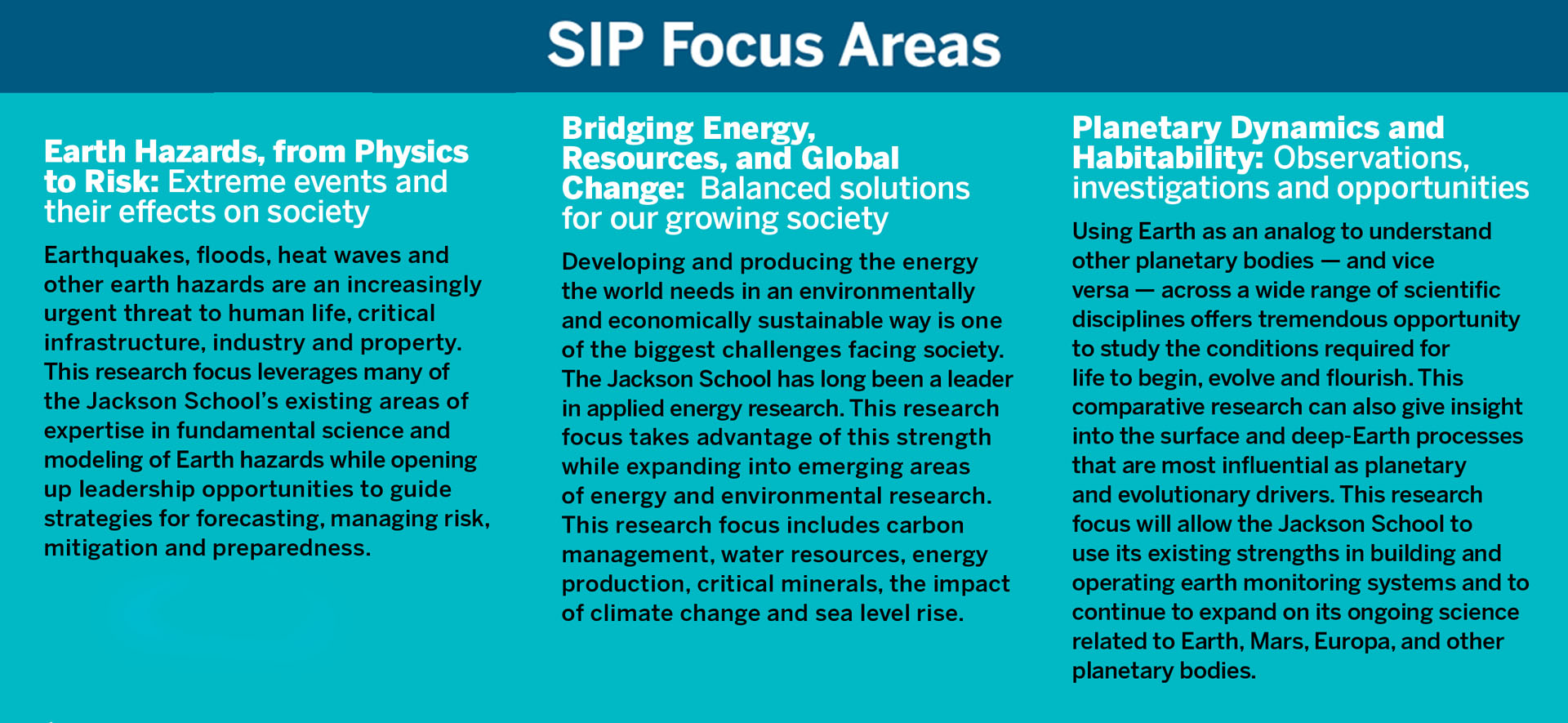
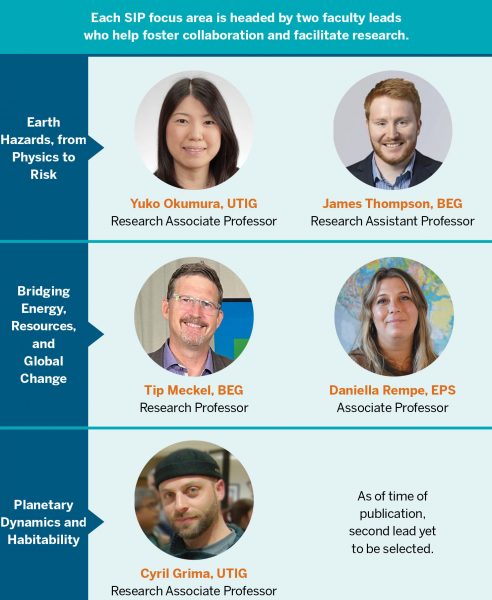
To take the next step, the Jackson School has launched a new $1 million Strategic Investment Plan (SIP) to better align those efforts and foster collaborative, interdisciplinary research to tackle three issues of major relevance to society:
- Earth Hazards, from Physics to Risk
- Energy, Resources, and Global Change
- Planetary Dynamics and Habitability
The bold move comes as the nation’s research funding environment is being radically changed, and the school is welcoming a new dean. Jackson School Associate Dean for Research Michael Young sat down with Communications Director Anton Caputo to discuss the SIP and why this is a perfect time for the effort.
What is the SIP?
The idea behind the SIP is to organize ourselves to do great science around our strengths and along common themes of research that are already being conducted across the school. The Jackson School has a distinct advantage because of the size and the breadth of science that can be done here. It’s a place for people looking to do meaningful science to partner and invest. So, the SIP takes advantage of what’s here and moves it toward a common goal. It’s not a research proposal, but a plan of tactics to lead in the areas of geosciences that can help solve the biggest challenges facing society. Ultimately, we want to elevate science to make a real difference.
The three focus areas are geohazards, energy, and planetary dynamics. How did you come up with them?
We focused the discussions on what the Jackson School’s individual units (the Bureau of Economic Geology, Department of Earth and Planetary Sciences and Institute for Geophysics) identified in their own strategic plans, and what they want to emphasize in the future. We took those plans and found common areas of interest so all the units could be involved. And really, we wanted to focus on areas of research that are relevant to society — big issues where we can help lead the charge to find solutions.
If the Jackson School already works in these areas, how will the SIP help?
We specialize in many areas of geosciences at the Jackson School, but we can leverage them further by combining them. By bringing these research areas together, we can help better define the questions that need to be solved and then contribute to solving them. This is really an effort to make science more effective and relevant. For example, if we focus on understanding the physics of geohazards, we will be able to do a better job of understanding and forecasting the downstream impacts on communities and infrastructure. We have lots of people doing great work on geohazards, very huge strengths in geodynamics and solid earth and earthquakes. We do a lot of work on extreme climatological events, droughts, floods, hailstorms, things like that. We have several faculty working on wildfires and erosion events and things of that nature. But we haven’t really put them together. The school has been around for 20 years, but it tends to be kind of siloed between the three units. Even though we’re all geoscientists, there are still significant differences in the way that the three units operate, and these differences keep them from collaborating as much as we would like. What we have done with the SIP is help enable collaboration across the units, as well as across UT and other institutions.
You’ve allocated $350,000 for each of the SIP areas. What is this funding for?
We felt that another strategic plan without money behind it was just going to end up on a shelf. We thought, “Let’s put some real money behind it and use that as a way of exciting people.” It brings the units together, and it sends a very strong signal outside of the Jackson School that even in times of turmoil, we’re not going to sit back and do nothing. We know that $350,000 is not enough to do lots of research, but it’s enough to hire a postdoc and do very targeted types of things — workshops, bring in a faculty member or researcher from off campus for three or four months, hire a program coordinator. All of those things could be necessary to enhance the research and reduce the bureaucratic drag and speed bumps. There are bureaucratic and administrative hassles to doing research. We all know this, but we don’t want the faculty to have to deal with those, because that burns a lot of creative energy. So, we are helping to build administrative structure surrounding these teams to make it as easy as possible for them to be creative as they build out these research areas.
How will you judge success?
That’s a good question and a hard one to answer because success comes in different ways. Let’s say in the end we publish some synthesis papers or maybe some journal articles that really try to redefine the science. OK. Maybe we get some proposals approved — great. Maybe we have a better understanding of each other and have more respect for each other’s research and our research units — that’s great too. If we suddenly get a $10 million grant to build a Science and Technology Center, yep, check. That’s good. And if we help to set an example for geosciences and other universities, check. That’s great.
Ultimately, we’ll have to see if we can redefine the science and build stronger connections to other stakeholder groups that we didn’t have before, not only in the Jackson School, but elsewhere across our campus and in other campuses. And if other schools look at what UT is doing and take a cue from it, to me, that would be amazing.
As you said, this is a difficult time for research funding. Is this the time to roll out something new like this?
Why do this now? Because we can. And because during times when funding is uncertain is when we focus on leaning forward, so we are years ahead of the game when the funding cycle returns.
Years ago, I was at a meeting with the university liaison lead for a major oil company. And they had just made a large donation to UT to do research in topics that they really weren’t focused on. They were interested in topics that were outside of their traditional upstream, midstream and downstream businesses. And we came up with several ideas — geothermal, global water issues. Lots of different things. I asked the liaison, “Why are you doing this now with oil at $50 a barrel and lots of surplus?” And they told me that the company waits
for the bad times to invest in research so that when the cycle reverses, they are ahead of everybody else. So really, whether we’re in good times or not, this is something we should be doing, but especially now.
Finally, the Jackson School is about to undergo a change of leadership and welcome a new dean. Does that make the timing of the SIP more difficult?
We really feel that a new dean is going to look at the SIP and understand that it’s the right thing for the Jackson School to do. But this is not a finished process, and the door is open for new ideas. These topics are fairly obvious given where we are societally, but there are opportunities for the new dean to tweak or add however he or she wants to.
The University of Texas at Austin
Web Privacy | Web Accessibility Policy | Adobe Reader