

GATEWAY TO
GEOSCIENCES
Most undergraduate students have little familiarity with geosciences.
That’s changing thanks to one of the Jackson School’s fastest growing majors: environmental science.
BY JULIA SAMES
O
n a sunny Monday afternoon in late March, 40 students stand knee-deep in the cool waters of Upper Barton Creek. Notebooks in hand, they shuffle through the water in waders, fumbling under the surface for pebbles to catalog their size, and measuring the creek’s lethargic movement with portable flow meters.
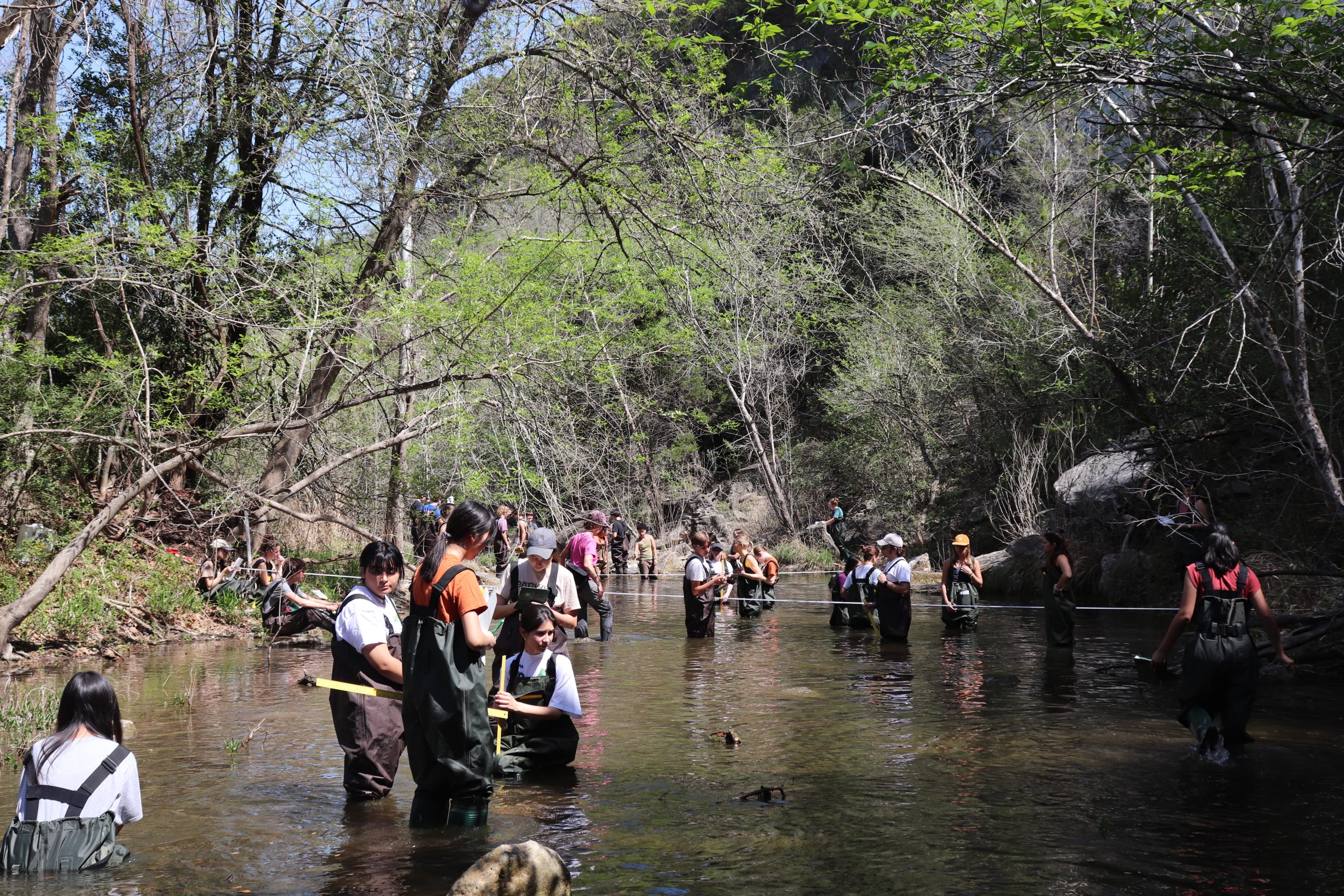
For most of these fledgling environmental scientists, this is their first time using this kind of field instrument. It makes the experience of EVS 311: “Field Seminar in Sustainability” all the more memorable.
The course drops students in the middle of natural areas all around Austin — Lost Pines, Mirasol Springs, Waller Creek and Bull Creek, to name a few — and emboldens them to observe and analyze their surroundings through the eyes of a researcher. It’s a required introductory course of all environmental science students, and it’s often remembered as a favorite.
That’s certainly the case for Rachel Breunig, who took EVS 311 nearly 10 years ago when she was a novice geoscientist. She is now a doctoral student at the University of Wisconsin-Madison, where she is studying the feedbacks between rock, water, and life in the Earth’s shallow subsurface. This research could help scientists better understand the distribution of water resources and nutrients in a landscape.
“I wouldn’t have found my home in geosciences if I hadn’t had the introductory experience through environmental science,” Breunig said. “Through the way the classes were set up, they really nourished my curiosity, they allowed me to have safe independent research experiences, and they taught me that I have the ability to address hard questions.”
Breunig is one of the hundreds of students and counting who have found their pathways to the geosciences through the school’s environmental science major.
The major is interdisciplinary, shared between three colleges at The University of Texas at Austin: the Jackson School of Geosciences, the College of Natural Sciences and the College of Liberal Arts. Each school has its own environmental science (EVS) track: geosciences, biological sciences and geographic sciences, respectively.
During the past five years, the once-small program has become one of the most popular degrees in the Jackson School. The number of students majoring in EVS Geo has soared from 28 in 2019 to 109 in 2024. These students now make up about a third of the Jackson School’s total undergraduate enrollment.
Students have long cared about the subjects covered in an EVS Geo major: clean water, clean air, mitigating environmental pollution, and determining the environmental response to climate change. And there’s a growing demand for workers with knowledge and skills in these areas, from environmental consultants to municipal water managers to corporate sustainability directors.
However, according to EVS program director and associate professor Tim Shanahan, there historically has been a disconnect between students’ interest in environmental science and their awareness that many of these topics are rooted in geosciences disciplines.
“I think a lot of the people who do environmental science or who are interested in these kinds of problems — they don’t realize these things are taught in geoscience departments,” Shanahan said. “Much like how people don’t understand that climate science is part of geoscience, and that water resources and hydrology are, for the most part, geoscience.”
The situation is changing thanks to a recent revamp of the EVS program led by Shanahan. The intent of the curricular update is to expose EVS students to the nuances of the different tracks as first-year students, thus enabling them to get a clearer picture of which skills, academic subjects and career paths fit with each track.
Armed with this experience, students are now flocking to EVS Geo, and the geosciences in general.
GROWTH SPURT
Shanahan’s strategy to incorporate more experiential learning in the EVS introductory courses is in direct response to what many in the field see as a historic gap in exposure to the geosciences at the K-12 level.
Most students leave high school with a firm grasp of what biology, chemistry, physics and engineering are, but a hazy understanding of the geosciences, even though they are at the heart of many issues that young students care 49 college, the Jackson School’s environmental science major seemed like the strongest choice, and its interdisciplinary curriculum has been a great fit for her. about. Most of the students on the EVS 311 field trip were lucky to have been introduced to environmental science in high school through an Advanced Placement course. Over and over again, when they were asked what brought them to this major, this was the refrain: a really great AP Environmental Science class. One student said it was the only high school class they actually liked.
Some students, after being properly introduced to the geosciences through the EVS program, decide to pivot to a deeper geological specialization within the Jackson School. This is a secondary benefit of having built up the EVS program: higher retention overall in the geoscience majors.
“Maybe they stay in EVS. Maybe they go into traditional geology or hydrology or climate system science,” Shanahan said. “All those things are linked to their environmental interest.”
That’s exactly how Will Eagle, who was once pursuing an EVS Geo major, switched to general geology during his third year.
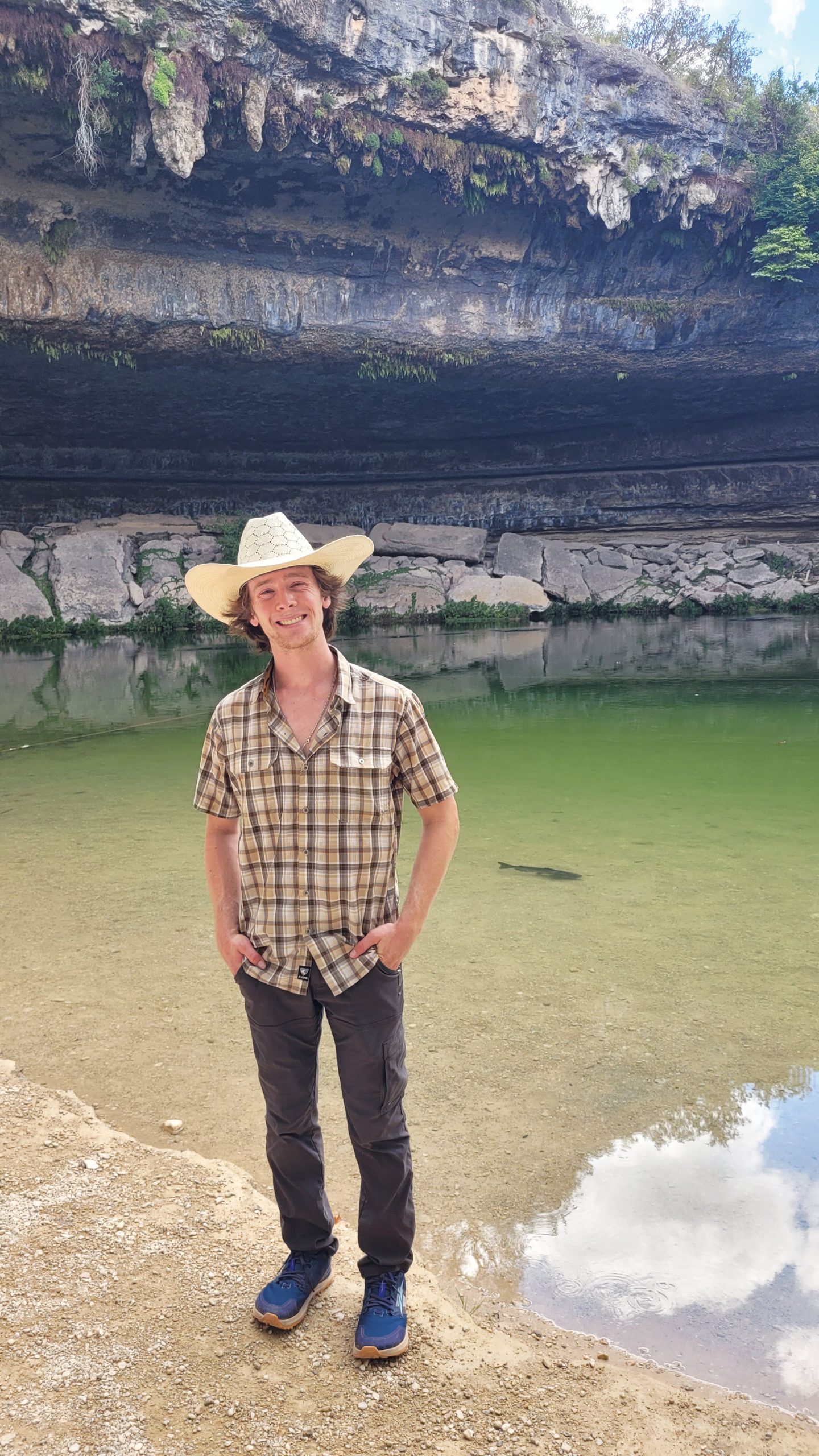
As Eagle chipped away at his EVS degree, he realized some of the required courses for the major weren’t really of interest to him. In order to develop well-rounded environmental scientists who can advocate for their work and collaborate with colleagues across disciplines, students are required to take interdisciplinary courses such as ecology and economics. Eagle realized he would rather be taking aqueous geochemistry and structural geology. And with the classes he had already completed by his third year, he was just as far along toward a general geology degree as he was an EVS degree.
“I was like, ‘Well, I’m already doing everything that a geology student does. Why don’t I just do a geology degree?’” Eagle said.
After graduation, he sees himself doing hydrogeology work or perhaps continuing his studies in graduate school. Regardless, his underlying motivation remains the same — he wants to be a force for good for the Earth.
Whether an EVS Geo or general geology major, Dean Claudia Mora said the goal in the Jackson School is for students to find the right path for their interests and ensure they have the skills to succeed professionally in that path.
Breunig said she values the interdisciplinary education she received through the environmental science program.
“At the end of the day, the rocks are important — we get many resources out of them. But the reason why we study geology is ultimately to support human life and a broad, biodiverse community,” she said. “I think it’s very beneficial to have that background biological knowledge.”
The popularity of EVS Geo has been great for students and has helped the Jackson School buck the national trend of shrinking geoscience programs. But it has come with some growing pains.
The 40 field explorers wading through Upper Barton Creek were only half of the students enrolled in EVS 311 last spring. The other half of the class was in the lab that day, going over measurements from their own f ield work during the prior week. The two cohorts alternate between the field and the lab because there aren’t enough waders, vans or teaching assistants to drive 80 students around every week.
And this is just the beginning. EVS students are required to complete a capstone project for their degree, which requires mentoring and one-on-one time with professors who have jam-packed schedules. The capstone project is a formative experience for EVS students. According to Breunig, her capstone — examining weathering indicators in interbedded systems in Northern California under the mentorship of Associate Professor Daniella Rempe — played a critical role in clarifying the specific field of study most interesting to her.
To help alleviate some of these stress points, the school hired Tony Hollenback, an environmental chemist and assistant professor of practice, to help teach some of the introductory EVS and GEO classes. He has also been tasked with maintaining and organizing much of the department’s EVS f ield and laboratory equipment, and acting as liaison between faculty members and EVS students as they work on their capstones.
Danny Stockli, chair of the Department of Earth and Planetary Sciences, noted that during the past few years especially, environmental science students have become much more enmeshed with the rest of the geosciences students at the Jackson School. T hey are taking geosciences courses, working with Department of Earth and Planetary Sciences professors and research groups, attending department lectures and events, walking across the graduation stage with the rest of the Jackson School students, and hanging out in the preeminent geosciences gathering spot — the Jackson School’s patio — along with all the other geosciences students.
“EVS has gone from a semi-orphaned, small interdisciplinary program to a much more integrated program that both the dean and I push very hard,” he said. “I think EVS and GEO are one community at this point, which is really positive to see.”
CAREERS THAT MATTER
Crystal Alao, a third-year EVS Geo student double majoring in African and African Diaspora studies, was a nature-loving Girl Scout and camping-enthusiast as a child. She remembers what first piqued her interest in this subject — an environmental scientist who visited her troop to teach them about air pollution. Alao got a badge, and she was hooked.
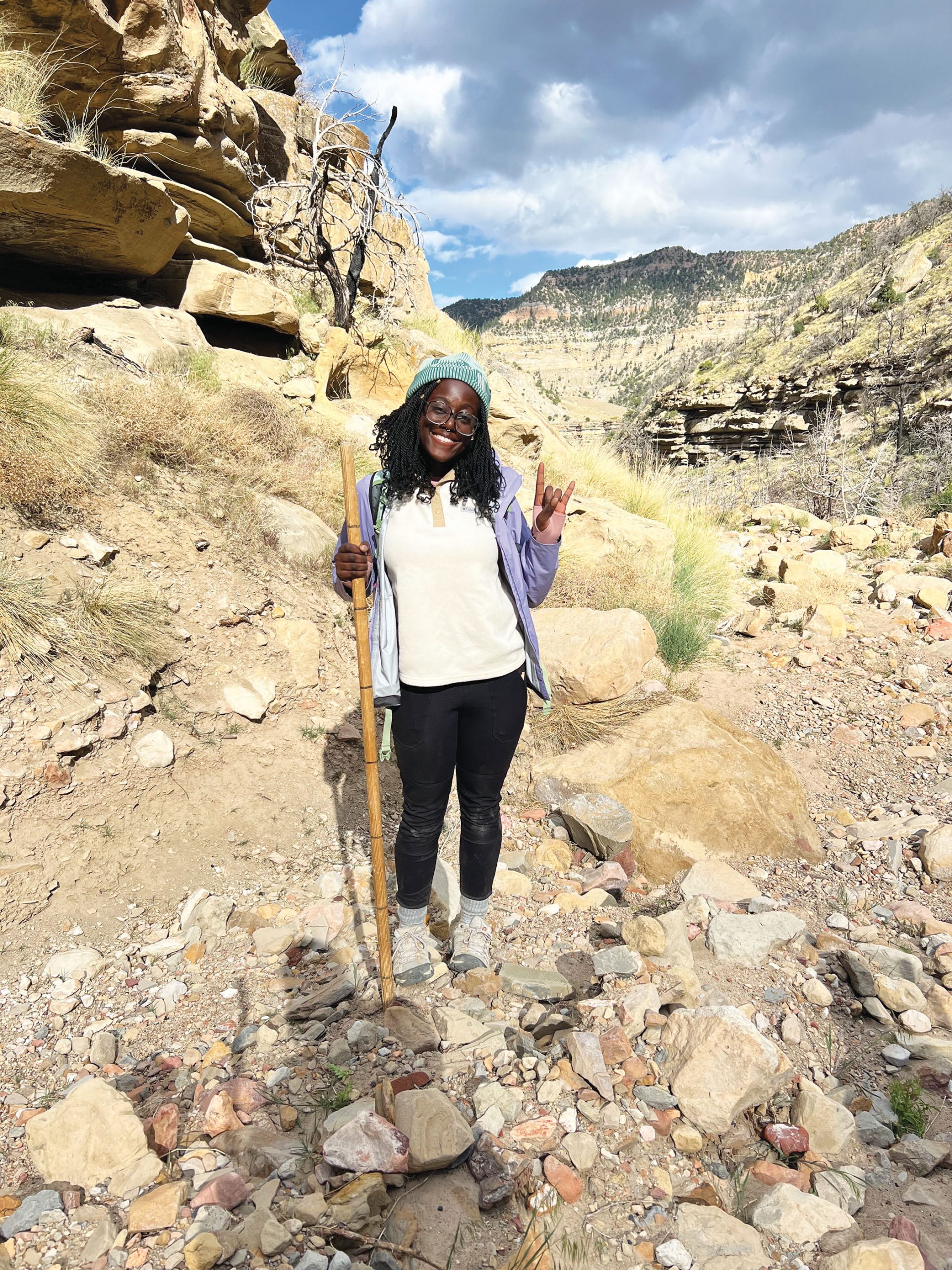
When it came time to apply to college, the Jackson School’s environmental science major seemed like the strongest choice, and its interdisciplinary curriculum has been a great fit for her.
“I’m learning everything. I know physical geology, hydrology, human geography and physical geography. I feel like I’m learning so much more than I would have thought I would, and it’s helped me frame what I want to do in the future,” Alao said.
She came to the Jackson School thinking she would graduate and go into environmental consulting. But Alao has learned how much she loves working in the field and, through an internship with the City of Austin’s Youth Forest Council, realized that she was passionate about education. She now plans to go to graduate school with the goal of becoming an environmental science professor.
Jobs in assuring clean water, clean air and a healthy environment — jobs that drive personal fulfillment and take on critical issues — align with the values of Generation Z writ large. And these are the kinds of jobs that flow naturally from a geosciences education, be it focused on environmental science or traditional geology.
A great example of that impact is developing in the Jackson School’s EVS Geo and hydrology programs, which were boosted by a $1 million donation from an anonymous donor (see story, page 66). That gift will support student field research in regional hydrology and internships in Texas state agencies that are responsible for managing our water resources. Students will help build public online dashboards to help Texas communities better understand and manage their water resources.
“Our job is to ensure that regardless of the path they choose, Jackson School students will be prepared for the challenges of the future,” Mora said. “Building up the next generation of energy and resource geologists, environmental scientists, hydrologists, climate scientists — that’s why we’re here.”
The University of Texas at Austin
Web Privacy | Web Accessibility Policy | Adobe Reader