November 11, 2026
Science Y'all! staff writer Alex Watson highlights fieldwork done in the Sierra Blanca Mountains of West Texas by first-year Master's student Adrianna Martinez.
In my opinion, the best part of geology is the field work. There’s something amazing about visiting a site and witnessing billions of years of history with your own eyes. Every rock you pick up, every sample you take, is a clue that helps piece together Earth’s story. I love learning about the field work Jackson students are doing, and I recently spoke to Adrianna Martinez about her trip to the Sierra Blanca Mountains, a gorgeous West Texas range with untapped geologic mysteries—mysteries Adrianna hopes to help solve.

Adrianna is a first-year geology master’s student studying rare earth element deposits in the Sierra Blanca Mountains. She majored in Environmental Science as an undergraduate student but became fascinated with geology her junior year. In her last year, she dove headfirst into the field, taking as many geology classes as she could. She said finally getting the chance to conduct field work as a graduate student has been incredibly rewarding.
“For a while, I just felt like this was a field that I wanted to get into, and now I feel like I’m in it,” Adrianna said. “That has been such a shift for me in such a positive way, and now I just really want to contribute meaningfully.”
More than anything, Adrianna said she was thrilled to be in the field and experience the joy of being a geologist, tackling these mysteries alongside her team.
“Everyone in geology just really loves what they do. That was really sweet to see that play out while we were out there,” she said. “Even just hiking up this mountain, looking around to see if I find what I want to find. It was really hot, and it was kind of tiring, but I did love it. It was so cool to be doing something that feels so important.”
Adrianna’s passion for geology is clear in the way she speaks about her work. In the past, there has been extensive research on Round Top, one of five laccoliths in the Sierra Blanca complex. Geologists found that Round Top is enriched in heavy rare earth elements (REEs), making it an incredibly unique deposit. REEs are a valuable critical mineral used for everything from magnets to batteries to defense systems, and their production is considered essential for national security. Adrianna explained that light rare earth enrichment has been discovered in other parts of the United States, but until now, heavy rare earth production has mainly been concentrated in China.
“There’s an opportunity for the U.S. to gain a domestic supply of heavy rare earth elements specifically,” she said. “That’s why there’s a special interest in Round Top itself, but in general, there’s an interest in a couple of the other laccoliths that also share this enrichment story.”
Round Top has been heavily researched, but geologists know comparatively little about deposits in the other four laccoliths. Adrianna’s research seeks to fill in this gap in the mystery of the Sierras, specifically focusing on the mineralogy of Little Blanca. Geologists have performed bulk chemistry analysis at Little Blanca and found evidence of rare earth enrichment, but the mineralogy is not yet defined. That’s where Adrianna’s work comes in.
The magmatic composition of the laccoliths is unusual for a REE deposit. There is a high concentration of fluorine in the magma itself, which would have bound to the REEs and kept them suspended in the magma for longer, leading to higher enrichment than you would typically see with this kind of magma.
“It’s a very unique chemistry, and we don’t see this chemistry often, and we haven’t seen it in a heavy rare earth element enrichment process,” Adrianna said.
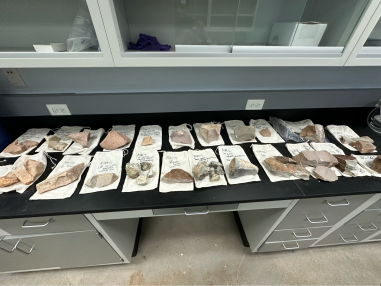
In September, Adrianna visited Little Blanca with her research team to survey the area and collect her first round of samples. She had access to previous geologic maps of the area, but for the most part, she was left to rely on her intuition as a geologist. Much of the fluoritization in the area occurs at the limestone-rhyolite contacts, and identifying these points required Adrianna to examine the texture of the rocks to see if they matched the description of rhyolite, putting her research into practice.
“I think I got kind of lucky,” Adrianna said. “I stumbled into this area where I could see that there was a fluorite vein, and I believe that vein was at one of the contacts.”
Adrianna said her goal for the first visit was to gather as much information as possible. She made sure to note the geologic features of the area and their coordinates, taking care not to overlook anything.
“You just want to be as descriptive as possible because as you’re going through a research project,” she said. “You don’t know what’s going to be valuable information until later, and then maybe all these things converge and there’s a pattern that emerges.”
After collecting the samples, the next step is to perform geochemical analysis and get a good look at the rocks under a microscope. Adrianna said the big question is whether the fluorite was present during the initial crystallization of the magma chamber, which would point to REE enrichment similar to that found at Round Top.
“I would love for it to be similar to Round Top because that makes my life easier, but also, if it’s different, that’s not a bad thing as far as future mining prospects,” Adrianna explained. “It just means that I might have to approach it differently, which would be cool.”
Regardless of what she finds, Adrianna’s work will provide crucial information for future mining projects, both in the Sierra Blanca complex and in the United States as a whole. Unraveling the mysteries beneath the laccoliths will allow us to better identify REE deposits in the future and determine the best way to extract these critical minerals. After a promising first trip to Little Blanca, Adrianna is excited for future field campaigns!