Student Opportunities
GRADUATE STUDENT RESEARCH OPPORTUNITIES FALL 2026
U-Pb & REE LA-ICP-MS depth profiling and mapping (Graduate)
Seeking motivated Ph.D. students interested in in-situ geochronology to pursue project in method development and application of laser ablation continuous mode or single-pulse U-Pb and REE LA-ICP-MS depth-profiling and mapping to constrain deformation and metamorphic histories of lower and middle crustal rocks. The UTChron Geo- and Thermochronometry laboratory houses two Element2 magnetic sector single collector ICP-MS instruments with a large-volume cell Excimer laser system, ideally suited for depth profiling and U-Pb and trace element split stream analysis and single grain mapping. The laboratory also houses a Bruker optical interferometric microscope to control laser ablation rates as well as a Raman system. The focus of applications is on method development and application to the exhumation of middle and lower crustal rocks in rifted margin settings and subduction settings.
Syn-kinematic Calcite U-Pb geochronology (Graduate)
Recent development of U-Pb dating of carbonate has made a lot of progress. We have been successfully dating microfossils, calcite cements, autigenic calcite/dolomite, vein fill, and fault-related synkinematic calcite growth. This project focuses on structural geology and calcite U-Pb dating of syn-kinemtic calcite along the Lewis thrust in Glacier National Park. This iconic thrust fault that place Precambrian strata over Creteacous foreland basin deposits and is characterized by sheared and faulted Precambrian carbonate along the main thrust plane. Directly dating the fault motion and placing it into a regional context is of fundamental importance for understand this evolution and thrust architecture of the Cordilleran fold-and-thrust belt in NW Montana.
UNDERGRADUATE RESEARCH OPPORTUNITIES – NOW
Origin of Libyan glass (impact) – it’s really cool tektite glass from the Egyptian sand sea that I have collected. The origin and timing is debated and totally enigmatic. We want to use He and U-Pb dating as well as geochem to shed more light on the timing and what impact structure this glass might be related to. This project will also involve CT scanning and SEM characterization of impact glass, followed by geochronology.
NOR-R-AM 1 and NOR-R-AM 2
Norwegian-Russian-North American collaboration in Arctic Research and Education
 FOR MORE INFORMATION CLICK HERE
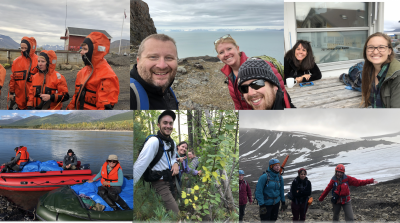
The Stockli research group is involved in a multi-national and multi-institutional Eduction and Research initiative in the Arctic with a focus of understand the tectonic and magmatic evolution of the Arctic and training the next generation of Arctic tectonicists. This initiative has offer the graduate students of the Stockli group numerous educational and research opportunities over the past few years. The group of scientists teaches annual short courses and courses through UNIS in Svalbard, as well as involved students and research in field research opportunities. The program is funded by the Norwegian NSF.
Recent activities and opportunities included, 2018 short course in Svalbard (Odlum & Kortyna), 2018 field work/trip to Verkhoyansk fold and thrust belt in E. Siberia (3 weeks, Flansburg and Robbins), 2019 Svalbard UNIS course (6 weeks, Poulaki and Ross), etc.
BLOG on Verkhoyansk trip by Megan Flansburg and Sam Robbins CLICK HERE
BLOG on 2018 Svalbard NOR-R-AM Short Course by Margo Odlum CLICK HERE