August 12, 2026
In Fall 2025, the Science Y’all! Editorial team sponsored free headshots at the GSEC general meeting. We wanted to share with you more about some of the students we saw there. We touch on not only their incredible work but their interests outside of the Jackson School in a series entitled “Research & Recreation.” This is the second in that series. For this installment, we focus on how much can change in a semester as a graduate student.
Discipline Tags: volcanology, modeling, remote sensing, hazard mitigation
Leah Cecchini’s drive is evident from the moment you meet her. This was true in November of 2025 during our initial interview, and even more so during our follow-up conversation in July. When I first spoke to Leah about her graduate research, she was working on a Master’s thesis focusing on how pyroclastic flow is affected by topography using tree fall data. It was clear from the outset that she was passionate about this work and ready to make the most of her time in graduate school.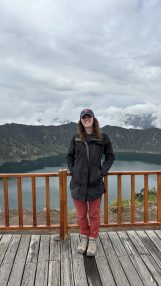
Back in November when I asked Leah about her plans post-Master’s degree, she was open to the idea of a PhD but unsure what she would look for in a program or where she’d be heading.
“The thought of finishing my Master’s is daunting,” she shared. “Should I take a break? Should I go straight in? Do I prioritize fieldwork? What’s the funding landscape going to look like in 2 years?”
On top of her questions, so much can change in a semester. Every experiment run, dataset analyzed, field trip taken, and conversation shared can change perspective…
In the 8 months since we last spoke, Leah has committed to staying on with Dr. Jim Gardner for a PhD. That decision was made official after a couple months of introspection and conversing with collaborators—but Leah knew her answer from the moment the offer was extended.
“I knew I loved the Jackson School. Undergrad taught me that. The first year of my Master’s taught me that I love the problem-solving aspect of research,” she reflected. “I love being independent and self-driven while also having the opportunity to collaborate with the incredible faculty here.”
Leah had mentioned in our initial interview that she was feeling the time crunch of a Master’s. I was curious if the decision to switch to PhD had alleviated any of that stress.
“Absolutely not. If anything, there’s more pressure. I’m more driven.” Leah has an incredible breadth of research she is excited about and set on sharing as much of it with the broader community as she can before she graduates.
Having gotten through the qualifying exam process myself back in February, I asked Leah how she was feeling about suddenly having to prepare for the exam as she transitions to a new degree path.
“I found out less than an hour ago that I’m taking my quals this spring, so not quite sure,” she said with a laugh. “I feel like I’m ready though—it’s just a matter of getting it all on paper.” She attributes her readiness in large part to the supportive community of fellow graduate students and her advisor here at Jackson.
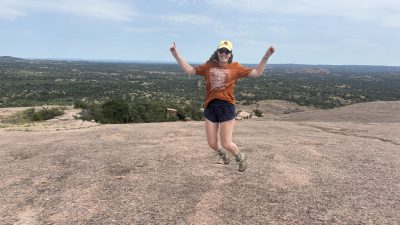
In November, I was curious what challenges Leah may be running into as she transitioned out of undergrad.
“The sheer amount of data is staggering. The management of it is my biggest challenge right now,” she shared. After wrapping up her first year as a graduate student, Leah says the challenge of data management is still there but now it’s more exciting than anything.
“It’s incredible. I have this unique data set and the opportunity to share it with, yes, the scientific community but beyond that as well.” She’s headed to AGU this December to present this work for the first time.
A key topic Leah and I connected on is the importance of scientific communication outside of your subdiscipline. Leah plans to use the third chapter of her dissertation to incorporate social outreach in collaboration with the Smithsonian Museum.
“I am honored that I will have the opportunity to share my work with a community outside of the sciences,” she said. “I think people don’t realize how diverse the geosciences are and how much of your everyday life is entwined with the work we do.”
Geoscience has been a part of Leah’s everyday life since she was a young girl learning about the eruption of Mount Vesuvius—a geologic event that she shared she would love to witness given an opportunity to time travel. “Not only is it infamous but it holds a special place in my heart for inspiring my dream of becoming a volcanologist.”
Leah’s drive extends beyond volcanic peaks. When I spoke with her in November, she was an active member of both intramural and league soccer teams, playing volleyball, and practicing guitar. But shortly after our November meeting, Leah tore the ACL in her right knee. I asked how this mandatory and unforeseen break from sports has shifted her work and personal life. 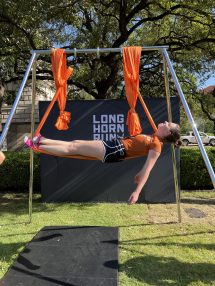
“Well, I finally gave myself time to pick up a book—imagine that,” she laughed. “It’s getting better every day. If anything, it has given me a mindset shift when it comes to how hard I’m working.”
Prior to the injury, Leah told me she found herself working 10+ hours some days. But the forced breaks of physical therapy have shown her that she’s capable of accomplishing her academic goals without spending all her waking hours in the office.
“I’ve definitely learned that the key is to average out your work rather than having these crazy high and low peaks.”
To wrap up our conversation, I asked Leah what message or advice she had for our readers. Back in November she had said, “push yourself beyond what’s comfortable. My greatest moments of growth came from the classes that were the most daunting.”
After finishing her first year of graduate school, her advice is this: “take a moment to step back and see how far you’ve come. Look ahead to where you’re going. Don’t miss the forest for the trees.” Apt for this volcanologist pushing the boundaries of how we reconstruct flow using evidence from tree fall.