Solution ICP-MS Sample Preparation Guidelines
Before submitting samples to the lab, please make sure that your sample preparation steps have considered all seven (7) guidelines below.
1. No particles
Samples must be free of particulates (gels, flocs, undigested crud) that could clog sample line tubing and the nebulizer. It is the responsibility of the submitter to ensure that proper filtration or centrifugation is performed in advance so that samples contain only soluble metals. Micro-nebulizer replacement costs are about $600.00.
2. Use sample tubes that fit in autosampler racks
15 mL conical bottom polypropylene test tubes and caps are good choices for ICP-MS, as they are less likely to contribute trace contamination than borosilicate glass. These also fit directly in autosampler racks for the ICP-MS, and can be easily cleaned in acid before rinsing in type 1 water and drying. Some recommended products are listed below.
- Polypropylene test tubes: https://www.fishersci.com/shop/products/evergreen-scientific-test-tubes-r-us-general-purpose-polypropylene-test-tubes-6/22043126
- Polyethylene stopper caps: https://www.fishersci.com/shop/products/evergreen-scientific-polyethylene-stopper-caps-12/0555517?searchHijack=true&searchTerm=0555517&searchType=RAPID
- 15mL falcon tubes are another good option (a bit more expensive): https://www.fishersci.com/shop/products/falcon-15ml-conical-centrifuge-tubes-5/p-193301
3. Keep sample vial labels simple and order by increasing concentration
To reduce the possibility of sample-to-sample carryover, samples are best analyzed in order of increasing concentration (e.g., blanks and controls first, then other samples). If unknown, blanks should be ordered before unknowns. We suggest using your initials as a prefix in this ordering ordering scheme (e.g., JD1, JD2, JD3, . . . ). Additional sample information (longer sample IDs) can be integrated with results, but please provide a sample sequence spreadsheet structured similar to below.
| Vial ID | Sample ID | Concentration/TDS |
| JD1 | longer description | lowest concentration samples |
| JD2 | longer description | higher concentration samples |
| JD2 | longer description | higher concentration samples |
4. Make dilutions in 2% HNO3 if possible*
It is highly recommended that sample solutions match conventional ICP lab standards (typically 1-2% nitric acid). The typical laboratory blank acid is 2% HNO3 (vol/vol from trace metal grade reagent), similar to the matrix of most calibration standards, and this acid may be used to make appropriate dilutions in our lab.
*Some elements are better analyzed in a different matrix. For example, Au and Hg are stable in a chloride matrix. We use 2% HCl (v/v) for these elements, or 2% HNO3+3% HCl (v/v) if other elements are to be analyzed.
5. Dilute samples so analyte concentrations fall within typical calibration ranges
Samples need to be diluted to fall within the calibration range, but above the limit of detection (LOD). The common ranges for many sample types are shown below.
| Element | High Cal Std (ppb) | LOD (ppb) |
| Na, Ca | 25,000 | <10 |
| Mg | 12,500 | <2 |
| Si | 10,000 | <3 |
| K | 6250 | <3 |
| P, B, Al, Fe, Li, Sr, Zn | 1000 | <1 |
| All others | 200 | <1 |
Semi-Quant Option: If you have no idea how to dilute your samples, or if you expect samples to have highly variable analyte concentrations, consider running samples separately by “Semi-Quant”. Semi-Quant requires analysis of a single standard and the unknowns. It provides a semiquantitative estimate of element concentrations across the AMU range and a TDS estimate from which dilutions for Quantitative analysis can be made. This approach can be most efficient (and least costly), as opposed to making and running multiple dilutions or having to redilute and rerun samples that had inappropriate initial dilutions.
6. Provide at least 5mL (preferably 10mL) of diluted sample
Our intelligent dilution autosamplers work great, but are “thirsty”. Our standard sample loop pumps 2mL of diluted sample per analysis. If there is a problem, a second (or even third) analysis may be required. A minimum of 5 mL of appropriately diluted sample is therefore requested. We can work with smaller volumes, but must bipass the intelligent dilution system. 5 mL is sufficient for two or more analyses using conventional sample introduction with ~400 µL/minute uptake rate, and also provides sufficient volume for making a matrix spike sample for quality control. We can also work with smaller volume samples (1 mL) using a microflow nebulizer with ~100 µL/minute uptake rate.
7. Dilute samples to ≤ 200 ppm TDS (ideally)
If you do not know the approximate concentration of your samples, it may be worth running a few representative samples over a range of dilutions (10,000 – 1000 – 100 – 10x) to see what works best. In cases where high and low concentration analytes are both of interest, running samples at two separate dilutions may provide the best results.
Conductivity meters can provide a rough estimate of TDS (expressed in ppm or µg/mL or mg/L) for natural waters. The relationship between conductivity and concentration is not standardized and may not be linear at high concentrations, but conductivity values (µS/cm) are roughly 1 to 2 times that of corresponding TDS concentrations (ppm).
- Saline samples – conversions are based on NaCl at ~0.5 ppm TDS per µS/cm; thus conductivities for diluted ICP-MS samples should be < 4000 µS/cm.
- Freshwater samples – mineral compositions including bicarbonates are ~ 0.6-0.7 ppm TDS per µS/cm; thus conductivities for diluted ICP-MS samples should be < 2860-3330 µS/cm.
Note that although samples with ~200 ppm TDS are safe to run on the instrument, your analyte concentrations in final dilution must be within the typical calibration range. For example, a CaCO3 digest diluted to 200 ppm TDS would have Ca concentrations far in excess of the typical high calibration range of 25 ppm. If Ca is an analyte, the sample would need to be further diluted to be < 25 ppm. In cases where major (Ca) and trace elements are desired, two separate dilutions may be warranted.
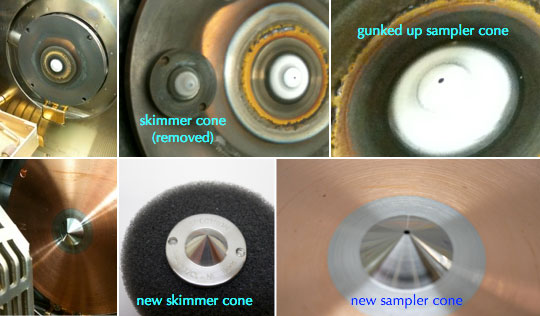
Why Dilute? It is important to dilute samples to minimize matrix effects that can affect the consistency of ionization in the plasma and focusing of the ion flux beyond the interface region of the ICP-MS. Both of these effects can affect quantification. It is also important to dilute samples so that the measurement conditions of the ICP-MS remain consistent throughout the analytical session. Analysis of high TDS samples can rapidly coat the sampler and skimmer cones with residues that can change orifice geometries and flow dynamics, and also constitute a source of contamination if partially ionized during the analytical session. The photos below show the effects of running high TDS samples on sampler and skimmer cones.
7. Plan quality control in advance
We are happy to provide recommendations for obtaining robust quality control, but it is ultimately the responsibility of the submitter to specify minimal quality control metrics (e.g., outside reference checks, replicates, and method blanks).
Method blank(s)
ICP-MS measurement is only as good as the quality of reagents used and cleanliness of contacting labware and sample preparation procedures. High and variable blank levels will adversely affect the quality (or uncertainty) of reported results. To improve accuracy and precision, steps must be taken to control the analytical blank and limit sample exposure to all sources of outside contamination (i.e., airborne contamination, contaminated acids & reagents, contaminated glassware and plastic ware, personal contamination). Because of the high sensitivity of ICP-MS, reagents used for lower sensitivity metals techniques may not be acceptable; depending on reporting limits required for common contaminant elements. Consider including a method blank(s) to evaluate contamination related to representative sample processing.
Matrix spike(s)
Consider including a matrix spike to evaluate matrix bias. A sample matrix that is significantly different from that of calibration standards may affect quantitative results. To evaluate and compensate for this possibility, unknowns spiked with known concentrations of an analyte can be measured to evaluate recovery efficiencies.
Unknown replicate analyses
Precision – to evaluate analytical and/or sample-related reproducibility requires replicate analyses of unknowns. Replicates of blanks, calibration control samples, and standard reference materials (SRMs) will generally be included, but replicates on unknowns must be specifically requested.
Certified reference material replicate analyses
Accuracy – requires checks of standard reference materials (standards, waters, rocks) for which there are certified compositions. We provide these for elemental standards and natural waters. Rock and other material reference standards require appropriate digestions, but may be available through the laboratory.