Proposal
Abstract
Shorebird (Charadriiformes) populations are declining globally due to their vulnerability to anthropogenic change. Increasing unpredictability in the abundance and timing of prey due to land use and climate change may threaten migratory shorebirds’ ability to acquire nutrients necessary for the intense physiological demands of migration and reproduction. Micronutrients such as Zinc, Copper, Selenium, Iron, Calcium, Sodium, and other elements can limit shorebirds’ reproduction if they are too scarce in the diet, while heavy metals can disrupt reproduction at high concentrations. Despite this, we lack any knowledge on the nutritional composition of shorebird prey, including whether different prey taxa vary in their concentrations of important elements. To determine whether the nutritional content of shorebirds’ arthropod prey varies across taxa, a method is needed to quantify the concentration of micronutrients and heavy metals in these prey items using ICP-MS.
Research Objective and Significance
Migratory animals are among the most threatened taxa in the world (Cooke et al., 2024). Anthropogenic changes such as land use and climate change intensify the challenges faced by migratory animals, which must meet critical nutritional requirements to move between distant habitats at specific times of year (Reynolds et al., 2017). Shorebird (Charadriiformes) populations around the globe are trending towards decline, as their long, energetically costly migrations and small overwintering ranges make them especially vulnerable to anthropogenic changes (Koleček et al., 2021). Despite widespread conservation concern for migratory shorebirds, our understanding of the nutritional challenges shorebirds face throughout their migration is lacking, which prevents effective conservation across their overwintering and breeding habitats.
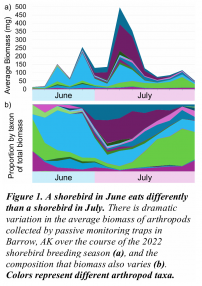
After migratory shorebirds arrive at their breeding habitat, they must acquire the majority of the nutrients to invest in reproduction. In addition to macronutrients (protein and fat), micronutrients such as Zinc, Copper, Selenium, Iron, Calcium, Sodium, and other elements can limit shorebirds’ reproduction if they are too scarce in the diet, while heavy metals can disrupt reproduction at high concentrations. Despite this, efforts to quantify the nutrition available to breeding shorebirds have previously only focused on the biomass and identity of invertebrate prey (e.g. McKinnon et al., 2012; Shaftel et al., 2021; Flemming et al., 2022), leaving a critical knowledge gap of whether different prey taxa vary in their nutritional content. Because the abundances and available biomass of different prey taxa vary over the course of the breeding season (Figure 1) and those timings vary year to year, the availability of nutrients to breeding shorebirds likely varies if different prey taxa have distinct nutritional profiles. I hypothesize that the concentrations of micronutrients and heavy metals will vary across arthropod taxa.
To determine whether the nutritional content of shorebirds’ arthropod prey varies across taxa, a method is needed to quantify the concentration of micronutrients and heavy metals in these prey items using ICP-MS. Analytes will include B, Ba, Ca, Cd, Co, Cr, Cu, Fe, Hg, K, Li, Mg, Mn, Na, Ni, P, S, Si, Sr, and Zn.
Review of Relevant Work
Various studies preparing arthropod samples for ICP-MS have digested arthropods in different ratios and concentrations varying from HNO3 only assisted with microwave digestion (Gohlke et al., 2025; Hansson et al., 2019), 3:2 v/v of concentrated HNO3 and H2O2 30% w/w P.A assisted by microwave digestion (Costa et al., 2020), and a 2:1 v/v solution of trace-metal grade HNO3 and H2O2 without microwave digestion (Prater et al., 2020). A study evaluating digestion methods for biological samples compared five methods including various combinations of acids (HNO3 only, HNO3 and H2O2, or HNO3 and H2SO4) and various digestion times and temperatures. The study found that digestions at low heat (85°C) were inadequate to fully dissolve all sample material. They concluded that the method that most effectively solubized fats, resulting in clear solutions free of precipitates, was combined HNO3 and H2O2 digestion for 24 h at 160 °C (Binder et al., 2018).
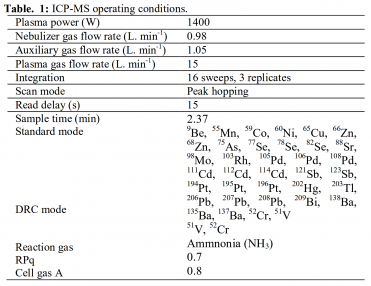
Because my analysis will be multi-elemental and focused on micronutrients important to animals, I reviewed two studies similarly focused on micronutrients important to humans, particularly Cu, Fe, Mn, P, Se, and Zn (Salau, 2014) and Be, Bi, Ba, Pb, Pd, Pt, Rh, Ni, V, Cr, Mn, As, Cd, Mo, Co, Hg, Tl, Sr, Sb, Se, Cu and Zn (Kira et al., 2014). Importantly, Kira et al., 2014 specified the CRC modes used for each analyte. Their operating conditions were as follows:
Salau, 2014:

Kira et al., 2014:
Materials and Methods
After sorting to the desired taxonomic level, invertebrates will be freeze dried and then separated into samples containing at least 1 mg dry biomass. Samples will be homogenized using a laboratory mixer and then digested using a solution of HNO3 and H2O2 for 24 h at 160 °C. The dry mass of each sample will be recorded in order to calculate the elemental concentrations per unit of dry biomass for each sample.
Operating conditions will be based off of Salau, 2014 and Kira et al., 2014. CRC modes for each analyte will be based off of Kira et al., 2014 (see tables above). However, because my sample matrices will be different from those in these studies, it is possible I will need to modify these methods to account for interferences unique to arthropod matrices.
To validate the method, insect standards, either BFLY-1 (black soldier fly larvae meal), KRIK-1 (cricket flour), or VORM-1 (mealworm powder), will be obtained from the National Research Council Canada (Holowaty et al., 2024).
Discussion of Possible Outcomes
For each element measured, concentrations will be compared across taxa using ANOVA to evaluate the hypothesis that elemental concentrations vary across taxa. A PCA will be used to visualize the similarities and differences in multi-elemental composition within and across taxa (Herzog et al., 2023). Significant differences in elemental concentrations between different taxa and tight clustering of multi-elemental composition will support the hypothesis that different taxa of shorebird prey have different compositions of micronutrients and heavy metals. This result will validate the need for further research into how the nutrients and contaminants in shorebird prey vary over time and in response to human activity.
Timeframe and Budget
All invertebrates will be sorted and freeze dried by mid-October and divided into the appropriate dry biomass per sample, digested, and diluted by November 6th. Five distinct taxa will be analyzed for their elemental content with three replicates for each taxon. This analysis will involve 15 unknown samples and at least once blank and one standard. The estimated cost of this analysis at $60 per microwave digestion and $20 per sample to run on ICP-MS is $1,240. Assuming each sample takes 1 minute to run, the estimated run time is a little over an hour, not including time needed for the instrument to warm up.