Proposal
Abstract
The Ivrea-Verbano Zone (IVZ) in northwestern Italy is a cross-section of lower crust and upper mantle that was uplifted from the base of the crust to the surface during the Alpine orogeny, where it is exposed today. The IVZ hosts ultramafic harzburgitic pipe intrusions that are mantle-sourced, and host complex metasomatic assemblages of hydrous silicates (e.g., phlogopite and amphibole) and Ni-Cu-PGE mineralization consisting of pyrrhotite (FeS1-x), pentlandite (Fe,Ni)9S8, and chalcopyrite (CuFeS2). The oldest pipe at Fei di Doccio, emplaced at ~277 Ma, and the youngest pipe at Valmaggia, emplaced at ~249 Ma, represent long-lived fluid and metal transfer from the mantle to the lower crust. Both pipes are characterized by two physical and chemical domains: the outer rim of the pipe that exhibits a higher degree of metasomatism and higher modal abundance of sulfide, and the inner core of the pipe that exhibits a lesser degree of metasomatism and lower modal abundance of sulfide. While the pipes host varying degrees of sulfide mineralization, they also host platinum-group elements (PGE; e.g., Ru, Rh, Pd, Os, Ir, Pt) in the form of platinum-group mineral-alloys (PGM; e.g., merenskyite) and as trace elements hosted within sulfide minerals. This project aims to develop a method using the PGE in pentlandite and associated phlogopite to determine the capacity and efficiency of mantle-sourced metasomatic fluids in transporting and mineralizing PGE. Using LA-ICP-MS, the two domains (rim and core) of the two pipes will be analyzed separately to determine 1) if pentlandite and phlogopite PGE analysis can be used to determine the efficiency of a fluid in transporting PGE, and 2) if analyzing the physical chemical domains (rim vs. core) can be a useful tool in determining fluid flow and PGE transport and entrapment in an intrusive body.
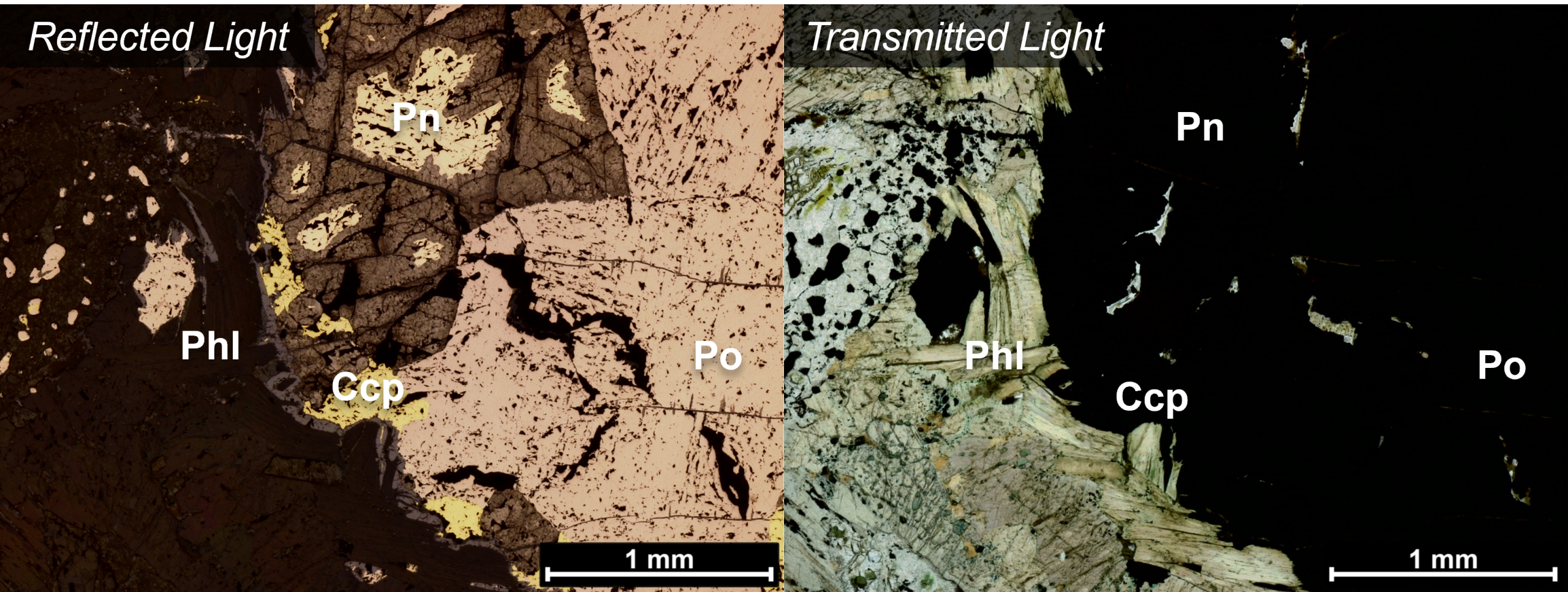
Figure 1: Reflected light (left) and transmitted light (right) microphotographs of characteristic phlogopite-sulfide relationships.
Po = pyrrhotite, Pn = pentlandite, Ccp = chalcopyrite, Phl = phlogopite.
gg
Research Objective
In metasomatic systems in which ore minerals are brought in via mantle-sourced fluids, determining the metal endowment and transport mechanisms of the source fluids as they cross the subcontinental lithospheric mantle boundary is critical. In this project, we aim to analyze base metal and platinum-group element (PGE) concentrations of pentlandite and phlogopite as a proxy to determine the metal endowment of the source fluid.
Ni-Cu-PGE magmatic sulfide deposits are important sources of critical metals. In many Ni-Cu-PGE deposits, PGE is commonly associated with platinum-group minerals (PGM) and pentlandite. Phlogopite is a high-temperature potassium phyllosilicate mineral that is commonly generated via metasomatic fluid infiltration. While phlogopite does not preferentially partition PGE, it does uptake trace amounts of Ni, an element that has a high association with PGE.
In this study, we will be analyzing pentlandite [(Fe,Ni)9S8] and phlogopite [KMg3(AlSi3O10)(OH)2] that are physically associated to determine 1) if side-by-side pentlandite and phlogopite PGE analysis can be used to determine the efficiency of a fluid in transporting PGE, and 2) if analyzing the physical chemical domains (rim vs. core) can be a useful tool in determining fluid flow and metal transport PGE in an intrusive body.
Statement of Significance
Platinum-group elements are of critical interest in the modern day due to chemical properties that make them excellent for use in electronics, vehicles, jewelry, pharmaceuticals, medical implants, and numerous other industrial uses (Zientek et al., 2017). However, Rudnick and Gao (2003) have estimated that the average composition of the upper crust contains ppb-levels of most PGE, making them extremely rare elements in upper crustal units. As you move progressively deeper in the crust to the mantle, PGE concentrations increase (Rudnick and Gao, 2003), making the upper mantle and lower crust promising PGE reservoirs.
This rarity in the upper crust means that exploration for PGE deposits and characterizing PGE-bearing deposits sourced from the mantle, but emplaced in the upper crust, are of extreme interest in mineral exploration. While the PGE concentrations in the ultramafic pipe deposits within the Ivrea-Verbano Zone are not high enough to be economically mined, the information gathered can tell us a lot about similar deposits that have richer PGE sources.
Establishing a relationship between the metasomatic fluids (represented here by the phlogopite mineralization) and the PGE in sulfides has the potential to develop and add to exploration methodology for metasomatic Ni-Cu-PGE deposits.
The following analytes are to be used for pentlandite: 57Fe, 60Ni, 63Cu, 82Se, 99Ru, 101Ru, 103Rh, 105Pd, 125Te, 189Os, 193Ir, 195Pt.
Fe, Ni, and Cu are major and minor elements within pentlandite and phlogopite. Fe specifically will be used as an internal standard for both mineral phases, while Ni and Cu will be used primarily as comparison elements as nickel especially has a strong association with other metals (e.g., Se, Te, PGE). Selenium has a high association with pentlandite, and S/Se ratios are commonly used to determine country rock interactions. Tellurium is a critical component in forming PGM’s, as Te combines with PGE to form tellurides, important sources of PGE for extraction. Higher concentrations of Te in pentlandite could point to a possible higher telluride potential in the sample as a whole.
Ru, Rh, Pd, Os, Ir, Pt are platinum-group elements and will be the main target analytes. 99Ru and 101Ru will both be analyzed due to the numerous metal-argon polyatomic interferences that are possible when analyzing Ni-Cu sulfides (e.g., 59Co40Ar+, 63Cu36Ar+ interference on 99Ru and 61Ni40Ar+, 65Cu36Ar+ interferences on 101Ru).
Review of Relevant Work
Geological Background. The Ivrea-Verbano Zone in northwestern Italy is a world-renowned cross section of the lower crust and upper mantle (Locmelis et al., 2016) that host to numerous types of intrusions, namely a series of metasomatized ultramafic intrusive harzburgite pipes that originally intruded into the lower crust. These ultramafic pipes host a secondary metasomatic assemblage of hydrous silicates and Fe-Ni-Cu-PGE sulfide mineralization. Previous studies of these pipes have determined that the metasomatic fluids that enriched the pipes in metals were sourced from the mantle (Garuti et al., 2001; Locmelis et al., 2016).
The Ivrea-Verbano Zone is a well-studied area. However, there is not a wealth of research on the Ni-Cu-PGE sulfide mineralization or the fluids responsible for the ore genesis in the area. Two pipes are the focus of this project: Fei di Doccio and Valmaggia. The pipes are intrusive harzburgites with varying degrees of metasomatism and Ni-Cu-PGE sulfide mineralization (Garuti et al., 2001). Fei di Doccio was emplaced ~277 Ma and Valmaggia was emplaced at ~249 Ma (Garuti et al., 2001; Locmelis et al., 2016). These two pipes represent the upper and lower bounds, respectively, of long-lived fluid and metal transfer plumbing systems across the mantle-crust boundary.
Methodological Background and History. Inductively coupled plasma-mass spectrometry was developed in the 1970’s and commercialized in the following decade. At first, only aqueous samples could be analyzed, introduced to the plasma by a nebulizer, but in 1985, Alan Gray published the first analysis of solid sample by laser ablation. This initial experiment cited three core problems with ablation of solid samples; ablation results in a very short time interval for sample to be introduced to the detection system itself, quantitative standards are difficult to obtain as a result of often highly variable sampling sites which may affect plasma conditions, and some deposition of ablated sample was observed on the aperture or surrounding mechanics. Today, many of these initial complications persist, though significant advancements in the field have been made. Additional constraints include the effect of pulse rate on signal stability and careful consideration of time-resolved data (Norman et al., 1996; Longerich et al., 1996). As described in Zhang et al. (2016), laser wavelength, energy density, pulse width, repetition rate, and single spot ablation times may all influence the accuracy and precision of data produced. Background gas species and pressure directly influence the plasma and ablated sample and must also be accounted for. Fractionation of the sample can also bias data and there are many calculations and models which can account for differentiation. Many experiments have shown good correlation between data produced from solution based and laser ablation ICP-MS (Liu et al., 2013). However, data reduction strategies vary significantly, and many studies describe multiple computer software systems and calibration curves that aim to reduce noise and bias in data (Paton et al., 2011; Paul et al., 2023).
One major problem with ICP-MS systems in general has to do with the production of polyatomic species and with volatile or refractory species produced by the plasma itself. For LA-ICP-MS, Eggins et al. showed that introducing a helium flow into an argon plasma significantly reduces the production of volatile and refractory species from the ablation process. Helium flow may also enhance the robustness of the plasma itself, yielding a higher temperature (Zhang et al. 2016). Introduction of small amounts of N2 or H2 may additionally increase sensitivity and reduce polyatomic ion yield (Liu, et al., 2013). Samples themselves may produce significant volatile ion species.
Additionally, the hole geometry that results from ablation of a sample may influence the amount of sample that ultimately reaches the sampling orifice. Lighter species may preferentially make their way through the sampling orifice while heavier species will fail to reach the analyzer itself. Resampling of ablated material has also been tested, as material condenses on both the sample itself and the sample orifice as a result of the ablation process (Woodhead et al., 2007).
For sulfide analysis, generally the lack of robust and reproducible reference materials has suppressed the overall accuracy of data. Additionally, sulfides and metal oxides themselves produce volatiles on ablation, which can interfere with the plasma.
Materials and Methods
Four thin section samples from two localities are selected for analysis in this study: two thin sections are from Fei di Doccio and the other two from Valmaggia. Each pipe is subdivided into two domains: the rim of the pipe, which has a higher degree of metasomatism and sulfide endowment, and the core of the pipe, which has a lower degree of metasomatism and lower sulfide endowment. Of these four thin sections, two mineral phases will be analyzed: pentlandite and phlogopite. As they are different mineral phases, we intend to run a separate spot analysis run for each phase. We aim to analyze five spots per mineral per thin section totaling 20 pentlandite analyses and 20 phlogopite analyses.
Major elements and internal standard 57Fe will be analyzed via electron microprobe (EMPA) in the Department of Earth and Planetary Sciences in the Jackson School of Geosciences at The University of Texas at Austin.
Target analytes will be analyzed via laser-ablation inductively coupled plasma mass spectrometry (LA-ICP-MS) in the Jackson School of Geosciences at The University of Texas at Austin. The LA-ICP-MS is equipped with an Excimer 193 nm laser coupled with an Agilent 8900 triple quadrupole (QQQ-ICP-MS). Potential tuning parameters for sulfide analysis with LA-ICP-MS follow Mansur et al. (2020, 2025) with a spot size of 75 microns, laser frequency of 10 Hz, dwell time of 10 ms, and a fluence of 2.5 J/cm2.
The following pentlandite analytes will be analyzed: 57Fe, 60Ni, 63Cu, 82Se, 99Ru, 101Ru, 103Rh, 105Pd, 125Te, 189Os, 193Ir, 195Pt.
The following phlogopite analytes will be analyzed: 57Fe, 60Ni, 63Cu, 82Se, 99Ru, 101Ru, 103Rh, 105Pd, 125Te, 189Os, 193Ir, 195Pt.
Data reduction will take place using Iolite (Paton et al., 2011). Coordinating Fe values taken from EMPA analysis will be used an internal standard for each sulfide analysis.
Three reference materials will be used for calibration: STDGL3, UQAC-FeS-1 and GSD-1G. STDGL3 is a LiB glass standard (Belousov et al., 2023), UQAC-FeS-1 is a synthetic sulfide standard developed in-house at the Université du Québec à Chicoutimi (UQAC), and GSD-1G is a synthetic glass developed by the USGS (Guillong et al., 2005).
Discussion of Outcomes
Using LA-ICP-MS, this project aims to develop a method using the PGE concentrations of fluid-phase minerals (e.g., phlogopite) and sulfides (e.g., pentlandite) to determine the efficiency of metasomatic fluids in transporting PGE from the mantle to the lower crust.
As the PGE concentrations of both pentlandite and phlogopite in these specific samples are not well-known, samples from the same deposits report varying PGE contents in 100% sulfide analysis (i.e., combining all sulfide minerals), with no PGE or chalcophile elements reported for phlogopite in previous literature. This study will be the first study in which these analyses are integrated, and also likely the first in which PGE contents of hydrous phlogopite in Ni-Cu-PGE sulfide deposits are explored. It is noted that the fractionation of PGE into phlogopite is predicted to be low (ppb-level), however, so low detection limits will be required. To mitigate low analyte concentrations, analysis parameters will be optimized to get the highest resolution out of the phlogopite analysis to get an accurate and highly sensitive metallographic profile from the phlogopite. Additionally, the occurrence of PGE in pentlandite alone is highly variable, so it is anticipated that the analysis of Ni, Cu, Se, and Te will have a secondary role as backup analytes in order to compare the chalcophile distributions in both pentlandite and phlogopite.
Proposed Budget and Timeline
Timeline. The timeline of this project will span from September 1, 2025 to December 11, 2025. Samples will be pre-ablated and analyzed during the first week of November. Analysis using LA-ICP-MS will take place in late November. Research results from this project will be presented to the greater scientific community on December 11, 2025.
Budget. This project will budget for no more than one day of EMPA work for both pentlandite and phlogopite major and minor element analysis totaling $500. Five hours maximum of LA-ICP-MS laser time totals a laser analysis cost of $325. As the samples are already prepared into thin sections and polished, there will be no incurred costs for sample procurement or preparation.