Methodology
Sample preparation
Seventeen Monterey Formation shale samples spanning ~3409–4311 ft were prepared for solution-mode ICP-MS/MS analysis. Samples were acid digested and diluted to reduce total dissolved solids and minimize matrix effects during nebulization and plasma ionization. Procedural blanks and calibration/quality-control standards were included throughout the analytical sequence to monitor contamination, instrumental drift, and analytical precision.
Rock samples were first powdered to a homogeneous fine grain size to ensure representative aliquots and to maximize dissolution efficiency during acid treatment. Each digestion batch included a method blank and a dissolved multi-element standard for monitoring contamination and batch reproducibility. Approximately 50 mg of powdered material was subjected to closed-vessel HF–HNO₃ microwave digestion to fully decompose silicate, carbonate, and organic components.
Post-digestion solutions were transferred to beakers and evaporated to dry on a controlled-temperature hot plate. The dried residues were reconstituted in 6N HNO₃, with sample masses determined gravimetrically before and after acid addition. Because Monterey shale commonly contains refractory mineral phases, samples underwent sequential acid dissolution when necessary: initial reconstitution in HNO₃ was followed by 6N HCl addition and heating to ensure complete solubilization of trace metals. Samples that retained persistent precipitates were subjected to an additional cycle of evaporation and acid treatment, including the use of dilute Aqua Regia, before final dissolution in HNO₃.
Sample Selection
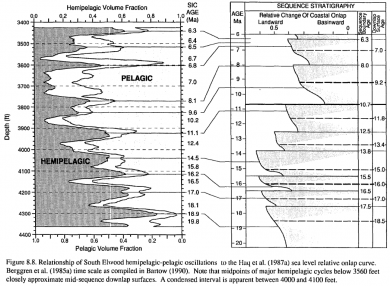
BW1) 4310.5 ft — just above Rincon–Monterey contact; phosphatic/hemipelagic band (boundary sample).
BW2) 4264.5 ft — phosphatic calcareous mudstone (phosphate-rich)
BW3) 4235 ft — organic, carbon-rich interval with hemipelagic peaks (TOC-rich target).
BW4) 4180.7 ft — to test for variability in hemi-pelagic peak
BW5) 4157.0 ft — lower edge of the package (transition).
BW6) 4092.7 ft — phosphatic calcareous siliceous mudstone (carbonate-rich condensed zone).
BW7) 4055.7 ft — mixed dolomite & phosphate pebbles.
BW7.5) 4038.6 — Provided as an extra test for digestion, pelagic comparative.
BW8) 4017.7 ft — interior of the condensed 4000–4100 ft zone (condensed zone representative).
BW9) 3929.3 ft — phosphatic mudstone (phosphate peak zone).
BW10) 3908.7 ft — TOC peak (high organic matter).
BW11) 3865.4 ft — quiet water background between hemipelagic clusters (pelagic background between events).
BW12) 3820.8 ft — mudstone with scattered phosphate blebs (good hemipelagic marker).
BW13) 3800.7 ft — top phosphate-rich bed below calcite-poor interval (transition).
BW14) 3707.4 ft — pelagic comparative
BW15) 3601.5 ft — pelagic comparative
BW16) 3408.8 ft — to test the rest of the unit
Certified Reference Material
SBC-1: USGS-SBC-1-IS_2022-508
Instrumentation and operating conditions
| Parameter | Value |
|---|---|
| Instrument | Agilent 8900 ICP-MS/MS |
| RF power | 1550 W |
| Plasma gas flow | 15.0 L/min |
| Auxiliary gas flow | 0.90 L/min |
| Nebulizer gas flow | 0.70 L/min |
| Make-up gas flow | 0.50 L/min |
| Spray chamber temperature | 2 °C |
| Nebulizer pump speed | 0.10 rps |
| Sampling depth | 8.0 mm |
| ORS modes | No Gas, He (3.0 mL/min), H₂ (5.0 mL/min) |
| Quantification | External calibration with internal-standard correction |
| Data output | g/t |
Plasma Stability and Sensitivity
Tune Report shows:
- Stable counts with RSD < 2% across masses 7, 89, 205 (p.1)
- Backgrounds = 0.000 CPS (p.1)
- Plasma settings: RF = 1550 W, Neb gas = 0.70 L/min, Makeup gas = 0.50 L/min (p.1)
These indicate extremely stable plasma conditions and clean backgrounds ideal for trace-metal analysis.
Oxide and Doubly Charged Ratios
- Oxide % (156/140) = 1.882% (from Tune Report, p.1)
- Doubly charged (70/140) = 8.343% (from Tune Report, p.1)
Values <2–3% (oxides) and <10% (DC) are considered excellent for shale matrices.
The elevated production of doubly charged ions likely resulted in significant spectral interferences on low-mass elements (P, Ti, V, Cr, Mn, Fe, Co, and Ni) due to overlaps from REE²⁺ species at half-mass. This production may have moderately affected Al as well.
Peak Shape and Quadrupole Alignment
Tune Report shows:
- Peak widths at 50% height: 48–0.56 amu (p.1)
- Mass axis alignment within ±0.05 amu (p.1)
This shows optimal mass resolution and centroid alignment.
Collision/Reaction Cell Parameters
Settings (Tune Report, pp.2–5):
- He Mode: He flow = 3.0 mL/min
- H₂ Mode: H₂ flow = 5.0 mL/min
- O₂ Mode: O₂ flow = 40%
- No-Gas Mode: Baseline ion transmission
Supports multi-mode analyte configuration.
Analyte Mode Configuration
| Analyte | Transition(s) | Mode(s) |
| Al | 27 → 27 | NG, He |
| P | 31 → 31; 31 → 47 | NG; O₂ (mass-shift) |
| Sc | 45 → 45; 45 → 61 | NG, He; O₂ |
| Ti | 47 → 47; 47 → 63 | NG; O₂ |
| V | 51 → 51 | NG, He |
| Cr | 52 → 52; 53 → 53 | He; He |
| Mn | 55 → 55 | NG |
| Fe | 56 → 56 | H₂, He |
| Co | 59 → 59 | NG |
| Ni | 60 → 60 | NG |
| Y | 89 → 89; 89 → 105 | NG, He; O₂ |
| Ba | 137 → 137 | NG |
| La | 139 → 139; 139 → 155 | NG, He; O₂ |
| Ce | 140 → 140; 140 → 156 | NG, He; O₂ |
| Pr | 141 → 141; 141 → 157 | NG, He; O₂ |
| Nd | 146 → 146; 146 → 162 | NG, He; O₂ |
| Sm | 147 → 147; 147 → 163 | NG, He; O₂ |
| Eu | 153 → 153; 153 → 169 | NG, He; O₂ |
| Gd | 157 → 157; 157 → 173 | NG, He; O₂ |
| Tb | 159 → 159; 159 → 175 | NG, He; O₂ |
| Dy | 163 → 163; 163 → 179 | NG, He; O₂ |
| Ho | 165 → 165; 165 → 181 | NG, He; O₂ |
| Er | 166 → 166; 166 → 182 | NG, He; O₂ |
| Tm | 169 → 169; 169 → 185 | NG, He; O₂ |
| Yb | 172 → 172; 172 → 188 | NG, He; O₂ |
| Lu | 175 → 175; 175 → 191 | NG, He; O₂ |
| U | 238 → 238; 238 → 270 | NG; O₂ (mass-shift) |
Internal Standard Performance Summary
![Ga[no Gas]](https://www.jsg.utexas.edu/geo392-f25-class-project-4ecrujiqes/files/2025/12/GaNo-Gas-400x214.png)
![Ga[o2]](https://www.jsg.utexas.edu/geo392-f25-class-project-4ecrujiqes/files/2025/12/GaO2-400x217.png)
![In[no Gas]](https://www.jsg.utexas.edu/geo392-f25-class-project-4ecrujiqes/files/2025/12/InNo-Gas-400x215.png)
![In[o2]](https://www.jsg.utexas.edu/geo392-f25-class-project-4ecrujiqes/files/2025/12/InO2-400x217.png)
![Re[no Gas]](https://www.jsg.utexas.edu/geo392-f25-class-project-4ecrujiqes/files/2025/12/ReNo-Gas-400x217.png)
![Re[o2]](https://www.jsg.utexas.edu/geo392-f25-class-project-4ecrujiqes/files/2025/12/ReO2-400x219.png)
The internal standards (Ga, In, and Re) all show tightly clustered signal intensities at their expected concentrations, indicating stable instrument performance and consistent ionization throughout the run. Signal levels shift between No Gas and O₂ modes as expected due to changes in plasma chemistry, but the internal standards remain highly reproducible within each mode. Overall, their stability confirms that matrix effects and instrumental drift were minimal, supporting high-quality quantitative data.
Mode Specific Linearity
Examples:
- 51→51 V [He]: R² = 0.9998 (from calibration graphic)
- 95→95 Mo [NG]: R² = 1.0000 (from graphic)
- 172→188 Yb [O₂]: R² = 1.0000 (from graphic)
- 238→270 U [O₂]: R² = 1.0000 (from graphic)
These confirm proper ion chemistry and mode selection.
Sensitivity & background performance
DL and BEC values extracted visually from calibration graphics:
- DL values typically 002–0.04 ppb
- BEC values generally <0.1 ppb
Those observations derive directly from numeric labels on your calibration images.
Analytical sequence
Blank → Calibration → QC → Samples → QC → Blank
Internal standard behavior
Source: multiple graphics showing Ga, In, and Re response stability.
Examples:
- 69→69 Ga [NG]: narrow scatter, no drift (from calibration graphic block)
- 115→115 In [H₂]: stable intensity (from graphic)
- 185→185 Re [O₂]: consistent response (from graphic)
These confirm minimal matrix suppression and successful drift correction.