Biography
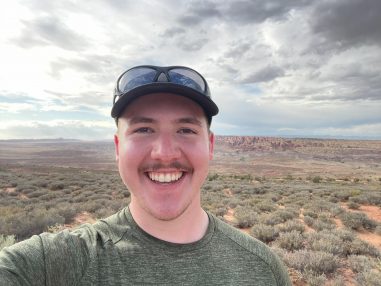
Eric Estrada
Eric is an undergraduate student in the Department of Geological Sciences at the University of Texas at Austin, pursuing a degree in Geological Sciences with a minor in Geography. He is a U.S. military veteran who brings experience in expeditionary fieldwork and strong leadership skills into his academic studies.
His current academic focus is on exploration geology, with an emphasis on identifying new zones for critical mineral acquisition. He uses Inductively Coupled Plasma Mass Spectrometry (ICP-MS), QGIS, ArcGIS Pro, remote sensing, and field methods to analyze geologic samples. Eric is also an FAA-certified remote drone pilot, applying unmanned aerial systems to geological mapping and remote sensing research. His coursework and projects integrate geosciences, analytical chemistry, and physical geology to build a comprehensive foundation in exploration geology.
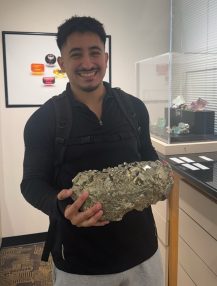
Brendan Wood
Growing up in the Dallas–Fort Worth area, Brendan Wood always had a curiosity about the natural world and how it worked, from the rocks in the backyard to the changing Texas landscapes. In high school, that curiosity turned into a more formal pursuit when he enrolled in dual credit courses. By the time he had graduated, he had already earned an Associate of Science degree, giving them a strong start in the sciences before even stepping onto a university campus.
At The University of Texas at Austin, Brendan chose to study general geosciences, a field that offered the broad perspective he was looking for. Courses in physics and chemistry, alongside their geoscience classes, have deepened his appreciation for the connections between natural processes and the analytical tools used to study them. This foundation has prepared him to engage with advanced analytical methods such as inductively coupled plasma mass spectrometry (ICP-MS), a technique that closely aligns with his interests in chemistry, physics, and of course, geology.
Known for a careful and detail-oriented approach, Brendan has not yet had the chance to work extensively in a laboratory setting, but feels confident in his ability to thrive once given the opportunity. With a strong academic background and a clear enthusiasm for connecting broad geoscience questions with technical analysis, he is eager to apply his skills to research that correlates field observations with laboratory instrumentation.