

Work in the Geological Fluid Mechanics Group
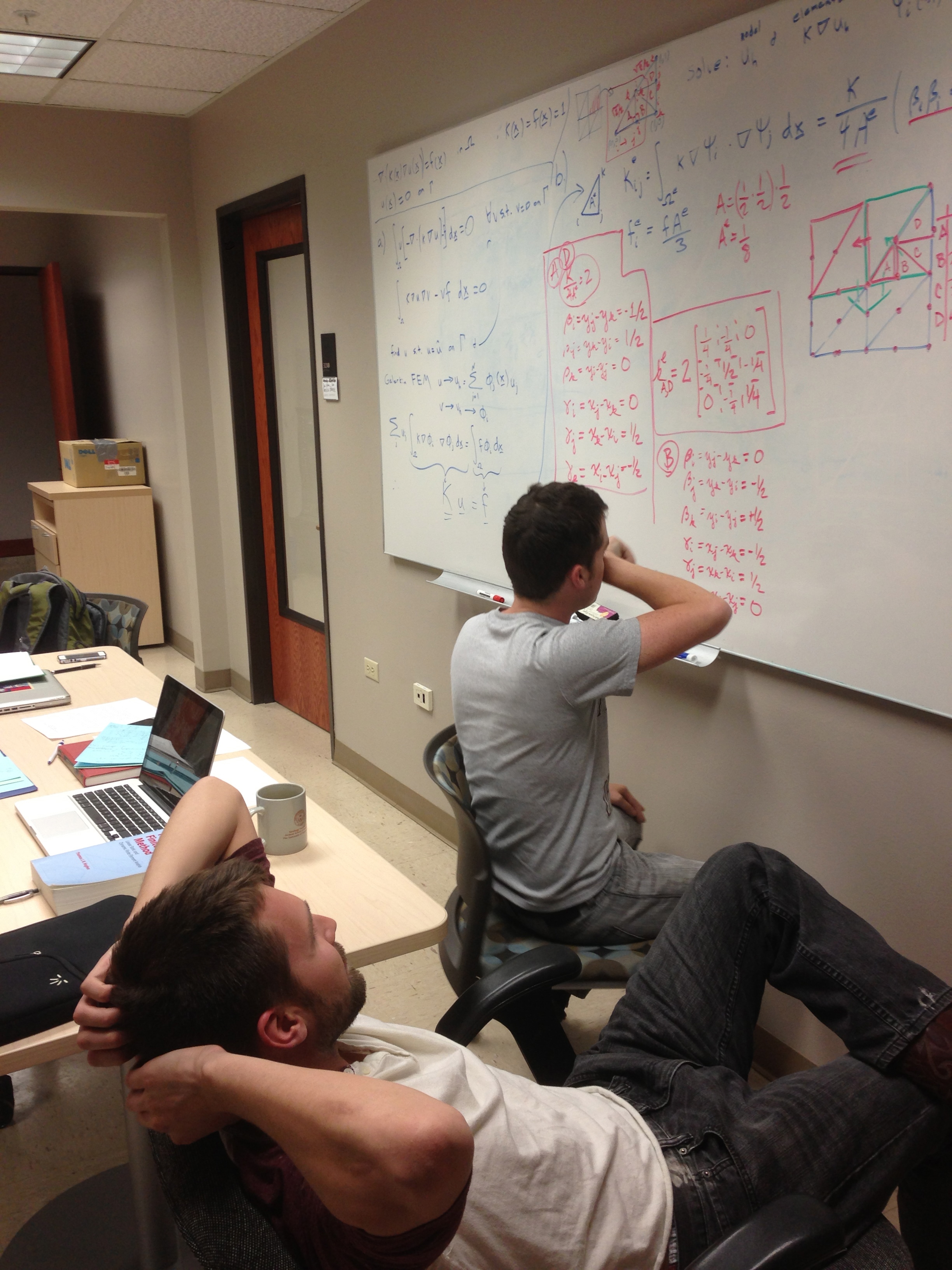 Our group is very diverse, current students are enrolled in PhD programs in Geological Sciences (this includes Geophysics), Petroleum and Geosystems Engineering, and Computational Science Engineering and Mathematics and they have undergraduate degrees in the Geosciences, Engineering, and Physics. All have a quantitative background and share an interest in mathematical modeling and numerical simulation of complex geosystems and the dynamics of flow in porous media. The new Graduate Portfolio Program in Computational Geosciences (starting Fall 2013) forms the backbone of the graduate education in our group. This new program is a first-of-a-kind interdisciplinary graduate program designed to educate tomorrow’s leaders in computational and quantitative geosciences. Dr. Hesse teaches a sequence of graduate courses focussed on porous media that tightly integrate mathematical modeling and numerical simulation and provide the background required for advanced graduate work.
Graduate students are generally expected identify an important problem in the Earth and environmental sciences, develop appropriate and most likely new mathematical models. The course work will provide students with the skills to analyze their model and to develop appropriate numerical solutions. The group has a strong esprit de corps and graduate students share skills and help each other with problem shooting.
Scientific Computing Projects for undergraduates
I regularly advise Scientific Computing Projects for undergraduates enrolled in the Computational Science and Engineering (CSE) Certificate Program or undergraduate theses for students in the BSc in Computational Engineering degree. Any student interested in working with me must first complete my class GEO 325M Numerical Modeling in the Geosciences.
Postdoctoral Opportunities
The Jackson School of Geosciences provides competitive Postdoctoral Fellowships for outstanding young scientists in all areas of the Geosciences. Applicants with independent funding can contact Marc Hesse directly.
Current PhD Opportunities
I am currently looking for new graduate students starting in the fall 2019 in the following areas. If you are interested, please contact me directly.
Multiphase flow in ductile rocks
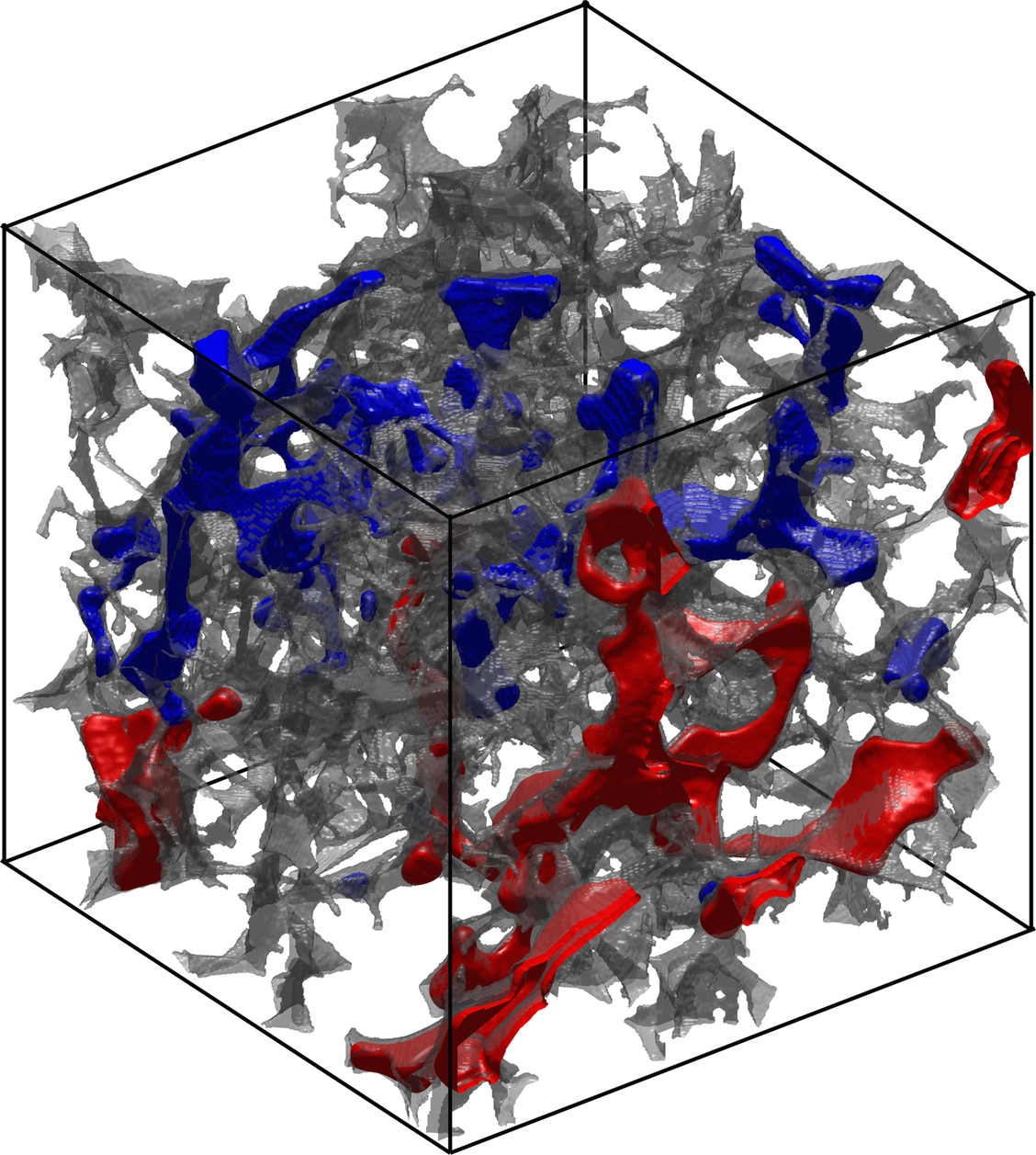
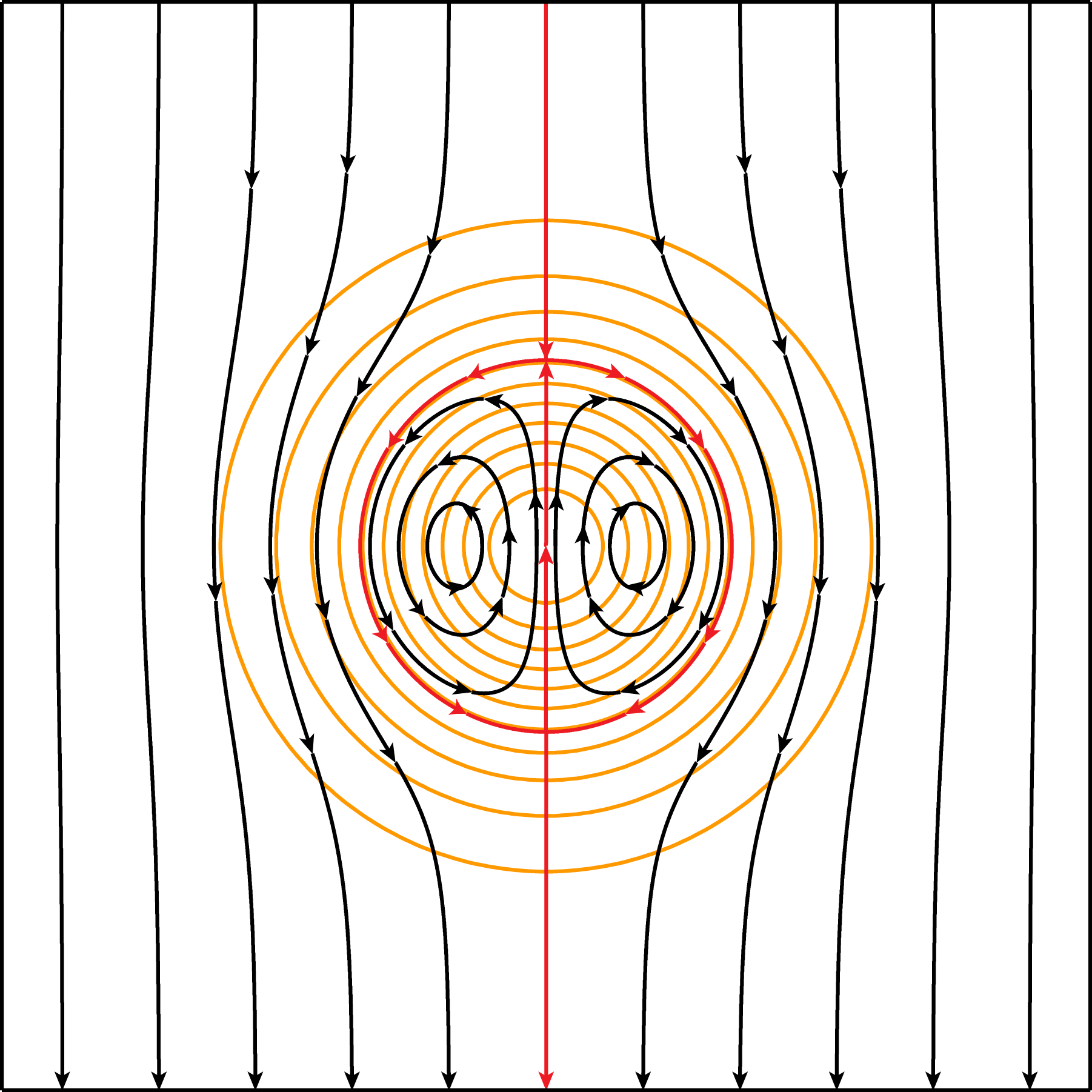 The aim is to derive continuum models for the motion of two pore-fluids in a viscously deforming porous matrix and develop numerical methods for their solution. The project is funded to understand the conditions that allow the invasion of brine and hydrocarbons into the base of sedimentary salt deposits. Although salt is generally considered impermeable, a broad range of observations suggests the migration of pore fluids into and through salt at depth (Ghanbarzadeh et al. 2015). Episodic fluid migration through salt may explain some of the dramatic variations in sub-salt pore pressure, which pose a significant operational hazard in hydrocarbon exploration. Beyond the application to salt-brine-hydrocarbon systems, such three-phase flows have broad applications in solid earth and planetary sciences. The ideal applicant has an interest in applied mathematics, solid/fluid mechanics and numerical methods. Applicants without geoscience background should have a genuine interest geological problems.
Thermal evolution and chemical differentiation of primordial planetesimals
The Geological Porous Media Group has a funded PhD position to develop models for asteroid evolution starting in the summer/fall 2019. The aim of this project is to develop three-dimensional models for the hydrothermal evolution of chondritic and achondritic meteorite parent bodies to determine: (1) heating and cooling histories and mechanisms, (2) influence of breakup and reassembly and its on asteroid evolution, (3) partial melting and differentiation, (4) conditions and mechanisms of crustal formation. The motivation for this study are recent petrologic observations suggesting that the LL chondrite parent body cooled at a rate >1 C/y from a temperature of ~950 C, implying that it was catastrophically fragmented and quenched from its peak metamorphic temperature (Dygert et al. 2018).
This project is part of a collaboration that will apply new thermometers to constrain the high-temperature evolution chondritic and achondritic meteorite parent asteroids.
The University of Texas at Austin is an Affirmative Action / Equal Opportunity Employer.
Posted – 11/27/2017