Skip Navigation
The University of Texas at Austin
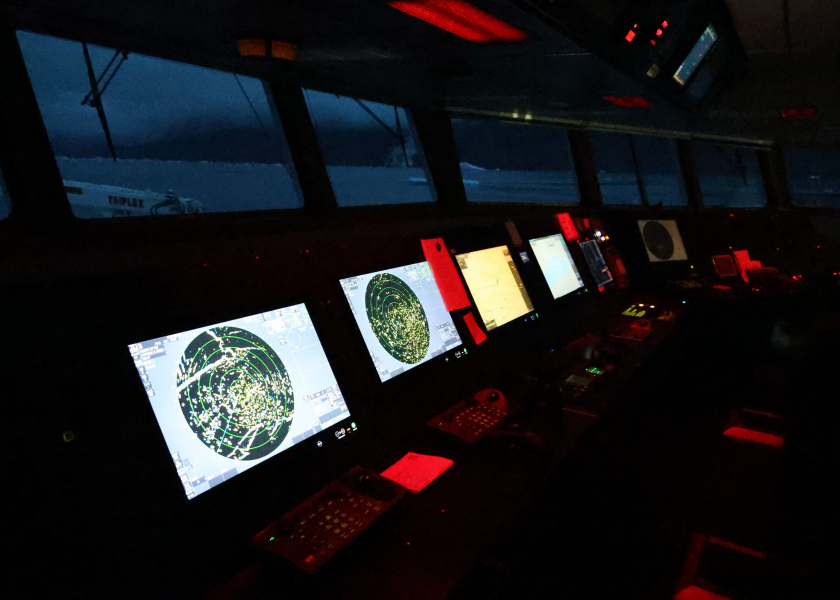
Set Sail for Adventure - May 28-July 29: Join an expedition to the Gulf of Alaska through this real-time blog

Set Sail for Adventure

May 28-July 29: Join an expedition to the Gulf of Alaska through this real-time blog

Uncharted Waters - A Behind the Scenes Look at the Struggle to Kill the Deepwater Horizon Oil Spill

Uncharted Waters

A Behind the Scenes Look at the Struggle to Kill the Deepwater Horizon Oil Spill

Tiny Particles Enlisted to Tackle Fracking's Mysteries

Tiny Particles Enlisted to Tackle Fracking's Mysteries

Geoscientist Says

Geoscientist Says "Use the Force!"

How particle physics could shed light on some deep questions

Video: The Secrets of Caves - Charting Past Droughts in Texas

Video: The Secrets of Caves

Charting Past Droughts in Texas

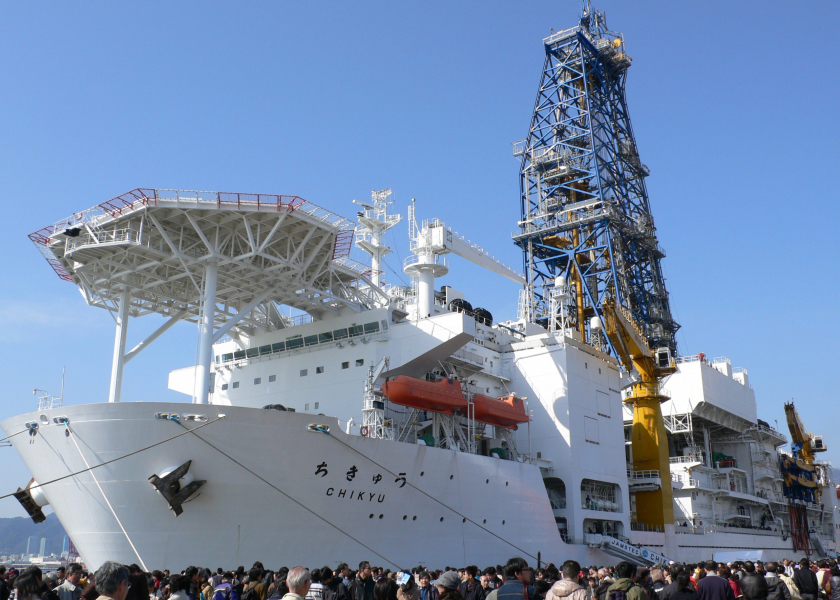
An international team of 34 scientists sets sail today aboard the scientific ocean drilling vessel JOIDES Resolution to collect sediments in the Gulf of Alaska and investigate the interactions between long-term global climate change and the simultaneous growth of mountain belts....

JUN
19

UTIG Special Seminar: Amy McAdam, Planetary Environments Lab, NASA
12:00 PM

UTIG Special Seminar: Amy McAdam, Planetary Environments Lab, NASA

  Start: June 19, 2013 at 12:00 pm     End: June 19, 2013 at 1:00 pm
 Location:PRC, 10100 Burnet Road, Bldg 1.603, Austin, TX 78758
 Contact:Joe Levy, joe.levy@utexas.edu , 512.475.6121
 URL:Event Link
"Investigating the Signatures of Aqueous Alteration on Mars"

Abstract:

The nature of the martian surface environment, and the implications for past and present alteration conditions, have important implications for understanding martian climatic history, surface weathering processes, and ultimately the possibility of past or present life. The characteristics of martian surface materials, and implications for formation environments, can be investigated using several key approaches. In this talk, I will discuss my recent work on terrestrial analogs to martian materials, as well as in situ analyses of martian surface materials from the recently landed Mars Science Laboratory (MSL) rover Curiosity.

I plan to present the results of MSL-like analyses of Mars-relevant materials carried out during several field seasons of the Arctic Mars Analog Svalbard Expedition (AMASE), as a member of the Sample Analysis at Mars (SAM) instrument team. AMASE expeditions have investigated a range of geologic settings on the arctic archipelago of Svalbard with methodologies and techniques under development for Mars missions. During AMASE, I worked with a complementary instrument setup that simulates measurements made by the MSL SAM instrument. SAM analyzes gases evolved by pyrolysis of samples, as well as atmospheric gases admitted through an atmospheric inlet. A suite of instruments inside SAM are used to carry out isotopic and chemical analyses of Martian samples, including studies of inorganic compounds and a sensitive search for volatile organic sample components, thereby investigating Martian geochemical processes and potential habitability. The results of the AMASE SAM team analyses, together with other AMASE team data, have given us valuable insight into the organic content, organic-mineral associations, and mineralogy of several analog materials. These results and interpretations are relevant to the interpretation of in situ analyses from MSL.

I also plan to give a brief overview of MSL results that will primarily center on SAM solid sample analyses, though some comparisons to other MSL instrument datasets will be included. Although MSL has analyzed many rocks and soil samples since landing in August of last year, SAM solid sample analyses have only been performed on a select few of the samples. I will discuss the results of analyses of soil materials from the Rocknest aeolian bedform, selected results from analysis of drilled powder from the rock John Klein, and preliminary implications of these results for surface alteration environments and habitability on Mars.

SEP
11

Networking & Etiquette Dinner
6:00 PM

UTIG Special Seminar: Amy McAdam, Planetary Environments Lab, NASA

  Start: June 19, 2013 at 12:00 pm     End: June 19, 2013 at 1:00 pm
 Location:PRC, 10100 Burnet Road, Bldg 1.603, Austin, TX 78758
 Contact:Joe Levy, joe.levy@utexas.edu , 512.475.6121
 URL:Event Link
"Investigating the Signatures of Aqueous Alteration on Mars"

Abstract:

The nature of the martian surface environment, and the implications for past and present alteration conditions, have important implications for understanding martian climatic history, surface weathering processes, and ultimately the possibility of past or present life. The characteristics of martian surface materials, and implications for formation environments, can be investigated using several key approaches. In this talk, I will discuss my recent work on terrestrial analogs to martian materials, as well as in situ analyses of martian surface materials from the recently landed Mars Science Laboratory (MSL) rover Curiosity.

I plan to present the results of MSL-like analyses of Mars-relevant materials carried out during several field seasons of the Arctic Mars Analog Svalbard Expedition (AMASE), as a member of the Sample Analysis at Mars (SAM) instrument team. AMASE expeditions have investigated a range of geologic settings on the arctic archipelago of Svalbard with methodologies and techniques under development for Mars missions. During AMASE, I worked with a complementary instrument setup that simulates measurements made by the MSL SAM instrument. SAM analyzes gases evolved by pyrolysis of samples, as well as atmospheric gases admitted through an atmospheric inlet. A suite of instruments inside SAM are used to carry out isotopic and chemical analyses of Martian samples, including studies of inorganic compounds and a sensitive search for volatile organic sample components, thereby investigating Martian geochemical processes and potential habitability. The results of the AMASE SAM team analyses, together with other AMASE team data, have given us valuable insight into the organic content, organic-mineral associations, and mineralogy of several analog materials. These results and interpretations are relevant to the interpretation of in situ analyses from MSL.

I also plan to give a brief overview of MSL results that will primarily center on SAM solid sample analyses, though some comparisons to other MSL instrument datasets will be included. Although MSL has analyzed many rocks and soil samples since landing in August of last year, SAM solid sample analyses have only been performed on a select few of the samples. I will discuss the results of analyses of soil materials from the Rocknest aeolian bedform, selected results from analysis of drilled powder from the rock John Klein, and preliminary implications of these results for surface alteration environments and habitability on Mars.

Networking & Etiquette Dinner

  Start: September 11, 2013 at 6:00 pm     End: September 11, 2013 at 8:00 pm
 Location:AT&T Center, Room 103
 Contact:Chelsea Ochoa, chelsea.ochoa@jsg.utexas.edu, 512-232-8903

SEP
20

Geosciences Career Fair 2013
10:00 AM

UTIG Special Seminar: Amy McAdam, Planetary Environments Lab, NASA

  Start: June 19, 2013 at 12:00 pm     End: June 19, 2013 at 1:00 pm
 Location:PRC, 10100 Burnet Road, Bldg 1.603, Austin, TX 78758
 Contact:Joe Levy, joe.levy@utexas.edu , 512.475.6121
 URL:Event Link
"Investigating the Signatures of Aqueous Alteration on Mars"

Abstract:

The nature of the martian surface environment, and the implications for past and present alteration conditions, have important implications for understanding martian climatic history, surface weathering processes, and ultimately the possibility of past or present life. The characteristics of martian surface materials, and implications for formation environments, can be investigated using several key approaches. In this talk, I will discuss my recent work on terrestrial analogs to martian materials, as well as in situ analyses of martian surface materials from the recently landed Mars Science Laboratory (MSL) rover Curiosity.

I plan to present the results of MSL-like analyses of Mars-relevant materials carried out during several field seasons of the Arctic Mars Analog Svalbard Expedition (AMASE), as a member of the Sample Analysis at Mars (SAM) instrument team. AMASE expeditions have investigated a range of geologic settings on the arctic archipelago of Svalbard with methodologies and techniques under development for Mars missions. During AMASE, I worked with a complementary instrument setup that simulates measurements made by the MSL SAM instrument. SAM analyzes gases evolved by pyrolysis of samples, as well as atmospheric gases admitted through an atmospheric inlet. A suite of instruments inside SAM are used to carry out isotopic and chemical analyses of Martian samples, including studies of inorganic compounds and a sensitive search for volatile organic sample components, thereby investigating Martian geochemical processes and potential habitability. The results of the AMASE SAM team analyses, together with other AMASE team data, have given us valuable insight into the organic content, organic-mineral associations, and mineralogy of several analog materials. These results and interpretations are relevant to the interpretation of in situ analyses from MSL.

I also plan to give a brief overview of MSL results that will primarily center on SAM solid sample analyses, though some comparisons to other MSL instrument datasets will be included. Although MSL has analyzed many rocks and soil samples since landing in August of last year, SAM solid sample analyses have only been performed on a select few of the samples. I will discuss the results of analyses of soil materials from the Rocknest aeolian bedform, selected results from analysis of drilled powder from the rock John Klein, and preliminary implications of these results for surface alteration environments and habitability on Mars.

Networking & Etiquette Dinner

  Start: September 11, 2013 at 6:00 pm     End: September 11, 2013 at 8:00 pm
 Location:AT&T Center, Room 103
 Contact:Chelsea Ochoa, chelsea.ochoa@jsg.utexas.edu, 512-232-8903

Geosciences Career Fair 2013

  Start: September 20, 2013 at 10:00 am     End: September 20, 2013 at 3:00 pm
 Location:Student Activities Center Ballroom
 Contact:Maurine Riess, mriess@jsg.utexas.edu, 512-232-7673

more →

Celebrate With Us - May 5: A celebration of paleontologist Wann Langston's life
May 5: A celebration of paleontologist Wann Langston's life
Spring Graduation - May 18: JSG Spring Commencement Ceremony and Reception
May 18: JSG Spring Commencement Ceremony and Reception
The Burn Blog - An energy blog curated by the University of Texas at Austin
An energy blog curated by the University of Texas at Austin
The Tie That Binds - We salute the supporters who've helped make us a global geoscience leader
We salute the supporters who've helped make us a global geoscience leader
Walter Geology Library - More than 120,000 books and journals and 47,000 geologic maps
More than 120,000 books and journals and 47,000 geologic maps
Find a Supervisor - Grad students work with over 70 scientists in 9 research disciplines
Grad students work with over 70 scientists in 9 research disciplines
 
IT Help  |  Profiles  |  UT Direct  |  Blackboard  |  Privacy Policy  |  Accessibility
©2011 Jackson School of Geosciences, The University of Texas at Austin
Make a Gift to JSG JSG's YouTube Channel JSG's RSS News Feed JSG's Facebook